Best Mood Tracker Apps in 2026 (Free and Paid)
Nearly every roundup of the best mood tracker apps lists the same five names, Daylio, Bearable, How We Feel, Finch and Stoic, as if they all work the same way once you strip out the app icons. They do not. Four of the five are freemium products with a subscription waiting behind a limited free tier. The fifth was built inside a Yale research center and has never charged anyone a cent.
This roundup of the best mood tracker apps covers what each app’s free tier genuinely includes, what premium actually unlocks and where that one nonprofit exception fits if research-backed tracking matters more to you than a slicker interface.
What a Mood Tracker App Actually Logs
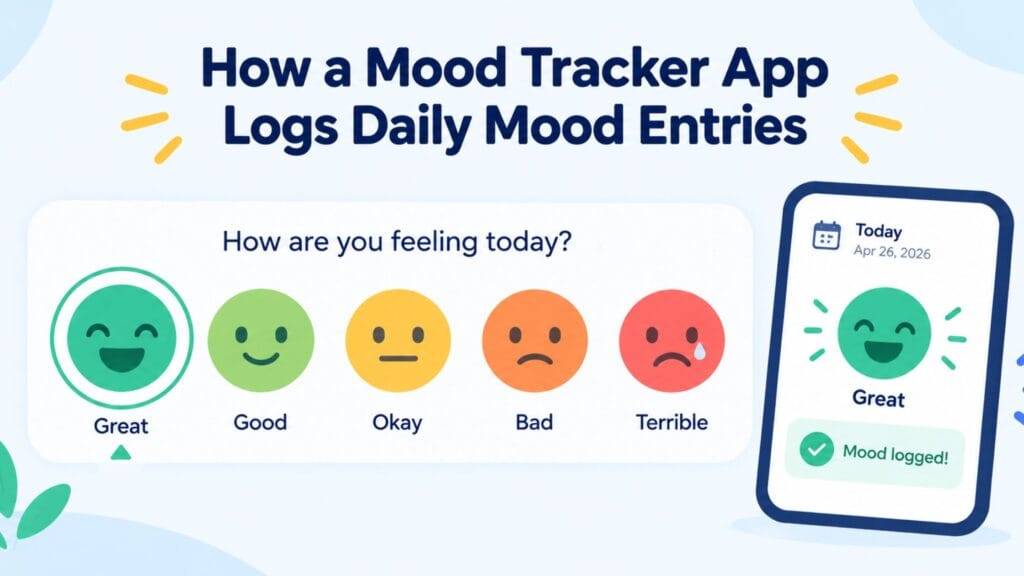
Every one of the best mood tracker apps shares the same core job: log how you feel at set points during the day, usually with a quick tap on an emoji or color scale and turn weeks of those entries into a pattern you can actually see. Most also let you tag context, sleep, activities, medication, weather, so the pattern points to a likely cause rather than just a mood score on its own.
Where they differ is in what happens after the logging: whether the free tier shows you those patterns or only stores the raw entries and holds the analysis behind a paywall.
The Five Apps Covered Here and How They Were Checked
Daylio, Bearable, How We Feel, Finch and Stoic were checked directly against their current pricing and product pages rather than an older summary, specifically for what the free tier includes versus what premium adds and whether any hidden trial-to-paid conversion applies.
Apps aimed at classroom or corporate wellness dashboards were left out, since the intent here is an individual picking from the best mood tracker apps for personal use, not an institution rolling one out to a group.
Free Tier Limits, Side by Side
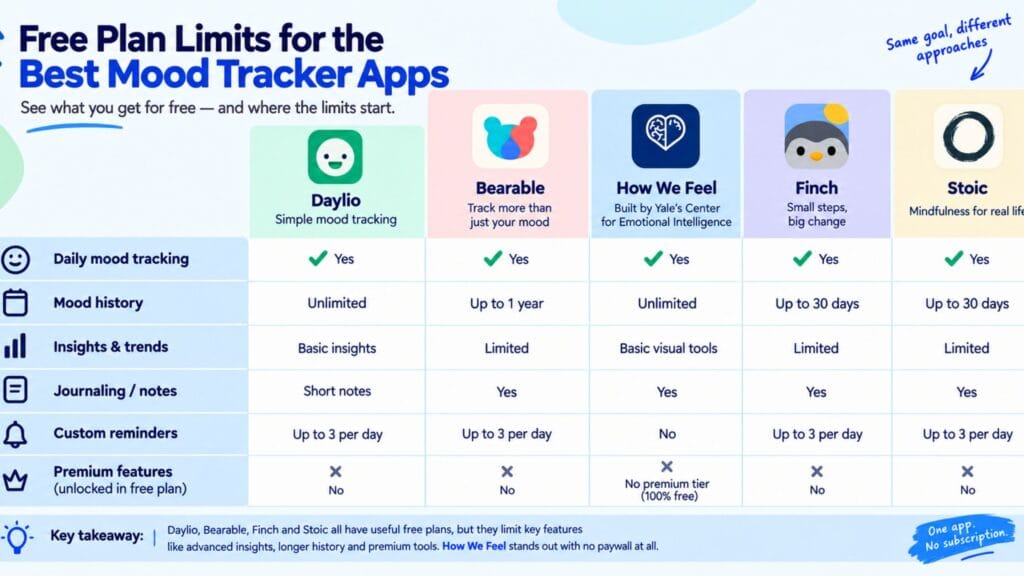
| App | Free Tier | Premium Price | What Premium Unlocks |
| Daylio | Full daily logging and basic stats | $4.99/mo or $35.99/yr | Advanced statistics, PDF export, extra customization |
| Bearable | Unlimited tracking, weekly reports, CSV export | $6.99/mo or $34.99/yr | Advanced graphs, passcode lock, unlimited routines |
| How We Feel | Everything, no premium tier exists | None | Not applicable |
| Finch | Core pet care and mood check-ins | Finch Plus (subscription) | Extra customization and activity content |
| Stoic | Basic journaling and mood logging | $8.99/mo or $39.99/yr | Deeper analytics and guided reflection content |
Daylio: Fast Daily Check-Ins, Premium for the Detail
Daylio’s free version covers most of what a daily mood log needs: a quick tap-based check-in, activity tagging and basic correlation graphs between mood and the activities you log. The review consensus across current sources is consistent that the free tier alone is enough for casual use.
Premium runs $4.99 a month or $35.99 annually with a 7-day trial and mainly adds a polished PDF export (useful if you plan to share entries with a therapist), more icon and color customization and deeper statistics. For anyone who just wants a daily habit-and-mood log without exporting reports anywhere, the free tier alone tends to cover it.
Bearable: Built for Tracking Symptoms Alongside Mood
Bearable’s free tier is unusually generous for the category: unlimited tracking of moods, symptoms, medications and activities, plus weekly reports and CSV export, all without a subscription. The catch is that full insight graphs and detailed statistics sit behind premium.
Premium costs $6.99 a month or $34.99 annually, with frequent discounts down to around $18.99 a year according to current reviews and unlocks advanced graphs, a passcode lock and unlimited routines. Bearable is a stronger pick than Daylio specifically if you want to correlate mood against physical symptoms or medication, not just general activities.
How We Feel: The One Built by a Yale Research Center
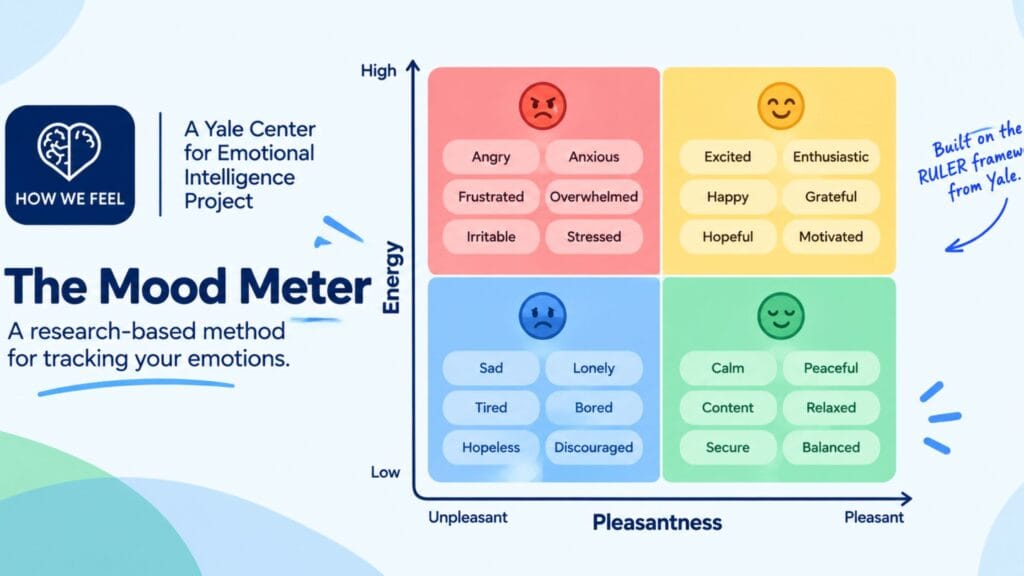
How We Feel stands apart from the other four apps in this comparison in a way that matters more than any feature list. It was created by Yale’s Center for Emotional Intelligence, with founder Marc Brackett and Pinterest co-founder Ben Silbermann involved in its development and operates as a nonprofit project funded by donations rather than a subscription business. There is no premium tier to unlock because the entire app is free.
Its core feature, the Mood Meter, comes directly from RULER, an evidence-based emotional learning framework already used in more than 5,000 schools and expands mood logging into 144 distinct emotion words rather than a handful of generic faces. For anyone who wants the tracking method itself to be backed by published research rather than an app company’s internal design choices, this is the one entry in the category built that way from the start.
Finch: A Self-Care Pet Wrapped Around Mood Logging
Finch turns mood logging into caring for a small virtual pet: checking in on your mood and completing self-care tasks earns rewards that keep the pet’s world growing. The free tier covers the core pet-care loop and basic mood check-ins, which is enough for the gamified habit-building experience Finch is known for.
Finch Plus, the subscription tier, adds extra customization options and additional guided activity content. Finch tends to suit people who find a plain log-and-graph app hard to stick with and respond better to a lightweight game layered on top of the same underlying tracking.
Stoic: Journaling-First, Subscription-First
Stoic frames itself around daily reflection and journaling drawn from Stoic philosophy, with mood tracking as one part of a broader daily check-in rather than the sole focus. The free tier covers basic journaling and mood logging.
Premium runs $8.99 a month or $39.99 annually and unlocks deeper analytics and guided reflection content, making Stoic the most subscription-forward app in this comparison. It is a reasonable pick specifically for someone who wants journaling prompts bundled with mood tracking rather than a standalone tracker.
Why a Mood Tracker Is Not a Substitute for Meditation or Therapy
A mood tracker and a meditation app solve different problems: one records how you feel over time, the other is a practice meant to change how you feel in the moment. Our meditation apps comparison covers guided sessions and breathing exercises, which pair naturally with a tracker like the ones here since the logged data can show whether a meditation habit is actually shifting your mood over weeks rather than just in the moment.
None of the five apps in this comparison are a substitute for therapy either. They are logging and pattern-recognition tools, not diagnostic or treatment tools and several of the apps’ own materials note this explicitly for anyone tracking a persistent mood concern.
Where Your Mood Data Actually Goes
Every one of the best mood tracker apps except How We Feel runs on a standard SaaS business model, which means your mood, symptom and activity entries live on that company’s servers and are covered by a privacy policy rather than any medical confidentiality standard. Daylio, Bearable, Finch and Stoic all state that entries are not shared with third parties for advertising but none of them are healthcare providers, so the data does not carry the same legal protections a conversation with a therapist would.
How We Feel’s nonprofit structure changes the incentive but not the underlying mechanics: entries are still stored on a server rather than only on your device. Anyone tracking sensitive health information in any of these apps should read the specific privacy policy for the one they pick rather than assuming a free or nonprofit label automatically means stricter data handling, since that is not something any of these apps’ marketing pages state outright.
What to Do With a Month of Logged Mood Data
The value of any of the best mood tracker apps only shows up once there is enough logged data to spot a pattern, which typically takes three to four weeks of consistent daily entries. A single week of logging rarely reveals anything beyond normal day-to-day variation, so the real test of whether an app fits your habits is whether it is easy enough to open daily that a month of entries actually accumulates.
Once that data exists, the most useful next step is usually correlating it against one specific variable at a time, sleep, a new medication, a change in routine, rather than trying to read broad conclusions into the mood score alone. Bearable and Daylio’s activity-correlation graphs are built specifically for this kind of single-variable comparison and exporting the data to review alongside a therapist or doctor, where relevant, tends to get more out of a month of logging than reading the in-app graphs alone.
How Long to Try an App Before Switching
Switching between the best mood tracker apps too early is one of the more common reasons the data never becomes useful. Because a meaningful pattern typically needs three to four weeks of entries, jumping to a different app after a few days of feeling unimpressed with the interface resets that clock and leaves every log fragmented across multiple tools with no single history long enough to analyze.
A more reliable approach with any of the best mood tracker apps is picking one based on the free-tier comparison above, committing to daily entries for a full month regardless of how the interface feels at first and only then deciding whether the data and insights justify staying or switching. Most of the friction people report with mood tracking comes from inconsistent logging rather than the app itself, so giving one tool a real trial run tends to matter more than which of these five you start with.
Matching an App to What You Actually Want to Track
Picking from the best mood tracker apps really comes down to what you plan to do with the data. If the goal is a fast daily habit log with minimal friction, Daylio’s free tier covers that well. If symptoms and medication need to sit alongside mood in the same log, Bearable’s free tier is built for exactly that and does not gate it behind a subscription.
If a research-backed method and a genuinely permanent free plan matter more than extra features, How We Feel is the only app here without a paywall anywhere in the product. If gamified motivation or journaling-first reflection fits better, Finch and Stoic respectively cover those angles, with a subscription eventually part of the picture for either.
FAQs
What is the best free mood tracker app in 2026?
Among the best mood tracker apps covered here, How We Feel is the only one with no premium tier at all, built by Yale’s Center for Emotional Intelligence and funded by donations. Bearable’s free tier is also unusually generous, covering unlimited tracking with only advanced graphs held behind its subscription.
Is How We Feel actually free or is there a hidden premium tier?
It is genuinely free with no premium subscription. It operates as a nonprofit project funded by donations rather than a freemium business model.
Does Daylio have a free version?
Yes. Daylio’s free tier covers daily check-ins, activity tagging and basic correlation graphs. Premium, at $4.99 a month or $35.99 annually, mainly adds PDF export and deeper statistics.
Can a mood tracker app replace therapy?
No. Mood tracker apps log patterns over time but are not diagnostic or treatment tools. Several of the apps covered here note this directly in their own materials.
What is the RULER framework mentioned in How We Feel?
RULER is an evidence-based emotional learning approach developed at Yale and used in more than 5,000 schools. How We Feel’s Mood Meter tool is built directly on that framework rather than a generic in-house design.
Which of the best mood tracker apps is best for tracking symptoms, not just mood?
Bearable is built specifically for that, letting you log symptoms and medications alongside mood and correlate them, with unlimited tracking included in its free tier.
Conclusion
The honest answer to which of the best mood tracker apps is worth installing depends less on features than on what kind of product you are willing to trust with a daily emotional log. Daylio and Bearable both offer strong free tiers for straightforward tracking, Finch and Stoic add gamification and journaling respectively for a subscription and How We Feel remains the one option built as nonprofit research infrastructure rather than a freemium app chasing a conversion rate.
Whichever tracker you land on, BratGen also has a few free tools to pair with your routine if you want something quick to make alongside your journaling or planning.