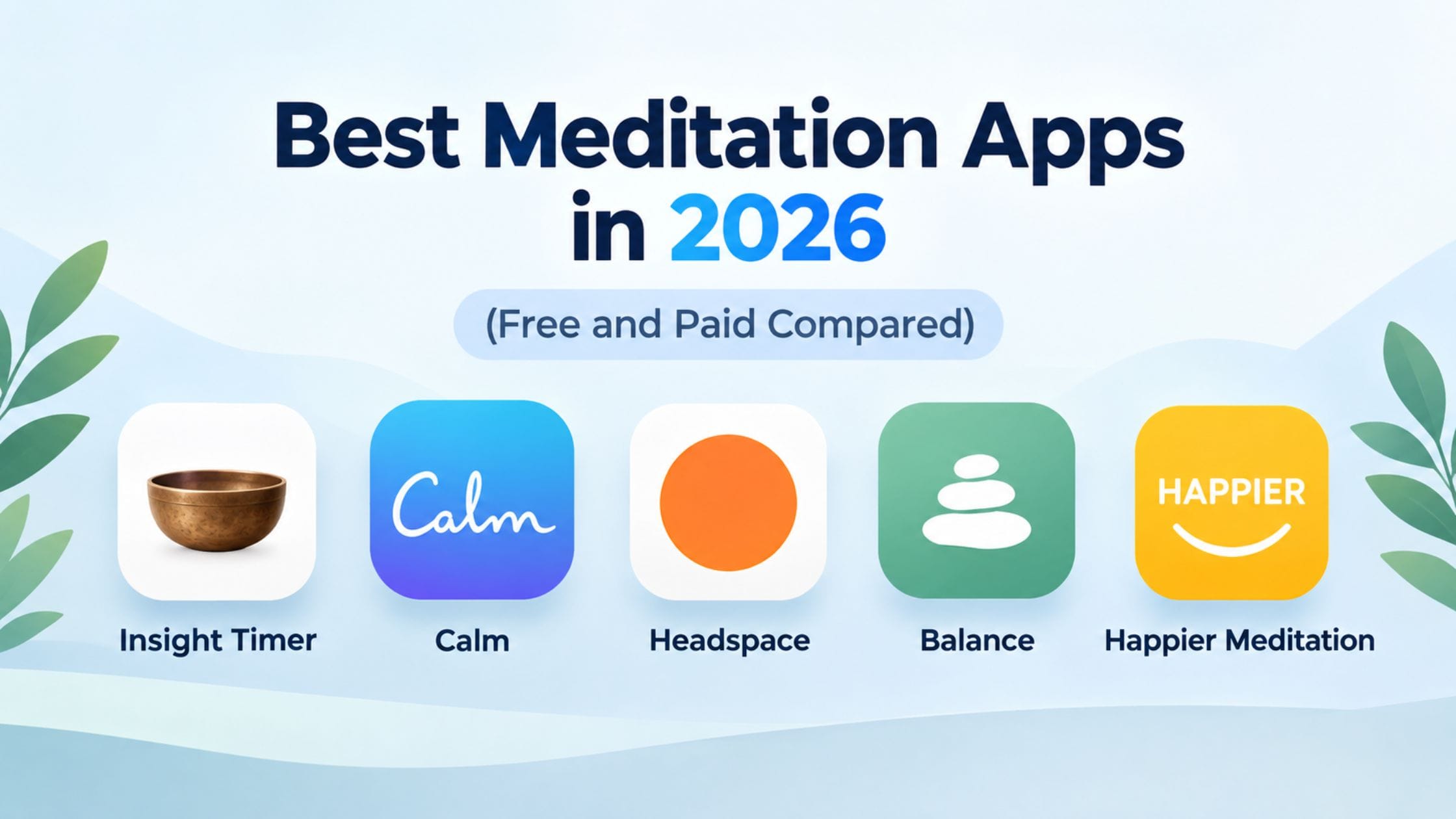
Best Meditation Apps in 2026 (Free and Paid Compared)
A lot of “best meditation apps” lists still describe Balance as the free option and Calm as the polished paid pick, repeating whatever was true when those apps first launched. Balance’s original offer, a full free year for new users, ended a while ago. Calm’s free section has always been thinner than most reviews let on. Meanwhile Insight Timer, rarely the headline pick, is the one app on this list with a free tier that was never a trial to begin with.
This comparison checks what each app’s pricing page and app-store listing actually say today, so the free-versus-paid picture below reflects 2026, not a launch-week press release.
Why the “Free Meditation App” Label Keeps Getting Outdated
Meditation app pricing changes more often than most comparison articles get updated. A promotional free year turns into a subscription. A free tier gets trimmed down to a handful of sample sessions. A publisher quietly raises prices for existing subscribers. None of that shows up in an article written two or three years ago and never revisited.
The result is that searches for the best meditation apps often surface outdated claims: an app still labeled “completely free” long after that offer ended or a free tier described as generous when it has since been narrowed to a short trial. Checking each app’s current pricing page directly, rather than trusting an older ranking, is the only way to know what you would actually get today.
The Apps Compared and How They Were Checked
Five apps made this comparison: Insight Timer, Calm, Headspace, Balance and Happier Meditation (formerly Ten Percent Happier). Each one was checked against its current pricing page and app-store listing rather than an older summary, with particular attention to what the free tier includes today and whether it is a permanent tier or a time-limited trial.
The comparison focuses on what changes daily use: how much is actually free, whether that free content renews or runs out, guided-session style and which use case (sleep, anxiety, daily habit-building, skeptics who want teacher-led explanations) each app leans toward.
Side-by-Side: Free Tier and Pricing
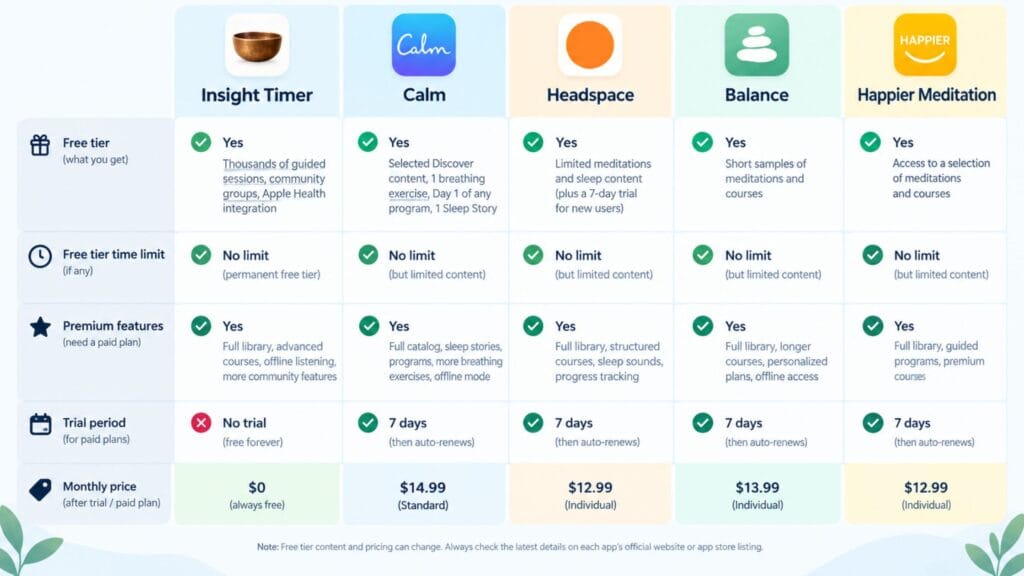
| App | Free Tier Type | Paid Price (approx.) | What the Free Tier Actually Gives You |
| Insight Timer | Permanent, not a trial | $59.99/year or $9.99/month | Thousands of guided sessions, community groups, timer, Apple Health sync |
| Calm | Limited sample content | $79.99/year or $16.99/month | Select Discover content, one breathing exercise, Day 1 of programs, one Sleep Story |
| Headspace | Trial only | $69.99/year or $12.99/month | Time-limited trial access before subscription is required |
| Balance | Trial only (free year promo has ended) | $69.99/year or $11.99/month | Trial access, converts to paid automatically unless canceled 24+ hours before renewal |
| Happier Meditation | Limited access | $99.99/year (or monthly options) | Sample teacher-led sessions before the paywall |
Insight Timer: The One Free Tier That Was Never a Trial
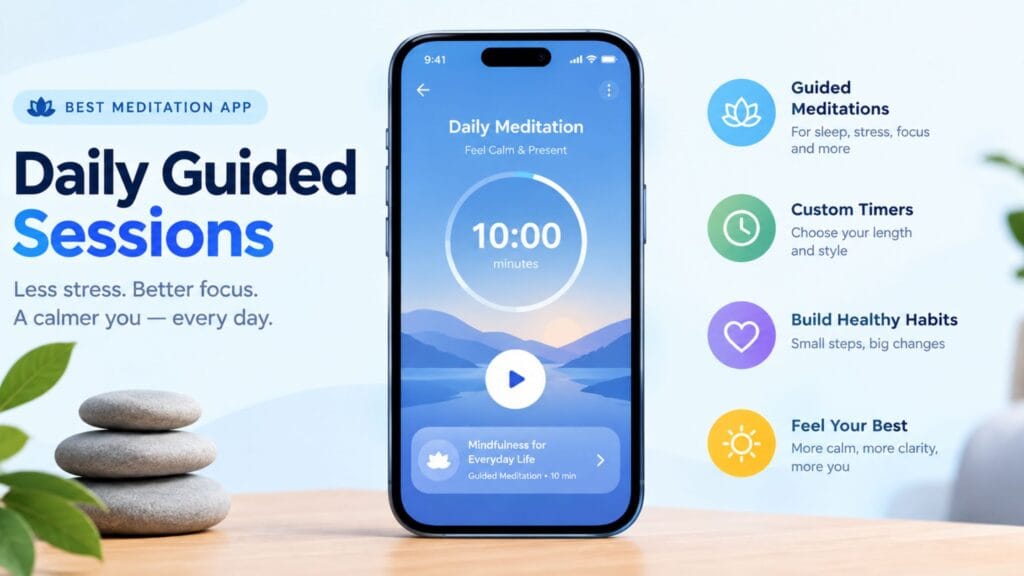
Insight Timer’s free tier is the outlier on this list because it was built as a permanent tier from the start, not a trial that converts to a subscription. The free version includes thousands of guided meditations and ambient tracks, community groups organized by interest, tools for following specific teachers, meditation statistics and milestones, Apple Health Mindful Minutes integration and a fully customizable timer for unguided sessions.
The paid Member Plus tier, at roughly $9.99 a month or $59.99 a year, adds structured courses, offline downloads, higher-quality audio and advanced playback controls. For anyone who wants to try meditation without committing to a subscription first, Insight Timer’s free tier is the most complete of the group by a wide margin.
Calm: Polished but Free Access Is Thinner Than It Looks
Calm’s app-store presence and marketing suggest a broad library but the free portion is narrow: a curated set of Discover-section content under “Less Guidance,” one breathing exercise, only the first day of any multi-day program, one Sleep Story and a handful of free background scenes. Reaching the rest of the catalog, which is most of it, requires a Premium subscription.
Calm’s pricing also shifted during 2026: as of February 2026, some subscribers on older legacy pricing were moved to the current standard rate at renewal, a change that is easy to miss if you subscribed years ago and have not checked your renewal price recently. Calm remains strong on production value and sleep content specifically but it is not a free app in any meaningful sense.
Headspace: Structured Courses Built Around a Teaching Style
Headspace’s format leans on structured, sequential courses with a consistent narrator style, which suits people who want a guided curriculum rather than an open library to browse. Its free access is trial-based only, currently advertised as a 14-day trial before the subscription price applies.
Pricing runs $12.99 a month or $69.99 a year, with a family plan at $99.99 a year covering up to six members, which works out cheaper per person than most individual plans on this list if multiple household members will actually use it.
Balance: What Happened After the Free Year Ended
Balance’s original pitch, when it launched, was a full year of free access for new users and that promotion is why it still shows up in older comparison articles labeled as the free pick. That offer is no longer how Balance works. New sign-ups now get trial access that converts automatically into a paid subscription, at roughly $11.99 a month or $69.99 a year, unless canceled at least 24 hours before the trial renews.
Balance still stands out for personalized recommendations based on daily check-ins but anyone choosing it expecting the original free-year deal will be signing up for a standard subscription instead.
Happier Meditation: The Teacher-Led Option for Skeptics
Happier Meditation, the rebranded Ten Percent Happier, is built around teacher-led explanations aimed at people who are skeptical of meditation’s claims and want the reasoning behind a practice explained before doing it. Free access is limited to sample sessions before the paywall appears.
At $99.99 a year or shorter monthly options between roughly $9.99 and $14.99, it sits at the higher end of this comparison. The audience it fits best is less about price and more about approach: if a guided session that opens with “here’s why this works” appeals more than one that starts straight into breathing instructions, this is the app built around that format.
Matching an App to Sleep, Anxiety or a Beginner Habit
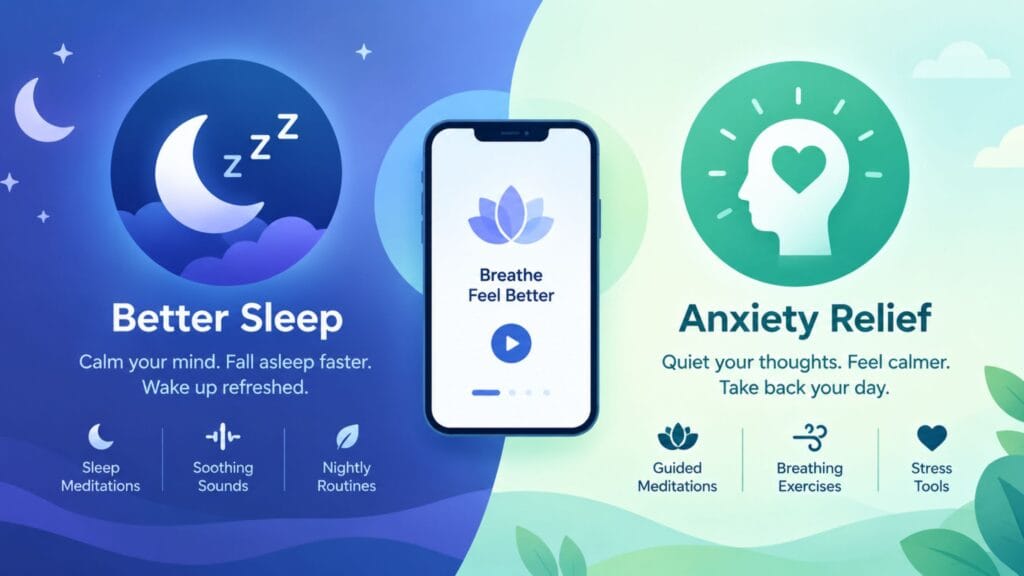
For sleep specifically, Calm’s Sleep Stories and wind-down content are its strongest feature even within a limited free tier, while Insight Timer’s free library also includes a large volume of sleep and ambient tracks without a subscription. For anxiety-focused use, shorter, structured sessions tend to build consistency faster than long-form content, which favors Headspace’s course format or Insight Timer’s shorter guided tracks over an open-ended library.
Beginners who are not sure meditation will stick for them are generally better off starting on a free tier before paying for anything: Insight Timer’s permanent free access removes the pressure of a trial countdown, while Happier Meditation’s teacher-led framing works well for beginners who want the reasoning explained rather than just instructed.
What Happens to Your Mood and Journaling Data
Meditation apps are unusual among lifestyle apps in how much personal information they end up collecting. Insight Timer and Balance both prompt daily mood check-ins, Insight Timer’s advanced journaling sits behind its paid tier and several of these apps sync meditation history to Apple Health or a similar platform, which can include mindful-minute logs alongside other health data already stored there. None of that is inherently a problem but it is worth knowing before granting the permission rather than after.
The practical questions worth checking in each app’s settings are whether mood or journal entries are stored only on the device or synced to a server, whether that data is used to personalize recommendations (Balance does this explicitly) and whether an account can be deleted along with its data rather than just deactivated. None of the five apps compared here publish a simple one-line answer to all three questions, so checking the current privacy policy before entering anything sensitive is worth the extra two minutes, especially for anyone using a meditation app specifically to manage anxiety or a diagnosed condition.
This is not a reason to avoid mood tracking features altogether. A daily check-in can genuinely help someone notice patterns over time that would otherwise go unnoticed. It is simply a reason to treat a meditation app’s data practices the same way you would any other app that asks for ongoing personal input, rather than assuming a wellness label means the data handling is automatically more careful than a typical consumer app.
What the Research Actually Supports
It is worth separating app marketing from what the evidence actually shows. According to the National Center for Complementary and Integrative Health, meditation and mindfulness practices show evidence of helping with stress, anxiety and some aspects of sleep, though the strength of that evidence varies by condition and study quality. None of the apps in this comparison have been individually validated by that research; the evidence applies to meditation practices generally, not to any specific app’s content library.
That distinction matters when comparing marketing claims. A polished app interface does not itself make a technique more effective. The consistency of practice, which app you will actually open daily, tends to matter more than which app has the most features.
FAQs
Which meditation app has the best free plan in 2026?
Insight Timer has the strongest free plan because it is a permanent tier, not a trial. It includes thousands of guided sessions, community groups and a full-featured timer without ever requiring payment.
Is Balance still a free meditation app?
No, not anymore. Balance’s original offer was a free year for new users at launch. That promotion has ended and Balance now uses the same trial-then-subscription model as Calm and Headspace.
Is Calm worth paying for if the free tier is limited?
Calm is worth it mainly for its sleep content and production quality if you plan to use it regularly. If you only want to try meditation without paying, Insight Timer’s permanent free tier is a better starting point.
What is the best meditation app for anxiety?
Headspace’s structured, sequential courses tend to build a consistent anxiety-focused habit well and Insight Timer’s shorter free guided tracks are a strong no-cost alternative for the same purpose.
What is the best meditation app for beginners?
Insight Timer is a low-pressure starting point since its free tier never expires and Happier Meditation suits beginners who want the reasoning behind a technique explained before trying it.
Do meditation apps need to be free to be effective?
No. Research from NIH’s National Center for Complementary and Integrative Health looks at meditation practices broadly rather than specific apps and consistency of practice tends to matter more than which app, free or paid, someone uses.
Conclusion
None of these apps is objectively the best meditation app for everyone. Insight Timer is the strongest free option and the easiest to try without commitment. Calm and Headspace both justify their subscription price if sleep content or structured courses matter most to you. Balance is worth using only once you accept it is a standard subscription now, not the free-year deal it launched with and Happier Meditation is worth the higher price mainly for its teacher-led explanations. For readers who came here from our screen time app comparison, pairing a screen-time tool with a meditation app is a common way to replace scrolling time with something more intentional, rather than just blocking the scrolling outright.
If you are building out a small toolkit of everyday digital habits worth keeping, it is also worth a quick look at BratGen’s free creative tools, since the same instinct that leads people to try a meditation app, wanting something simple that just works without a learning curve, tends to apply to the rest of the apps people actually stick with.