Best CRM Software for Small Business in 2026 (Free and Paid)
Nearly every roundup of the best CRM software for small business names HubSpot and Zoho CRM as the free-friendly picks and stops there, missing that Zoho has a separate, cheaper product built specifically for small business, Bigin, that undercuts its own flagship CRM by half. HubSpot’s free plan, meanwhile, caps at 2 users as well as 1,000 contacts, a limit most comparison content leaves out entirely.
This comparison covers HubSpot, Zoho CRM, Pipedrive, Bigin by Zoho and monday CRM on their current free-plan limits and per-user pricing, including the one product in this list that is routinely left off other comparisons altogether.
What Small Business CRM Software Actually Needs to Do
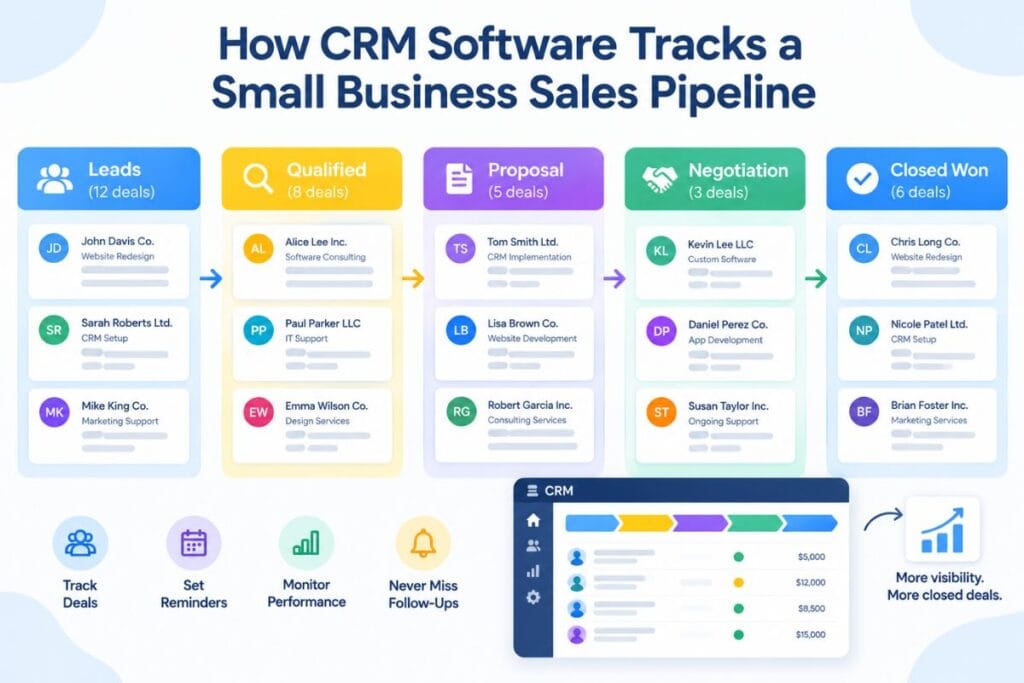
Every option covered in this best crm software for small business comparison shares the same starting point. At its core, CRM software tracks contacts, deals and the communication history behind both, so a small sales team can see where every lead stands without digging through email threads or a shared spreadsheet. Most tools in this category now bundle in basic automation, email tracking and a visual pipeline view as standard rather than premium features.
Where these tools genuinely diverge for a small business is not the core contact-and-deal tracking, nearly all of them handle that adequately but the free-plan ceiling: how many users, contacts and automations you get before the tool starts asking for a subscription.
A CRM is usually just one piece of a small business’s software stack. Our broader SaaS tools for startups roundup covers the project management, communication and finance tools that typically sit alongside whichever CRM ends up in the mix here.
The Five Tools Covered Here and How They Were Checked
These five make up the most commonly recommended best crm software for small business shortlist right now. HubSpot, Zoho CRM, Pipedrive, Bigin by Zoho and monday CRM were checked directly against their current pricing pages rather than an older summary, specifically for free-plan user and record limits and the exact per-user price at the entry paid tier.
Enterprise-focused platforms like Salesforce were left out of the main comparison since their entry pricing and feature depth target a different buyer than a small business evaluating its first CRM.
Pricing and Free-Plan Limits, Side by Side
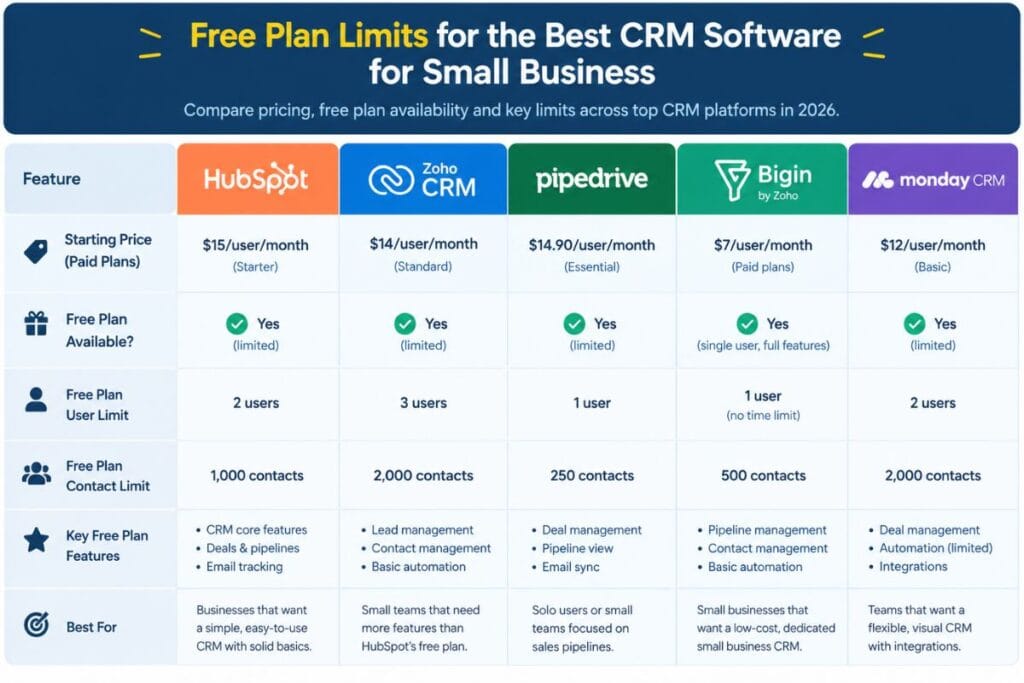
| Tool | Free Plan | Entry Paid Tier | Best For |
| HubSpot | 1,000 contacts, 2 users | $7/user/mo (Starter, annual) | A small team wanting an established, widely integrated CRM |
| Zoho CRM | 3 users, forever free | $14/user/mo (Standard, annual) | A business that wants CRM plus a wider Zoho software suite |
| Pipedrive | None; 14-day trial only | $14/seat/mo (Lite, annual) | A sales-first team that wants a visual pipeline above all else |
| Bigin by Zoho | 1 user, 500 records | $7/user/mo (Express, annual) | A small business that finds full Zoho CRM oversized |
| monday CRM | None; 14-day trial only | $12/seat/mo (Basic, annual) | A team already using monday.com boards elsewhere |
HubSpot: A Genuinely Free Plan With a Two-User Ceiling
HubSpot is the other name that dominates most best crm software for small business searches. Its free CRM is genuinely usable, not a stripped-down demo, covering contact management, basic email tools and live chat at no cost indefinitely. The catch most comparison articles state only half of: the free plan caps at 1,000 contacts and at 2 users, both limits apply together, so a three-person sales team hits the wall on users well before contacts become the constraint.
Starter, the entry paid tier, runs $7 a month per seat on annual billing and removes HubSpot branding while unlocking more email volume and automation. For a solo founder or a two-person team, the free plan alone tends to be enough; past that headcount, the per-seat pricing starts immediately.
Zoho CRM: Free for Three Users, Priced by Feature Depth
Zoho CRM is one of the two most commonly recommended picks for best crm software for small business searches. Its free plan supports up to 3 users at no cost indefinitely, one more user than HubSpot’s free tier, covering contact management, workflows and mobile access. Paid tiers scale by feature depth rather than by a single obvious jump: Standard runs about $14 a user per month annually, Professional around $23, with Enterprise and Ultimate climbing further for advanced customization and AI-driven automation.
Zoho CRM’s strength is the ecosystem it sits inside: a business already using other Zoho products, email, books, forms, gets tighter integration than pairing a separate CRM with those tools. For a business that only wants a CRM and nothing else in the Zoho suite, that breadth is not necessarily an advantage.
Pipedrive: No Free Plan, Priced for Pipeline-First Sales Teams
Pipedrive is the only tool in this best crm software for small business comparison with no permanent free plan at all, offering a full-featured 14-day trial instead. Its Lite tier starts at $14 a seat per month on annual billing, scaling to Growth at $39, Premium at $59 and Ultimate at $79 as automation, reporting and customization needs grow.
Pipedrive’s pipeline-first interface is built specifically around visualizing deal stages, which makes it a strong fit for a small sales team whose main need is tracking deals through stages rather than broader marketing or service features. Without a free tier, though, it is a harder recommendation for a business not ready to pay from day one.
Bigin by Zoho: The Small-Business CRM Most Roundups Skip
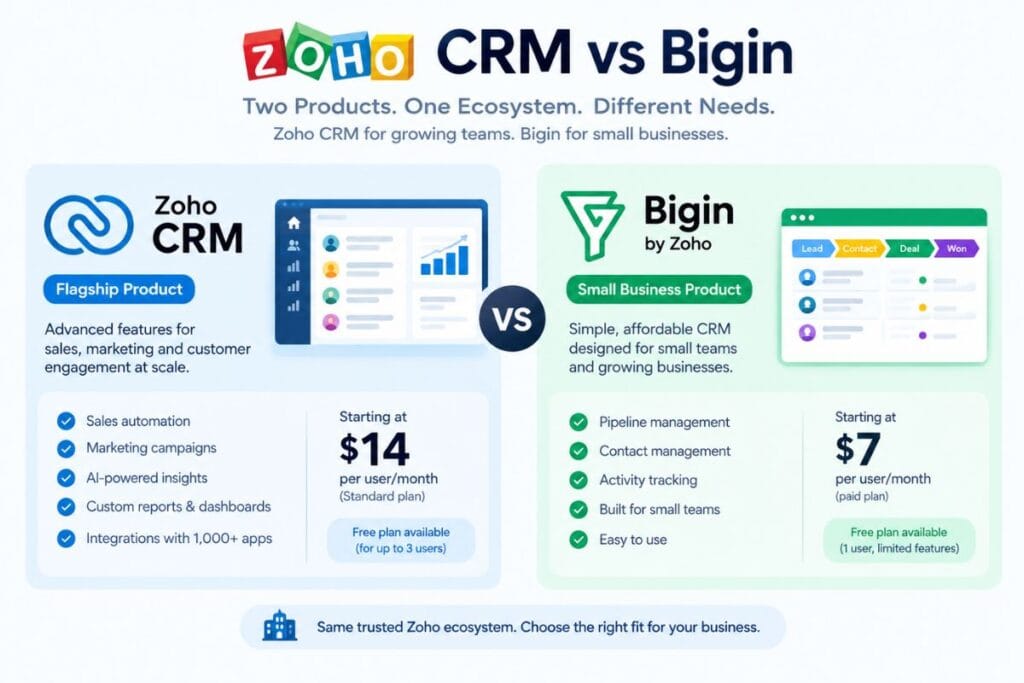
Of every tool in this best crm software for small business comparison, Bigin is the most overlooked. It is Zoho’s own separate product built specifically for small business, distinct from Zoho CRM itself and it is priced accordingly: a free plan for a single user with 500 records and paid tiers starting at just $7 a user per month on the Express plan, which is exactly half of what Zoho CRM’s own Standard tier costs. Most comparison articles mention “Zoho CRM” generically and never surface Bigin as the separate, cheaper option it actually is.
Bigin trades away Zoho CRM’s deeper customization and advanced automation in exchange for a simpler setup built around pipelines rather than a full CRM feature set, with a stated one-click upgrade path to full Zoho CRM if a business outgrows it. For a small business that finds Zoho CRM or HubSpot’s paid tiers oversized for what they actually need, Bigin is worth checking before assuming Zoho CRM is the only Zoho option.
monday CRM: Familiar Board Interface, No Permanent Free Tier
The last entry in this best crm software for small business comparison, monday CRM, builds on the same board-based interface as monday.com’s project management product, which makes it a natural fit for a team already using monday.com for other work. Like Pipedrive, it offers no permanent free plan, only a 14-day trial, with Basic starting at $12 a seat per month on annual billing.
Standard, at $17 a seat and Pro, at $28 a seat, add more automation and integrations. For a business with no existing monday.com usage, the interface familiarity advantage disappears and the lack of a free tier puts it behind HubSpot, Zoho CRM and Bigin on cost alone.
Why the Cheapest Named CRM Is Not Always the Cheapest Real Option
A comparison that only lists “Zoho CRM” at $14 a user per month misses that Zoho itself sells a cheaper, purpose-built small-business product at half that price. The same pattern shows up elsewhere in software comparisons: a vendor’s flagship product gets quoted as the vendor’s only option, while a genuinely cheaper sibling product goes unmentioned because it carries a different name.
Checking whether a CRM vendor offers a separate small-business-tier product, the way Zoho does with Bigin, before defaulting to the flagship product’s pricing is worth the extra step, since the difference here alone is a 50 percent price gap for a comparable single-user starting point.
What a Small Business Actually Loses on a Free CRM Plan
Across every free tier in this comparison, the two features that disappear first are marketing email volume and workflow automation, both of which get gated behind a paid tier well before the user or contact caps become the binding constraint for most small teams. Reporting depth is the second thing to go: free tiers generally offer basic pipeline views without the custom dashboards or forecasting that a paid tier adds.
None of the five free or trial options in this best crm software for small business comparison meaningfully restrict core contact and deal tracking, the fundamental job of a CRM stays intact even on the cheapest tier available. What a small business is really paying for once it upgrades is automation that saves manual work, not access to the CRM’s basic record-keeping function.
AI Features Across These Five Tools
AI-assisted features have moved from a premium add-on to a standard line item across most of these five tools, though what counts as “AI” varies widely. Zoho CRM’s higher tiers include Zia, its AI assistant for lead scoring and forecasting, while Bigin’s Premier and 360 tiers bundle a monthly AI credit allowance for similar lightweight prediction and drafting tasks.
HubSpot and Pipedrive both fold AI-assisted email drafting and deal-insight summaries into their paid tiers rather than the free plan and monday CRM offers AI-generated automation suggestions at its Pro tier. None of the five offer meaningful AI features on their free or entry tier, so a small business specifically hunting for an AI-driven CRM should expect to budget for at least a mid-tier paid plan rather than assuming AI comes free anywhere in this comparison.
Migrating From a Spreadsheet or an Old CRM
Every tool in this comparison supports a CSV import for bringing in existing contacts, which covers the most common starting point for a small business moving off a spreadsheet. Where they differ is in de-duplication and field mapping: Zoho CRM and HubSpot both offer guided field-mapping during import, while Bigin’s simpler interface handles a straightforward CSV import well but has fewer built-in tools for catching duplicate records automatically.
Moving from an existing CRM rather than a spreadsheet is a bigger job in every case and Bigin’s stated one-click migration path only applies to moving up to Zoho CRM specifically, not from a competitor. For a small business already invested in another CRM’s data, checking each vendor’s specific migration tooling before committing is worth doing separately from this general free-plan comparison.
Matching a CRM to Team Size and Sales Process
Matching the best crm software for small business to your actual team size avoids paying for headroom you do not need. For a solo founder or a two-person team, HubSpot’s free plan or Bigin’s free single-user tier both cover the basics without a monthly bill. For a three-to-five-person team that wants to stay free as long as possible, Zoho CRM’s 3-free-user plan stretches further than HubSpot’s 2-user cap before anyone has to pay.
For a team whose sales process is fundamentally about moving deals through visual pipeline stages, Pipedrive’s interface is purpose-built for that even without a free tier. For a business already living inside monday.com for other work, monday CRM’s shared interface may be worth the lack of a free plan for the reduced context-switching alone.
FAQs
What is the best free crm software for small business in 2026?
HubSpot’s free plan covers 1,000 contacts and 2 users and Zoho CRM’s free plan covers 3 users with no contact cap stated. Bigin by Zoho also offers a free single-user plan with 500 records, a lesser-known option built specifically for small business.
What is Bigin by Zoho and how is it different from Zoho CRM?
Bigin is a separate, simpler CRM product Zoho built specifically for small business, priced from $7 a user per month, about half of Zoho CRM’s own Standard tier. It trades deep customization for a simpler pipeline-first setup and offers a one-click upgrade path to full Zoho CRM later.
Does HubSpot’s free CRM have a user limit?
Yes. HubSpot’s free plan caps at both 1,000 contacts and 2 users at the same time, a limit many comparison articles only state the contact half of.
Is Pipedrive the best crm software for small business if I want something free?
No. Pipedrive has no permanent free plan, only a 14-day free trial with full feature access. Its cheapest paid tier, Lite, starts at $14 a seat per month on annual billing.
Which CRM is best for a team that already uses monday.com?
monday CRM shares the same board-based interface as monday.com’s project management product, which reduces the learning curve for a team already using it, though it has no permanent free tier of its own.
How many users can use Zoho CRM for free?
Zoho CRM’s free plan supports up to 3 users indefinitely, one more than HubSpot’s free tier, covering contact management, workflows and mobile access.
Conclusion
Picking the best CRM software for small business comes down to matching team size against each free plan’s actual ceiling rather than assuming the most-named tool is the cheapest option. HubSpot and Zoho CRM both offer usable free plans for a small team, Bigin by Zoho is worth checking specifically if Zoho CRM or HubSpot’s paid tiers feel oversized and Pipedrive or monday CRM make sense once a business is ready to pay for a pipeline-first or board-based workflow respectively.
Beyond CRM shortlisting, BratGen also has a few other free tools worth a look if you need something quick for a client-facing graphic or two.