
How to Calculate Your Hourly Rate Before Accepting Any Job Offer
Most job seekers focus on the annual salary figure when evaluating an offer. That number looks straightforward on paper, but it rarely tells the complete story. Commute time, unpaid overtime, benefit deductions, and taxes quietly reduce what you actually earn per hour and most candidates never do that math before signing.
Knowing your real hourly rate changes how you evaluate job offers. It gives you a concrete number to compare across different roles, work models, and industries. And it puts you in a far stronger position during salary negotiations.
This guide walks you through exactly how to calculate your hourly rate, what factors to account for, and which tools make the process fast and accurate.
Why the Annual Salary Number Is Misleading
An annual salary of $60,000 sounds like a fixed, measurable figure. In practice, it tells you very little without additional context.
A salaried employee who works 50 hours per week earns a very different hourly rate than one working a standard 40-hour week at the same pay. Add commute time, unpaid prep work, and benefits packages that differ between companies, and two offers at the same headline salary can be dramatically different in real value.
Most candidates skip this calculation and end up making decisions based on incomplete information.
The Core Formula: Salary to Hourly Conversion
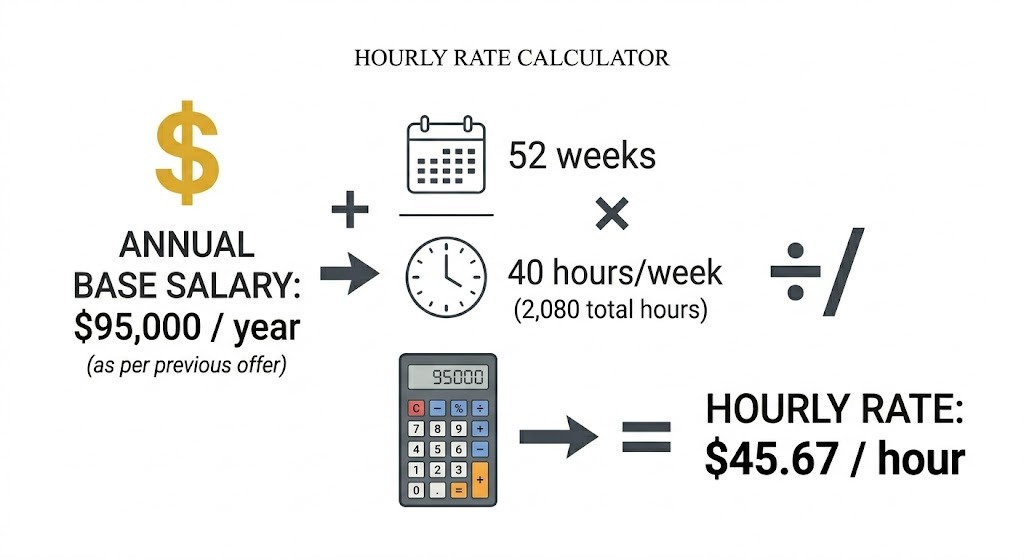
The standard formula for converting an annual salary to an hourly rate is straightforward.
Annual Salary / Total Hours Worked Per Year = Hourly Rate
For a standard full-time schedule, the calculation uses 2,080 hours as the baseline which is 40 hours per week multiplied by 52 weeks.
Example: $60,000 / 2,080 = $28.85 per hour
That is your gross hourly rate before any deductions or adjustments. It is a useful starting point, but it is not the complete picture.
Factors That Affect Your True Hourly Rate
The basic formula gives you a raw number. These factors adjust it to reflect what you actually take home per hour.
Overtime and Unpaid Hours
Many salaried roles come with an implicit expectation of extra hours. If you are regularly working 50 hours a week instead of 40, your real denominator increases.
$60,000 / (50 hours x 52 weeks) = $23.08 per hour
That gap compounds significantly over a full year.
Tax and Deductions
Your gross hourly rate is not your net rate. Federal taxes, state income tax, Social Security, and Medicare contributions reduce your actual take-home pay. Factoring in an effective tax rate of 25%, for example, brings $28.85 down closer to $21.64 per hour.
Benefits and Their Dollar Value
Employer-provided benefits have real monetary value. Health insurance, dental, retirement contributions, and paid leave can add thousands of dollars annually to your total compensation or cost you thousands if they are absent.
When comparing two offers, calculate the benefits gap. A $5,000 difference in annual salary can disappear entirely if one employer covers health insurance and the other does not.
An income tax calculator can help estimate how taxes and deductions affect your take-home pay when comparing compensation packages.
Commute Time and Costs
Commuting is unpaid work time. If you spend one hour commuting each way and drive five days a week, that is roughly 500 hours per year equivalent to more than 12 full work weeks.
Adding those hours to your annual total dramatically changes your true hourly rate.
How Online Calculators Make This Instant
Running these calculations manually is error-prone, especially when you are factoring in multiple variables at once. This is where dedicated salary conversion tools eliminate friction.
A salary to hourly calculator lets you input your annual, monthly, weekly, or daily pay and instantly see the equivalent hourly rate. Quality tools also allow you to adjust for hours worked per week, giving you a more accurate figure than the standard 40-hour assumption.
Instead of building a spreadsheet for every job offer, you can compare rates across multiple positions in minutes. This is especially useful when you are evaluating a salaried role against a freelance contract or a part-time position.
Calculating by Work Model
Your calculation approach changes based on how the job is structured.
Full-Time Salaried Roles
Use the standard formula with actual weekly hours, not the assumed 40. If the role has a history of overtime expectations, factor that in before accepting.
Part-Time Positions
Divide the annual or monthly salary by actual scheduled hours per year. Part-time roles sometimes offer a higher hourly rate on paper but provide fewer benefits, which reduces total compensation.
Freelance and Contract Work
Freelancers face a different calculation. You only get paid for billable hours, but you spend significant time on admin, proposals, and non-billable client communication. As a general benchmark, freelancers should target a rate at least 30-40% higher than an equivalent salaried employee to account for taxes, benefits, and uncompensated time.
Common Mistakes When Evaluating Job Offers
Most candidates make at least one of these errors when assessing compensation.
- Comparing gross salary figures without adjusting for hours worked
- Ignoring the monetary value of benefits packages
- Forgetting commute costs and time when calculating net earnings
- Accepting the first offer without running a quick hourly comparison against alternatives
- Treating salary and total compensation as interchangeable
Each of these mistakes can cost you thousands of dollars over the course of a year.
What a Good Hourly Rate Actually Looks Like
There is no universal answer, but there are useful benchmarks. Your target hourly rate should cover your cost of living, reflect your skill level and market value, and account for the full cost of working in that role.
A practical approach is to start with your required monthly take-home income, work backward through taxes and deductions, and then divide by actual working hours. This gives you a floor rate below which no offer makes financial sense.
Comparing your calculated floor rate against what an employer is offering tells you immediately whether the role is viable or just looks viable on paper.
Best Practices Before Signing Any Offer
These steps will help you make a fully informed compensation decision.
- Calculate your hourly rate using actual expected hours, not the assumed 40-hour week
- Quantify the benefits package in dollar terms and include it in your comparison
- Factor in commute time and transport costs as part of your total work hours
- Before comparing any two offers, run both numbers through a salary to hourly calculator at https://salarytohourlycalculator.us/ so you are always working with the same unit of measurement.
- Negotiate based on your calculated rate, not just the headline salary figure
The goal is to walk into any negotiation knowing exactly what an offer is worth per hour before you agree to anything.
Final Assessment
The annual salary figure in a job offer is a starting point, not a conclusion. What matters is what it actually works out to per hour, after accounting for real working time, taxes, benefits, and the hidden costs of employment.
Candidates who do this calculation before accepting an offer negotiate more effectively and make better career decisions. Those who skip it often discover the real value of a role months after starting.
The calculation is not complex. With the right formula and a reliable hourly rate calculator, it takes minutes. The insight it gives you is worth far more than the time it takes to run the numbers.