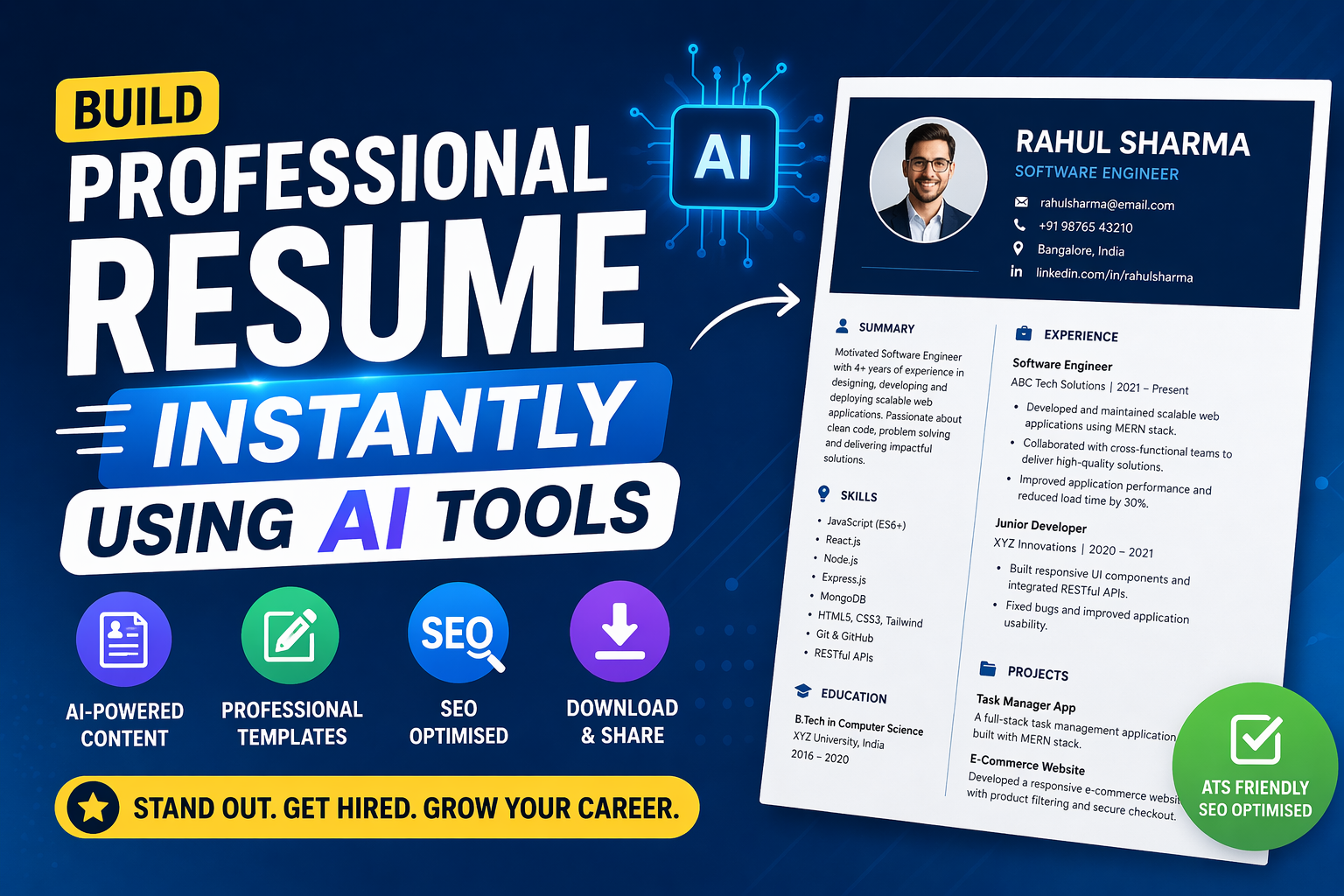
Build a Professional Resume Instantly Using AI Tools
In a hiring environment defined by speed, automation, and intense competition, the traditional approach to resume writing is no longer sufficient. Recruiters are screening hundreds—sometimes thousands—of applications for a single role, often relying on automated systems to filter candidates before any human review occurs. In this context, building a professional resume quickly and strategically is not just helpful—it’s essential.
This is where AI-powered resume builder tools are making a measurable impact. These platforms combine natural language processing, machine learning, and hiring data to help candidates generate high-quality, ATS-optimized resumes in minutes. Instead of struggling with formatting, phrasing, and structure, job seekers can now focus on presenting their value effectively.
The Demand for Instant, High-Quality Resumes
Opportunities don’t wait. Many employers shortlist candidates within hours of posting a job. If your resume isn’t ready—or worse, not optimized—you risk missing out entirely.
AI solves this by enabling near-instant resume creation without compromising on quality. You can input your details, select a target role, and generate a polished resume that aligns with current hiring standards almost immediately.
This shift from manual effort to intelligent automation is redefining how quickly candidates can enter the hiring pipeline.
The Mechanics Behind AI Resume Builders
AI resume tools are not just templates—they are decision-support systems trained on hiring data. Their functionality typically includes:
Semantic Analysis of Job Descriptions
AI parses job listings to extract key competencies, required skills, and preferred qualifications. It then aligns your resume content accordingly.
Natural Language Enhancement
Instead of basic descriptions, AI rewrites your experience using strong action verbs, quantifiable achievements, and industry-specific terminology.
Structural Optimization
The system organizes your resume into recruiter-friendly sections, ensuring logical flow and readability.
ATS Compliance Engineering
AI ensures your resume adheres to formatting rules that prevent parsing errors in Applicant Tracking Systems.
Core Advantages of Using AI Resume Tools
1. Speed Without Compromise
AI drastically reduces the time required to create a resume—from hours to minutes—while maintaining professional quality.
2. Precision Targeting
Every job application can be tailored using AI-driven keyword alignment, increasing relevance and match scores.
3. Enhanced Readability
AI enforces clean formatting, bullet hierarchy, and concise phrasing, making resumes easier to scan.
4. Data-Driven Content
Instead of guesswork, your resume is built using insights derived from real hiring trends and recruiter behavior.
From Responsibilities to Results
One of the most significant improvements AI brings is the shift from task-based descriptions to outcome-driven statements.
Traditional phrasing:
“Responsible for managing sales operations.”
AI-enhanced phrasing:
“Increased regional sales by 28% through strategic pipeline management and client acquisition.”
This transformation is critical because recruiters prioritize measurable impact over generic responsibilities.
ATS Optimization: A Non-Negotiable Requirement
A large percentage of resumes are rejected before reaching a recruiter due to ATS filtering. AI tools directly address this by:
- Embedding role-specific keywords naturally
- Avoiding incompatible design elements (e.g., tables, graphics)
- Maintaining standard section headings
- Ensuring machine-readable formatting
Without this level of optimization, even highly qualified candidates can be overlooked.
Customization at Scale
Applying to multiple roles used to require multiple resume versions—a time-intensive process. AI eliminates this friction.
You can generate and adapt resumes for different roles within minutes by:
- Uploading a job description
- Receiving tailored suggestions
- Updating keywords and skill emphasis automatically
This scalability allows candidates to apply more strategically and efficiently.
Key Features That Drive Performance
When evaluating AI resume platforms, prioritize the following capabilities:
Context-Aware Suggestions
The tool should understand your industry and provide relevant recommendations—not generic filler content.
Dynamic Keyword Matching
Real-time comparison with job descriptions ensures alignment with employer expectations.
Multi-Template Flexibility
Different roles and industries require different visual approaches. AI tools should offer adaptable, ATS-safe templates.
Integrated Feedback Systems
Look for scoring systems or improvement indicators that guide optimization.
Export and Sharing Options
Seamless export in PDF or DOCX formats is essential for compatibility with employer systems.
Minimizing Common Resume Pitfalls
AI tools systematically eliminate errors that often weaken resumes:
- Redundant or irrelevant content
- Overly complex formatting
- Weak action verbs
- Lack of quantifiable achievements
- Inconsistent tone and tense
By addressing these issues proactively, AI ensures your resume meets professional benchmarks.
The Role of Human Oversight
Despite its capabilities, AI is not infallible. It lacks full contextual awareness of your career nuances. Therefore, human input remains critical.
You should always:
- Validate factual accuracy
- Add specific metrics and achievements
- Adjust tone to reflect your personal brand
- Remove any generic or repetitive phrasing
The optimal workflow is collaborative—AI handles optimization, while you refine authenticity.
Use Cases Across Career Levels
AI resume builders are versatile and applicable across different career stages:
Entry-Level Candidates
They help structure limited experience effectively, emphasizing skills, internships, and academic projects.
Mid-Level Professionals
AI enhances impact by refining achievements and aligning experience with career progression.
Senior Executives
It helps articulate leadership outcomes, strategic initiatives, and business impact with clarity.
Career Transitioners
AI identifies transferable skills and reframes experience for new industries.
Emerging Trends in AI Resume Technology
The next generation of AI resume tools is expected to include:
- Predictive hiring analytics (fit scoring based on employer data)
- Integrated interview coaching modules
- Automated portfolio and LinkedIn synchronization
- Voice-assisted resume creation
- Real-time recruiter simulation feedback
These advancements will further compress the gap between application and hiring success.
Strategic Best Practices
To extract maximum value from AI resume tools:
- Customize every application—avoid one-size-fits-all resumes
- Prioritize measurable achievements over duties
- Keep content concise (ideally 1–2 pages)
- Regularly update your resume with new skills
- Use AI suggestions selectively, not blindly
Execution quality still determines outcomes.
Final Assessment
AI has fundamentally redefined resume creation—from a manual, time-intensive task to a fast, data-driven process. With the help of intelligent tools, candidates can now produce professional, ATS-optimized resumes in minutes, significantly improving their chances of getting noticed.
However, technology alone is not a differentiator—how effectively you use it is. Candidates who combine AI efficiency with strategic thinking and authentic storytelling will consistently outperform the competition.
In a hiring ecosystem governed by speed and algorithms, the ability to build a professional resume instantly is no longer a luxury—it’s a competitive necessity.