Meme Font Guide – Best Fonts for Memes & How to Use Them
There is a reason you can look at a meme you have never seen before and instantly know it is a meme. Before you read the words, before you understand the joke, something in the typography signals it immediately. That signal is almost always the font.
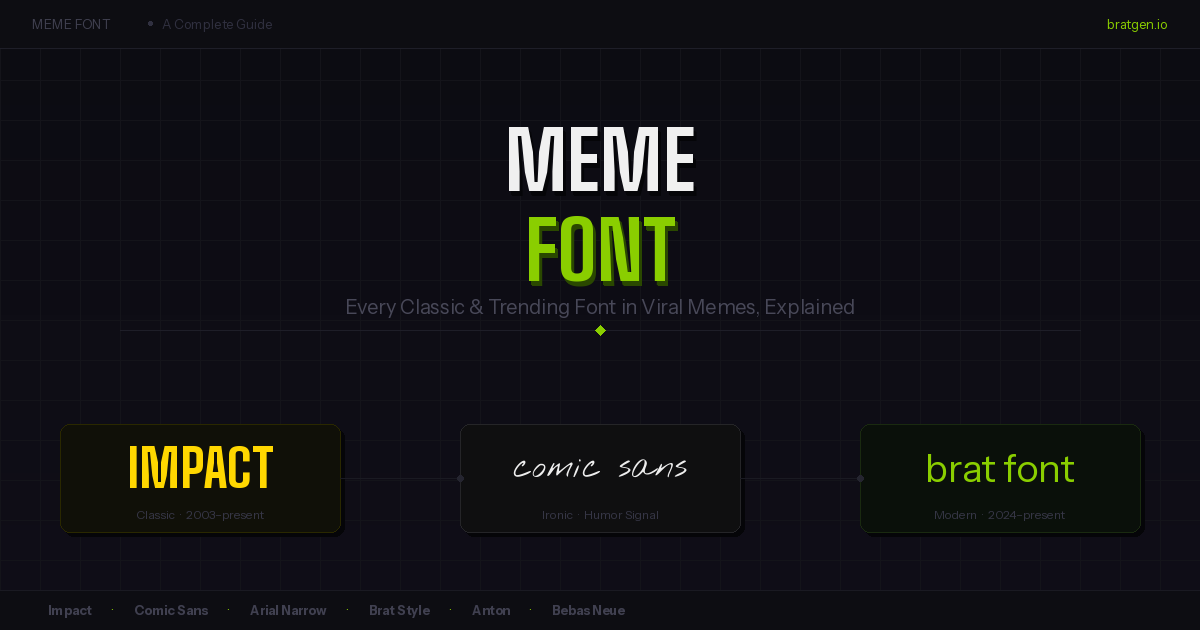
Meme fonts are not random. They follow patterns that developed over two decades of internet culture, and understanding those patterns explains a lot about why certain memes land and others fall flat. This guide covers every major font used in viral memes — where it came from, what it communicates, and when to use it — along with the modern alternatives that have replaced the classics on newer platforms. If you want to create meme-style text yourself, the free text and meme creation tools at Bratgen handle everything from classic bold formats to the Brat-style minimal aesthetic without any software or sign-up required.
What Actually Makes a Font Work for Memes
Before getting into specific fonts, it helps to understand what a meme font needs to do structurally. Meme text almost always appears as an overlay on top of an image — which means it has to stay readable against backgrounds that are busy, unpredictable, and often very different from the text color.
This creates a set of specific requirements that most decorative or body text fonts simply cannot meet:
- High contrast at small sizes — memes are shared as compressed thumbnails on social feeds, so fine details disappear
- Immediate legibility — the text has to land in under a second, before the viewer decides whether to keep scrolling
- Personality match — the font sets the tone before the words are read; a mismatched font undermines the joke
- Bold weight — thin fonts disappear against complex backgrounds, especially on mobile screens
Every font that has dominated meme culture, from Impact in 2007 to Arial Narrow in 2024, satisfies these four requirements in different ways for different aesthetic moments.
Impact — The Original Meme Font
If someone refers to “the meme font” without any qualifier, they mean Impact. It is the default, the archetype, the typeface that defined what internet text looked like for the better part of fifteen years.
Impact was designed by Geoffrey Lee in 1965, originally for Stephenson Blake type foundry in England. The design followed the decade’s trend of bold, condensed, industrial typefaces — thick strokes, very tight letter spacing, and almost no white space between characters. Lee’s stated goal was to create something that simply commands attention. The name describes the intention exactly.
The path from 1965 to “meme font” runs through Microsoft’s 1996 decision to include Impact in their Core Fonts for the Web package — eleven typefaces that shipped with Windows 98 and became the baseline of internet typography. Because Impact was installed on nearly every home computer by the late 1990s, early web tools could rely on it being available.
In 2003, Something Awful forum users like Kyle Fasel started captioning images using Impact in all-caps, white text with a black outline. The format spread. By the time “I Can Has Cheezburger” launched in 2007, Impact had become the default font across every major image macro generator — Cheezburger, Memegenerator, Quickmeme, 9GAG, Imgur — because it was already established as the visual grammar of that format. As Know Your Meme documents, that mass adoption across tools locked Impact into its role as the definitive meme font for an entire era.
Why it works: The condensed letterforms pack large text into a small horizontal space, which means you can write a full sentence across the top of an image without running off the edge. The heavy weight creates contrast against almost any background. The all-caps convention (which was never mandatory — just standard practice) adds volume and urgency without requiring a different font weight.
When to use it: Classic image macro formats, reaction images with top-and-bottom captions, anything that references early internet culture intentionally. Using Impact in 2026 reads as deliberately nostalgic or ironic — which is itself a valid and widely understood meme language.
Comic Sans — The Intentional Joke Font
Comic Sans MS was designed by Vincent Connare in 1994 for Microsoft Bob, a software program aimed at casual home users. Connare modeled it on the informal handwritten lettering in comic books — rounded letterforms, inconsistent baseline, deliberately unprofessional. Microsoft shipped it with Windows 95, and it spread to every office printer, school newsletter, and early website that wanted to seem approachable rather than corporate.
The backlash was immediate and never really stopped. By the 2000s, Comic Sans had become a reliable shorthand for design incompetence, bad taste, and misplaced cheerfulness. Designers treated it as the enemy.
Then meme culture arrived and made that reputation into a feature. Using Comic Sans in a meme communicates something specific: it signals that the creator is in on the joke, that the deliberately terrible font choice is part of the humor, that there is no pretension here. A deep philosophical quote set in Comic Sans hits differently than the same quote in a serif — the font undercuts the gravity and makes the combination funny on its own terms.
Why it works: In memes, it works precisely because it should not work. The recognition factor is extremely high, and the cultural baggage it carries is immediately readable to anyone who spent time online in the 2000s or 2010s.
When to use it: Ironic uses, intentionally absurdist formats, memes where the joke is partially that someone chose this font, and the emerging “meme poisoning” format where incongruity between font and content is the entire point.
Arial Narrow — The Modern Meme Font
This is where the evolution gets interesting for anyone following current internet aesthetics. Arial Narrow is a condensed variant of Arial — the ubiquitous corporate sans-serif that ships with every version of Windows and macOS. On its own, Arial is forgettable. Stretched vertically into its Narrow variant and set in bold lowercase, it becomes the typographic identity of an entire cultural movement.
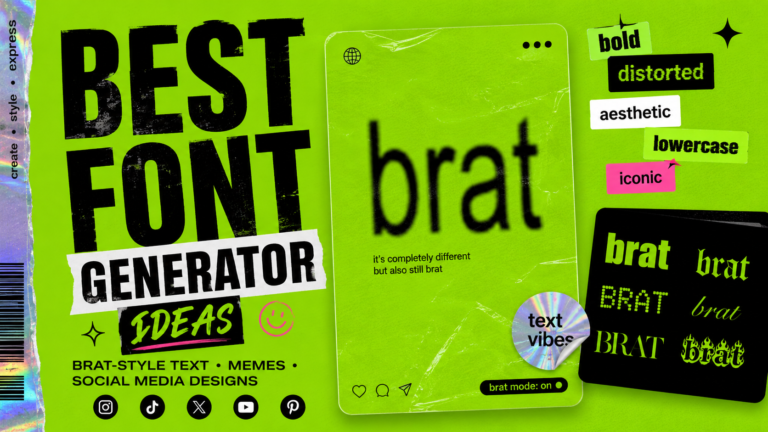
Charli XCX’s 2024 album Brat used a version of this treatment for its cover art — all-lowercase, tightly condensed, slightly blurred, on a flat lime green background — and the aesthetic exploded. The Charli XCX design trend became one of the most replicated visual styles of 2024 and continued strongly into 2025, generating a category of meme text that operates completely differently from the classic Impact format.
Where Impact is loud, all-caps, and declarative, Brat-style Arial Narrow is lowercase, compressed, and understated. The blur effect often applied to it adds a dreamlike, deliberately unpolished quality. It communicates something closer to “I am cool enough to not try too hard” rather than Impact’s “LOOK AT THIS.”
This is now the dominant meme font in aesthetics-focused and trend-aware online communities — particularly on TikTok, Instagram Stories, and aesthetic social media accounts where the older Impact style would read as dated.
If you want to create brat-style text in this format, or explore what that font actually is and how it is constructed, those resources cover the technical and cultural details in full. The Brat Font Generator also lets you apply this treatment directly to any text you want, with control over size, blur, and color.
Why it works: It satisfies the four requirements of a meme font — legibility, contrast, personality, weight — but through restraint rather than loudness. On platforms where Impact reads as a throwback, Arial Narrow reads as current.
When to use it: Aesthetic memes, coquette-adjacent content, Gen Z-oriented formats, anything styled around the Brat visual language, profile picture text, and social media captions where the vibe matters as much as the punchline.
Other Fonts Used in Memes
Helvetica Bold
Helvetica is the other major corporate sans-serif, preferred by designers who find Arial slightly clumsy. In bold weight it appears in cleaner, more design-literate meme formats — particularly in templates that imitate brand visuals or corporate communication ironically. The “Drake pointing” format and several approval/disapproval templates have used Helvetica variants to give a more polished, almost-professional appearance that sharpens the contrast with their comedic content.
Anton
Anton is a free Google Font designed specifically as a display typeface — heavy weight, narrow width, all-caps optimized. It is frequently used as an Impact replacement in tools that want the same structural function without the explicit vintage internet association. Canva templates, YouTube thumbnail generators, and several meme tools default to Anton when they want the classic image macro look without invoking Impact specifically.
Bebas Neue
Another condensed, all-caps display font. Bebas Neue has a slightly more contemporary feeling than Impact — cleaner geometry, less obviously 1990s. It is common in fitness-related memes, motivational content, and contexts where the aesthetic needs to read as bold but current rather than nostalgic.
Times New Roman
Times New Roman in memes is almost always ironic — it signals formality, academia, or officialness in a context where those things are absurd. The “my dissertation on why X is actually Y” meme format leans heavily on Times New Roman’s association with institutional documents to make the premise funny.
System Default Fonts (Helvetica, San Francisco, Roboto)
When users create memes directly in Instagram, TikTok, iMessage, or other platforms, they typically use the platform’s built-in text tool with system default fonts. These vary by platform and device, but they cluster around sans-serif, medium-weight options that prioritize screen legibility over personality. Memes created this way have a recognizable “made on phone” quality that is itself a distinct aesthetic — lo-fi, spontaneous, slightly rough.
How Font Choice Sets the Tone Before the Text Does
One of the most underappreciated aspects of meme typography is that the font communicates before you read a single word. A researcher analyzing visual processing found that audiences form initial impressions of text in under 400 milliseconds — which means the cultural signal carried by a font like Impact or Comic Sans lands before the conscious brain engages with the actual content.
This is why font mismatch humor works at all. Set the punchline of a serious philosophical quote in Comic Sans and the gap between the gravitas of the content and the casualness of the font creates tension that the brain resolves as humor. Set an absurd, stupid joke in Times New Roman and the formal font creates a comedic pomposity around it.
The same principle applies to the Brat-style lowercase aesthetic. Part of what makes it land is that the font signals a particular level of cultural awareness — people who use Arial Narrow in the Brat style know what they are doing, and that in-group signal is part of the joke and the identity.
Just as meme fonts establish a mood instantly, typography can shape how audiences perceive a business. Choosing the right typeface is therefore an important part of effective Branding Agency in USA
Where Meme Fonts Fail
Font choice alone does not make a meme work. The most common failure points:
Wrong weight for the background. A light or medium-weight font placed over a complex image becomes unreadable in seconds. If the background is detailed — a crowd scene, a cluttered room, a sunset — only heavy-weight fonts with strong outlines survive.
No outline on Impact. The standard Impact treatment uses white text with a black outline (technically a stroke or shadow, not a true outline). Remove the outline and put plain white Impact on a light background and the text essentially vanishes. The outline is not optional — it is load-bearing.
Misread cultural signals. Using Impact on an aesthetic or coquette-adjacent meme reads as someone who does not know what they are doing with that format. Using Brat-style Arial Narrow on an old-school image macro reads as someone missing the point of both aesthetics. Font choice is cultural literacy.
Too much text for the format. Every meme font has an ideal word count range. Impact image macros work best with five to ten words per caption block — beyond that, the text overwhelms the image. Brat-style text works with two to six words maximum. Over-stuffed meme text is a formatting error regardless of which font you use.
Understanding the meme backgrounds that work under each font style also matters — the background color, texture, and contrast level should be chosen in relation to the font weight and style, not independently.
How to Apply Meme Fonts Without Design Software
You do not need Photoshop or any installed software to produce meme text in any of the formats above. The main options:
Browser-based meme tools let you upload an image, select a font, and export with text overlay. Most default to Impact and offer a small selection of alternatives. They work, but tend to be limited in customization.
The Brat Meme Generator handles the modern Brat-style format specifically — the bold lowercase aesthetic with adjustable blur and color options — and exports as a clean high-resolution PNG you can use directly.
Platform native tools — Instagram, TikTok, Snapchat — all have built-in text tools that function as basic meme font generators for content staying within those platforms.
The tradeoff across all options is the same: convenience versus control. Platform tools are the fastest but the least flexible. Dedicated generators like the ones above offer more control over the specific visual output you want.
Frequently Asked Questions About Meme Fonts
What is the original meme font?
Impact, designed by Geoffrey Lee in 1965 and adopted as the default font across early image macro websites in the mid-2000s. It is still the most recognizable meme font in the classic tradition.
Is Impact the only meme font?
No. Comic Sans, Arial Narrow (Brat-style), Anton, Bebas Neue, Helvetica Bold, and various platform system fonts all function as meme fonts in different contexts and communities.
What font do modern memes use?
Newer meme formats — particularly those associated with Gen Z, aesthetic communities, and TikTok — tend to use condensed lowercase formats closer to the Brat aesthetic than classic all-caps Impact. The specific font varies by creator and community, but the lowercase, bold, minimal approach has largely displaced all-caps Impact in trend-aware contexts.
Why is Impact always white with a black outline?
That treatment developed early in image macro culture because it ensures legibility against any background color — the white text is visible on dark areas, and the black outline makes it visible on light areas. It became a convention that is now practically inseparable from the Impact meme format.
Can I use a different font for memes?
Absolutely. The “rules” of meme typography are conventions, not requirements. The conventions exist because they work reliably, but deliberately breaking them — using Comic Sans when Impact is expected, or using a serif font where people expect a sans-serif — is itself a recognized comedic technique.
What is the Brat font exactly?
It is a condensed, bold version of Arial or a similar sans-serif, set in lowercase with slight blur applied, on a flat bold background. The treatment was popularized by Charli XCX’s 2024 album cover and became a defining visual style of that era.
Final Thoughts
The meme font question seems simple on the surface — Impact, everyone knows this — but the actual answer is considerably more layered. Different platforms, communities, and aesthetic traditions use different fonts to signal different things, and choosing the right font is a form of cultural fluency rather than a technical decision.
Impact remains the foundation. Everything that came after it — including the Brat-style lowercase revolution — is in dialogue with what Impact established. Understanding that history makes it easier to use fonts intentionally rather than by default, which is ultimately what separates memes that land from memes that look like someone just picked whatever was available.
Whether you are working in the classic format or experimenting with modern Brat-style aesthetics, the font is doing more work than most people give it credit for.