Key Factors to Consider When Deciding What to Do With an Unwanted Property
Introduction
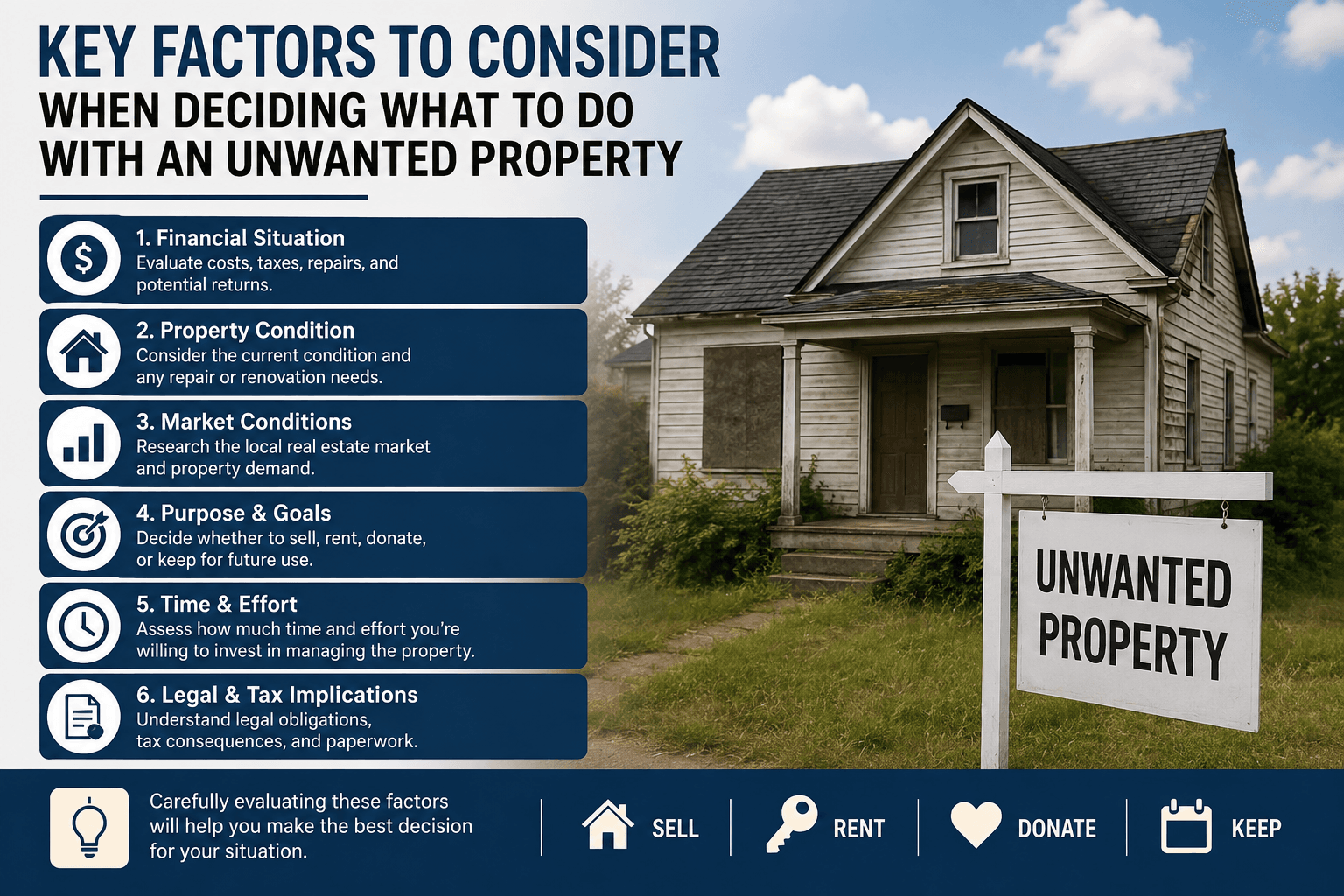
An unwanted property can become a significant responsibility, whether it is an inherited home, a vacant house after relocation, or a property that no longer fits your financial or personal circumstances. Holding onto a home can involve ongoing expenses and maintenance, while selling it requires decisions about timing, preparation, pricing, and the best sales method. Because every homeowner’s situation is different, there is no single solution that works in every case. Before deciding what to do, it helps to look at the property’s condition, its position in the local market, the costs of keeping it, and how much time and effort you are willing to invest. Taking these factors together can make the decision more practical and financially informed.
1. Determine Why the Property Is No Longer Suitable
Start by identifying why the property has become unwanted. You may have inherited it unexpectedly, moved to another area, experienced a change in household needs, or simply found that maintaining it is no longer worthwhile. Understanding the reason matters because some situations may be temporary, while others point toward a long-term decision.
For example, someone who expects to return to the area may view the property differently from an owner who has permanently relocated. Similarly, an inherited home may carry emotional or family considerations that do not apply to an investment property. Clarifying your priorities first can help determine whether selling is the right choice and what type of sale would best fit your circumstances.
2. Assess the Property’s Current Condition
The physical condition of the property can have a major effect on your available options. Look at structural concerns, outdated systems, cosmetic issues, deferred maintenance, and repairs that could affect the home’s value or marketability.
Not every problem requires a major renovation. Minor improvements may make sense when the property is generally market-ready, while extensive repairs can require considerable money and time. Before committing to any work, estimate the likely cost and consider whether the improvement could reasonably be recovered through a higher sale price.
3. Understand the Property’s Current Market Position
A property’s value depends on more than what the owner hopes to receive. Local demand, comparable properties, location, size, condition, and neighborhood characteristics all influence how buyers may respond.
Researching recently sold homes in the area can provide a more realistic picture of what similar properties are achieving. It is also useful to distinguish between asking prices and actual sale prices. Setting expectations around current market conditions rather than an ideal figure can help prevent a property from remaining on the market longer than necessary.
4. Consider the Costs of Keeping the Property
An unwanted property can continue generating expenses even when it is not being used. Mortgage payments, property taxes, insurance, utilities, repairs, landscaping, and routine maintenance can gradually add up.
Vacant properties may create additional concerns because they still require oversight and can be more vulnerable to maintenance problems. Instead of looking only at today’s costs, consider what keeping the property could cost over the next six months or year. Comparing those expenses with the potential financial outcome of selling can provide a clearer basis for the decision.
5. Explore Different Ways to Sell
Homeowners generally have several ways to approach a sale. A traditional listing with a real estate agent may provide broad exposure and professional assistance with pricing, marketing, negotiations, and paperwork. Selling independently can give an owner more direct control, although it also requires handling much of the process personally.
Another possibility is a direct sale to a property buyer, which may appeal to owners who value a simpler transaction or have a property that needs substantial work. For instance, someone researching how to Sell Your House Fast in Virginia Beach may compare local market conditions and different selling methods before deciding which approach is appropriate.
The important point is to compare the trade-offs rather than assuming one method is automatically better. Each approach can differ in speed, preparation requirements, costs, and the amount of involvement expected from the homeowner.
6. Think About Your Preferred Selling Timeline
Timing can be just as important as price. Some homeowners have flexibility and can wait for the right buyer, while others may need to sell because of relocation, financial commitments, an inherited property, or another deadline.
If speed is important, waiting several months for a potentially higher offer may not always be practical. On the other hand, accepting the first available offer without understanding the property’s market value could result in an unnecessarily low return. Establishing a realistic timeline before listing can help you choose a strategy that balances urgency with financial expectations.
7. Evaluate Offers Beyond the Headline Price
The highest offer is not necessarily the most valuable one. When comparing offers, consider whether the buyer is paying cash or relying on financing, how quickly they can close, and whether the offer includes contingencies.
Repair requests, inspection conditions, closing costs, and other transaction requirements can also affect the final amount you receive. A slightly lower offer with fewer conditions and a predictable closing process may ultimately be more practical than a higher offer that introduces uncertainty.
The figure that matters most is the net amount you expect to receive after relevant costs and obligations, not simply the number written at the top of an offer.
8. Consider How Much Work You Want to Put Into the Sale
Selling a property can involve considerably more work than placing a listing online. Cleaning, decluttering, repairs, photography, staging, inspections, showings, negotiations, and paperwork can all require time and coordination.
Some owners are comfortable investing weeks or months preparing a home for the market. Others may have limited time, live far away, or simply do not want to manage an extensive preparation process. Being honest about your available resources can help you avoid choosing a sales strategy that creates more stress than expected.
9. Understand When a Simpler Selling Option May Make Sense
A simpler approach may be worth considering when extensive preparation is impractical. This can be particularly relevant for properties requiring significant repairs, homes that have been vacant for a long period, or situations where the owner needs greater certainty around timing.
This does not mean a simplified transaction is automatically the best financial choice. Homeowners should still understand the property’s value, compare available alternatives, and review the terms carefully. However, quick home sale solutions may be considered by owners who place a higher value on convenience and speed than on completing a traditional, preparation-heavy sale.
10. Review the Financial and Practical Implications
Before making a final decision, calculate what the transaction could mean financially. Consider the outstanding mortgage, liens or other obligations connected with the property, estimated selling expenses, potential repair costs, moving expenses, and the amount you are likely to retain after the sale.
There may also be tax or legal considerations depending on how the property was acquired and the circumstances surrounding the sale. These issues can vary considerably, so it is sensible to verify them with an appropriate tax, legal, or real estate professional rather than relying on general assumptions.
11. Make the Decision Based on Your Situation
Ultimately, the right choice depends on the combination of price, speed, convenience, property condition, financial obligations, and personal priorities. A homeowner with plenty of time may choose a different route from someone dealing with an urgent relocation or a property that requires extensive repairs.
Rather than focusing on a single factor, consider how each option affects the overall outcome. A decision that appears less attractive based solely on sale price may make more sense when time, repair expenses, holding costs, and effort are included.
Conclusion
Deciding what to do with an unwanted property requires more than determining whether to sell. The property’s condition, market position, ongoing costs, selling timeline, available sales methods, and the amount of work you are willing to undertake all deserve consideration.
There is no universally correct approach for every homeowner. The most practical decision is the one that fits your financial position, timeline, property circumstances, and personal priorities. By evaluating these factors carefully and understanding the implications of each option, homeowners can move forward with a clearer idea of what makes sense for their particular situation.