
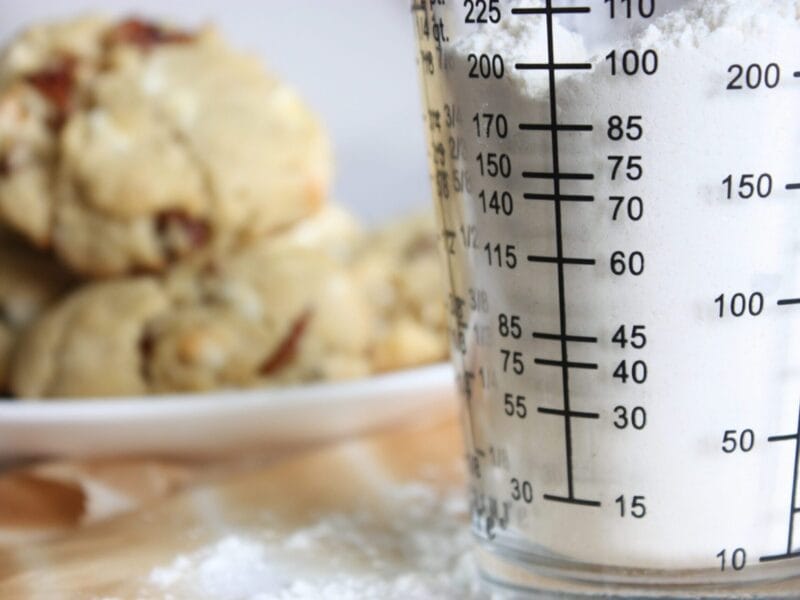
How to Convert ML to Grams for Recipes and Kitchen Measurements
Accurate measurements are an important part of successful cooking and baking. Recipes may use different measurement systems, with some ingredients listed in milliliters while others are measured in grams. This can become confusing when you have a kitchen scale but the recipe provides measurements in milliliters.
Although milliliters and grams measure different things, they can be connected through an ingredient’s density. Understanding this relationship makes it easier to measure liquids, powders, and other ingredients accurately.
If you need to convert ml to grams, the key is to know what ingredient you are measuring and understand its approximate density.
Understanding Milliliters and Grams
Before converting measurements, it is important to understand the difference between the two units.
Milliliters (ml) measure volume. They tell you how much physical space an ingredient occupies.
Grams (g) measure mass. They tell you how much an ingredient weighs.
Because different ingredients have different densities, the same volume does not always have the same weight.
For example, 100 ml of water weighs approximately 100 grams, but 100 ml of cooking oil weighs less because oil is less dense than water.
Why Density Matters
Density is the main factor when converting volume to weight. The basic relationship is:
Weight = Volume × Density
If you know the volume in milliliters and the ingredient’s density, you can estimate its weight in grams.
For water, the calculation is particularly simple because its density is approximately 1 gram per milliliter under common kitchen conditions.
So:
100 ml water × 1 g/ml = 100 g
For other ingredients, the result will be different.
Common Kitchen Conversion Examples
Many everyday cooking ingredients have approximate densities that can help with conversions.
Water
Water is one of the easiest ingredients to convert.
- 50 ml ≈ 50 g
- 100 ml ≈ 100 g
- 250 ml ≈ 250 g
- 500 ml ≈ 500 g
These values are useful for basic kitchen measurements.
Milk
Milk is slightly denser than water, so the weight is somewhat higher for the same volume.
Approximately:
100 ml milk ≈ 103 g
The exact value can vary depending on the type and composition of the milk.
Cooking Oil
Most cooking oils are less dense than water.
Approximately:
100 ml cooking oil ≈ 90–93 g
This means replacing a volume measurement of oil with the same numerical weight in grams would not be accurate.
Honey
Honey is considerably denser than water.
Approximately:
100 ml honey ≈ 140 g
This is why volume-to-weight conversions are particularly important for thick ingredients such as honey or syrup.
A Simple Formula for Converting ML to Grams
The general formula is:
Grams = Milliliters × Density
For example, if an ingredient has a density of 0.8 g/ml and you have 200 ml:
200 × 0.8 = 160 grams
This calculation gives an estimated weight of 160 grams.
For everyday cooking, you may not need highly precise density values, but accurate measurements become more important in baking and other recipes where ingredient ratios affect the final result.
Why You Should Not Always Use a 1:1 Conversion
A common mistake is assuming that every milliliter equals one gram. This works reasonably well for water but does not apply universally.
Ingredients can vary significantly in density. Flour, sugar, oil, milk, honey, and other ingredients all have different physical properties.
For example, 100 ml of flour will not weigh the same as 100 ml of water. Therefore, simply changing “100 ml” to “100 g” can produce an incorrect measurement.
Converting Different Types of Ingredients
Dry ingredients can be particularly challenging because their density depends on how tightly they are packed.
For example, flour can become more compact when pressed into a measuring cup. Sugar may also have different densities depending on whether it is granulated, powdered, or packed.
For these ingredients, using a kitchen scale and a reliable ingredient-specific conversion is generally more accurate than assuming a universal value.
Why Kitchen Scales Are Useful
A kitchen scale provides a direct measurement of mass and can improve consistency in recipes.
This is particularly helpful for baking, where small differences in flour, sugar, butter, or other ingredients can affect texture and structure.
If a recipe gives ingredients in grams, weighing them directly can be more reliable than trying to measure them by volume.
When a recipe provides milliliters but your scale measures grams, understanding density allows you to make an appropriate conversion.
Converting Recipes From ML to Grams
If you are adapting a recipe, begin by listing each ingredient that needs conversion. Then identify the approximate density of each ingredient.
For example, imagine a recipe calls for:
- 200 ml milk
- 100 ml oil
- 50 ml honey
The approximate weights would be different for each ingredient because their densities differ.
This approach is much more accurate than applying the same conversion factor to every ingredient.
Factors That Can Affect Accuracy
Ingredient density is not always fixed. Temperature, composition, moisture content, and physical form can influence the relationship between volume and weight.
Liquids may expand or contract slightly with temperature. Dry ingredients can vary depending on how they are stored and measured.
For most home recipes, approximate conversions are sufficient. However, professional kitchens, food production, and precise baking may require more exact ingredient specifications.
Common Conversion Mistakes to Avoid
Several mistakes can make kitchen conversions inaccurate.
Assuming ml and grams are identical: This only works approximately for substances with a density close to 1 g/ml.
Ignoring the ingredient: Always consider what you are measuring before converting it.
Using an unsuitable density: Different forms of the same ingredient may have different densities.
Overlooking measurement technique: Packed, sifted, or loosely measured ingredients can produce different weights.
Rounding too aggressively: Large rounding differences can affect recipes that depend on precise ratios.
When Accurate Conversion Matters Most
Precision is especially important for baking. Cakes, breads, pastries, and other baked goods depend on specific proportions of ingredients.
A small measurement difference may affect moisture, texture, rise, or consistency. In these situations, weighing ingredients with a kitchen scale is often preferable.
For simple cooking, approximate conversions may be perfectly adequate, particularly for ingredients where small differences do not significantly affect the final dish.
Conclusion
Converting milliliters to grams is not always a simple one-to-one calculation because milliliters measure volume while grams measure mass. The ingredient’s density determines how much a specific volume weighs.
When you convert ml to grams, use the formula grams = milliliters × density and select an appropriate density for the ingredient you are measuring. Water is approximately 1 gram per milliliter, while ingredients such as oil, milk, flour, and honey have different values.
Understanding these basic principles can make recipe adjustments easier, improve kitchen accuracy, and help you confidently work with different measurement systems.