Best Time to Post on Instagram and TikTok in 2026
If you look for the time to post on Instagram and TikTok, you will find many different answers. These answers are very sure of themselves. They do not match. One big study says that Thursday, at 9 a.m. Is the time to post on Instagram. Another study says that Wednesday afternoon is better.. A third study says that early morning is the best time to post on Instagram.
TikTok is more confusing. One big study says that Saturday is the day to post on TikTok.. Other studies say that Saturday is actually one of the worst days to post on TikTok. This guide cross-checks the major studies against each other, shows where they actually agree and explains why the rest of the disagreement exists in the first place.
Why This Advice Is So Inconsistent
Nearly every major scheduling and analytics platform publishes its own annual study on posting times and nearly every one presents its findings as the definitive answer rather than one data point among several. The studies are not wrong exactly, they are measuring different account samples, different industries, different time zones and sometimes different definitions of engagement, which produces genuinely different results from genuinely real data.
The practical effect is that a creator searching for a straight answer ends up with several straight answers that contradict each other, with no way to tell which one applies to their specific audience. Rather than picking one study and presenting it as gospel, this guide treats the disagreement as useful information in itself.
How We Built This Guide
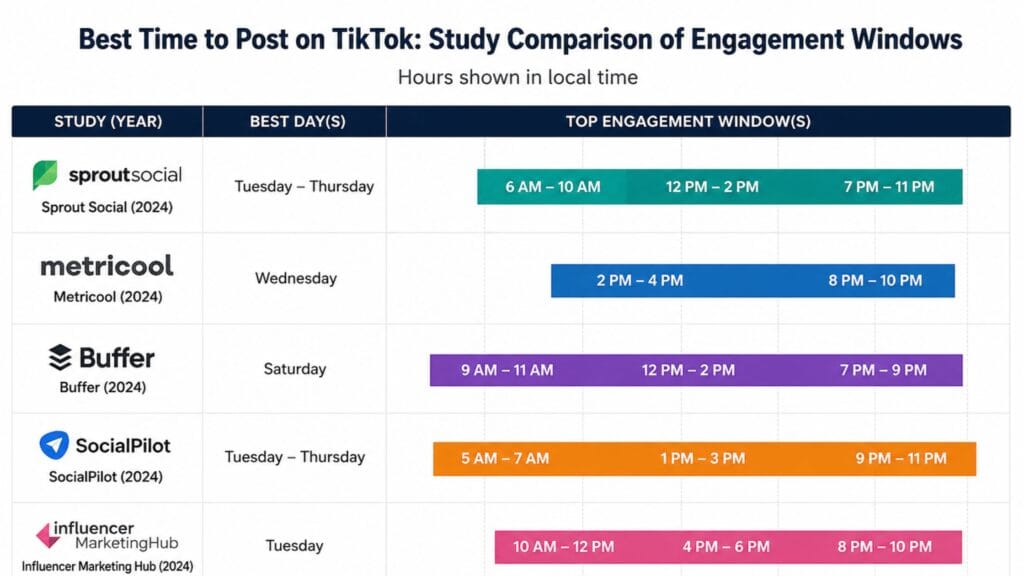
This guide cross-references data from several of the largest published studies on posting times, including Sprout Social’s analysis of nearly 2 billion engagements across roughly 307,000 profiles, alongside separate large-scale studies from Buffer, Metricool, SocialPilot, Influencer Marketing Hub and IQFluence. Rather than reporting any single study’s conclusion as the answer, we looked for the windows where several independent studies actually overlap.
Where the studies converge, that overlap is presented below as a consensus window with reasonably high confidence. Where they genuinely diverge, that disagreement is called out directly rather than smoothed over, since presenting a false sense of certainty would be less useful than an honest range.
Best Time to Post on Instagram: The Consensus Window
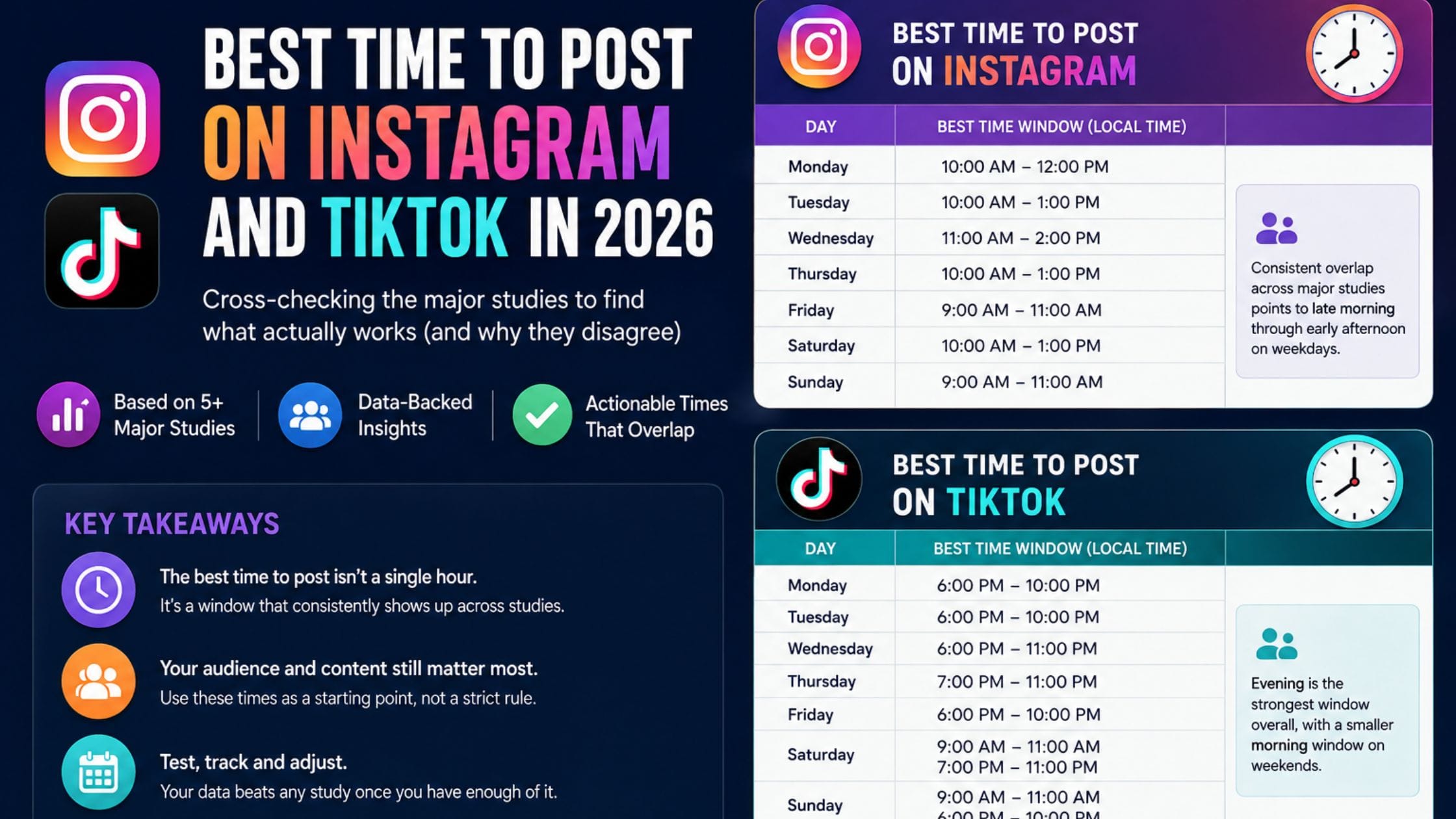
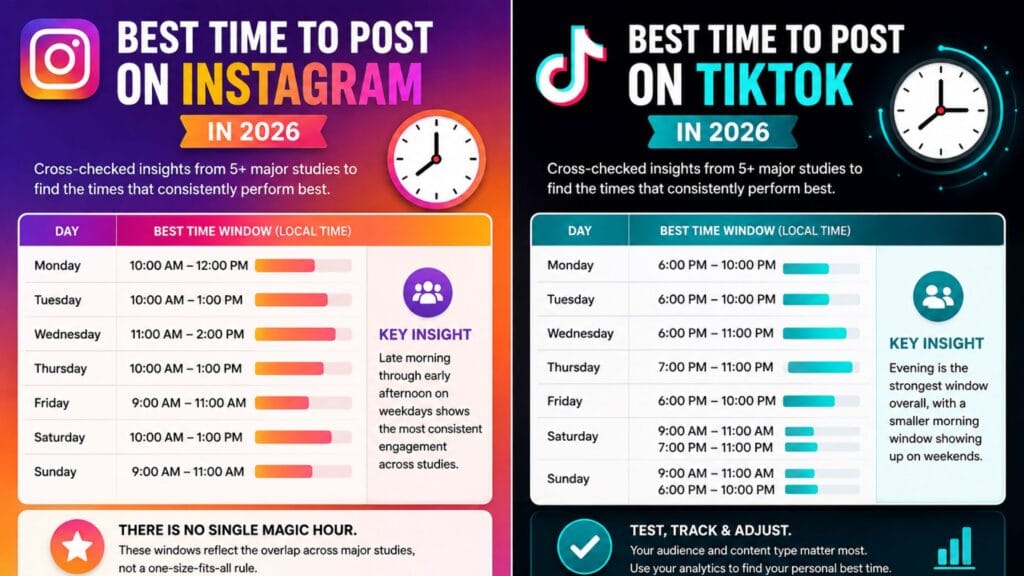
Across the major studies, Wednesday and Thursday come up as strong days more consistently than any other weekday, appearing as a top pick in the large majority of the studies reviewed for this guide. Within those days, late morning through early afternoon, roughly 9 a.m. to 1 p.m., shows up as a recurring window across multiple independent studies, alongside a secondary evening window around 6 to 9 p.m. that several studies flag specifically for Reels.
Monday and Tuesday afternoons also perform reasonably well across several studies, though with less consistency than the Wednesday and Thursday windows. Weekends show the widest disagreement for Instagram specifically, with some studies finding late-night weekend scrolling drives real engagement and others finding the opposite, which suggests weekend performance may depend more heavily on your specific audience than weekday performance does.
Best Time to Post on TikTok: The Consensus Window
TikTok shows less agreement across studies than Instagram does but Tuesday, Wednesday and Thursday still appear as strong days in most of the major studies reviewed, even where the exact hours differ. Within those days, two windows recur most often: a morning window around 7 to 9 a.m. or 9 a.m. to noon and an afternoon-to-evening window roughly 2 to 8 p.m., which together suggest TikTok engagement tends to cluster around commute and after-work hours rather than one single peak hour.
The clearest outlier in the data is weekend performance. Most studies rank Saturday and Sunday as weaker than weekdays for TikTok specifically but at least one large recent study found Saturday to be the single best day overall, ahead of every weekday. This is the most direct example of genuine disagreement in the data rather than a rounding difference and it is worth testing on your own account rather than assuming either answer applies to you.
Quick Comparison Table
| Platform | Strongest Days Across Studies | Recurring Time Windows | Where Studies Disagree Most |
| Wednesday, Thursday | 9 a.m. to 1 p.m., 6 to 9 p.m. for Reels | Weekend late-night performance | |
| TikTok | Tuesday, Wednesday, Thursday | 7 to 9 a.m., 2 to 8 p.m. | Whether Saturday is strong or weak |
Why the Studies Disagree So Much
Sample composition explains a large share of the disagreement. A study built from a scheduling tool’s existing customer base skews toward accounts that already post consistently and often work in specific industries, while a study built from a different platform’s user base skews differently and neither sample necessarily represents your specific niche or audience size.
Time zone handling is a second major factor. Some studies normalize every result to the viewer’s local time, which flattens real regional differences, while others report everything in a single reference time zone like Eastern Standard Time, which can make the same underlying pattern look completely different depending on where your audience actually lives. Finally, studies define engagement differently, some count likes and comments only, others fold in shares, saves and watch time and a platform update between one study’s data collection window and another’s can shift real behavior in ways neither study can control for.
Three Things That Matter More Than the Exact Hour
Content quality is the biggest lever by a wide margin. A genuinely strong post published at a mediocre time will consistently outperform a weak post published at a perfect time, since both platforms weight relevance and early engagement rate heavily regardless of the clock. Treat timing as a small optimization on top of good content, not a substitute for it.
Consistency is the second lever and it shows up across nearly every study reviewed for this guide regardless of which exact hours each one recommends. An audience that knows roughly when to expect new content from you engages more reliably than one following an unpredictable schedule, even if your chosen time is not the platform-wide statistical optimum.
Your own account’s data is the third and most reliable lever, since it reflects your actual audience rather than an aggregate of hundreds of thousands of unrelated accounts. Native analytics on both platforms show exactly when your specific followers are active, which will often diverge from the generic benchmarks in this guide in ways that matter more for your results than any published study.
How to Find Your Own Best Time
1. Open your Instagram or TikTok professional account dashboard and navigate to the analytics or insights section.
2. Look for an audience activity chart, usually broken down by day of week and hour of day, showing when your specific followers are online.
3. Cross-reference that activity window against your own post-level engagement data to see which past posts actually performed best, not just which times had the most followers online.
4. Test two or three candidate windows from this guide against your own audience data for several weeks each, rather than switching times too quickly to gather meaningful results.
5. Revisit this analysis every few months, since audience activity patterns shift as your following grows or as platform algorithms change.
How Posting Time Varies by Content Format
A single best time for an entire platform tends to break down once you separate content formats, since each one gets discovered differently. Instagram Feed posts and carousels rely heavily on your existing followers seeing them soon after publishing, which is why the mid-morning and lunchtime windows tied to normal browsing habits matter most for that format. If you regularly create carousel content, a carousel post generator can also help you turn ideas into engaging multi-slide posts more efficiently.. Reels behave differently, since the algorithm distributes them to non-followers over a longer window, which is part of why several studies specifically flag evening hours for Reels rather than the same late-morning window that works for static posts.
TikTok shows a similar split. A video posted specifically to ride a trending sound or format often benefits from posting as early in the trend’s life as possible, even outside your usual best window, since relevance to a fast-moving trend can outweigh a few hours of lost peak-time exposure. A more evergreen video without a time-sensitive hook has more flexibility to wait for your account’s proven best window instead.
Stories and other short-lived formats on both platforms reward a different pattern entirely, since they disappear after 24 hours and work best spread across the day to stay visible during multiple browsing sessions rather than concentrated into one single publishing moment. Treat the guidance in this article as most directly applicable to standard feed posts and videos and adjust for format as you build out a fuller schedule.
Time Zone Considerations for Global Audiences
Every window in this guide assumes your audience sits in roughly one time zone, which holds up fine for a local business or a creator with a geographically concentrated following but breaks down quickly for an account with a genuinely global audience. Posting at 9 a.m. Eastern reaches breakfast-time scrollers on the U.S. East Coast while landing in the middle of the afternoon in Western Europe and late evening in parts of Asia, so a single posting time can never be optimal for every follower at once.
For a global audience, the practical fix is choosing a primary time zone based on where the largest share of your followers actually live, which native analytics on both platforms will show directly, rather than guessing. Some creators split the difference by posting important content twice, once for each major audience cluster, though this only makes sense once your following is large enough in multiple regions to justify the extra planning it takes.
Building Timing Into Your Wider Posting Workflow
Timing works best as one piece of a broader content routine rather than an isolated decision made post by post. Once you have a rough schedule, pairing it with a solid hashtag strategy, covered in more depth in our TikTok hashtags generator guide and a caption that actually fits the platform and moment, covered in our AI caption generators guide, rounds out the three levers that most directly affect whether a post gets seen at all.
For styling the text itself once your caption and timing are settled, it is worth exploring the more free text and font generator tools available on the same site.
FAQs
What is the single best time to post on Instagram?
There is no single time that every study agrees on but Wednesday and Thursday between roughly 9 a.m. and 1 p.m. shows up as a strong window across the majority of major studies. Treat it as a reasonable starting point to test against your own account’s analytics rather than a guaranteed answer.
What is the single best time to post on TikTok?
TikTok shows more disagreement between studies than Instagram does but Tuesday through Thursday mornings around 7 to 9 a.m. or afternoons and evenings from roughly 2 to 8 p.m. both show up repeatedly across major studies. Weekend performance in particular varies significantly between studies, so it is worth testing directly.
Why do different studies give completely different answers?
Studies differ in which accounts they sample, how they handle time zones and how they define engagement, all of which produce genuinely different but equally real results from different datasets. None of the major studies are wrong, they are simply measuring different slices of the platform.
Does posting time actually matter compared to content quality?
Content quality matters more overall, since both platforms weight relevance and early engagement heavily regardless of the exact hour a post goes live. Timing functions as a smaller optimization on top of strong content rather than a replacement for it.
How do I find the best time to post for my specific audience?
Use the native analytics inside your Instagram or TikTok professional account, which show when your specific followers are actually active, then cross-reference that against which of your past posts performed best. This reflects your real audience far more accurately than any generic industry study.
Should I post at the same time every day?
Consistency in posting schedule tends to help audience habit-building more than hitting one exact optimal hour every single time. A reliable, roughly consistent schedule that your audience can anticipate generally outperforms a schedule that chases a shifting statistical optimum.
Conclusion
The honest answer to the best time to post on Instagram and TikTok is that Wednesday and Thursday show up consistently as strong days across major studies, with late morning and early evening windows recurring often enough to be a reasonable starting point but the exact hour matters far less than most headlines suggest. Content quality, posting consistency, and your own account’s actual analytics all outweigh chasing whichever single statistic a given study happens to publish.
If this guide helped you cut through the conflicting advice, share it with someone still chasing a single magic posting hour or drop a comment with the schedule that ended up working best for your account.