LLM Meaning: What Is a Large Language Model? (2026 Guide)
The short version of llm meaning is simple: Large Language Model, an AI system trained on enormous amounts of text to predict and generate language. That one-line definition is also where most pages ranking for this term stop, which is not much help if you actually want to understand what that means in practice.
There is also a second, unrelated llm meaning worth clearing up immediately, since a real share of people searching this exact phrase are not looking for anything related to AI at all. Both get addressed here, properly, along with how the AI version actually works under the hood.
LLM Meaning: The Short Answer
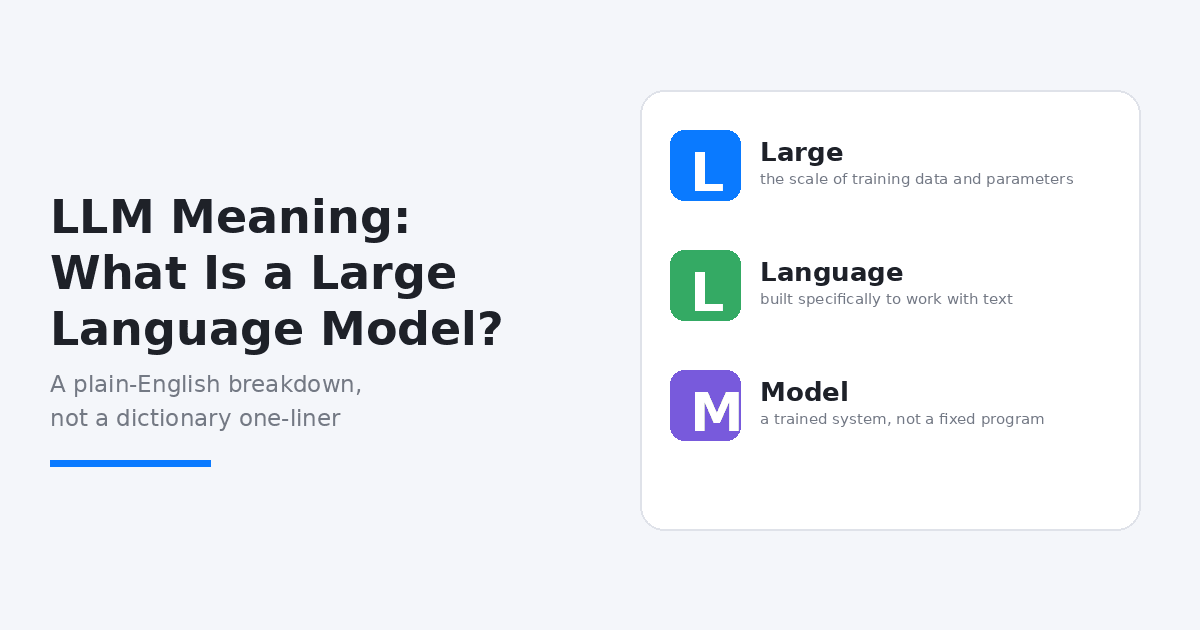
LLM stands for Large Language Model, a type of artificial intelligence trained on massive amounts of text (books, articles, code, conversations) to predict what word or piece of a word, should come next in a sequence. That prediction ability, repeated thousands of times per response, is what produces text that reads as a coherent answer rather than a random guess.
“Large” refers to two things at once: the size of the training dataset, often measured in trillions of words and the number of internal parameters (the adjustable values the model learns during training), which for current frontier models runs into the hundreds of billions. Neither number alone makes a model good but both tend to correlate with more capable, more general-purpose behavior.
The “model” part of the name matters too and gets skipped over more than it should. An LLM is not a lookup table or a fixed script, it is a trained statistical system, meaning its behavior comes entirely from patterns it inferred during training, not from any single rule a person wrote down for a specific situation.
The Other LLM Meaning (It Is Not About AI)
LLM also stands for Legum Magister, a Master of Laws degree, an advanced academic qualification law graduates pursue after their first law degree, usually to specialize in a specific area like tax, international or human rights law. It has existed as an abbreviation since long before AI language models did and it still ranks in search results for this exact phrase today.
If a law degree was what brought you here, this article will not help, your next search should include a word like “degree,” “law” or “university” to get pages focused on that meaning instead. Everything from here on covers the AI definition.
The overlap is a genuine accident of language rather than anything meaningful connecting the two, which is exactly why a search engine result page for this exact phrase will often mix both meanings together without flagging the distinction at all.
Where LLM Fits: AI, Machine Learning and Deep Learning
These terms get used almost interchangeably in casual conversation but they describe nested categories, not synonyms. Artificial intelligence is the broadest term, covering any system built to perform tasks that normally require human-like reasoning. Machine learning is a subset of AI, specifically systems that improve their behavior from data rather than being explicitly programmed with fixed rules for every situation.
Deep learning is a subset of machine learning that uses layered neural networks loosely inspired by how neurons connect in a brain and large language models are a specific application of deep learning, built and trained specifically to work with text. Every LLM is deep learning, every instance of deep learning is machine learning and every instance of machine learning is AI but the reverse is not true at each step.
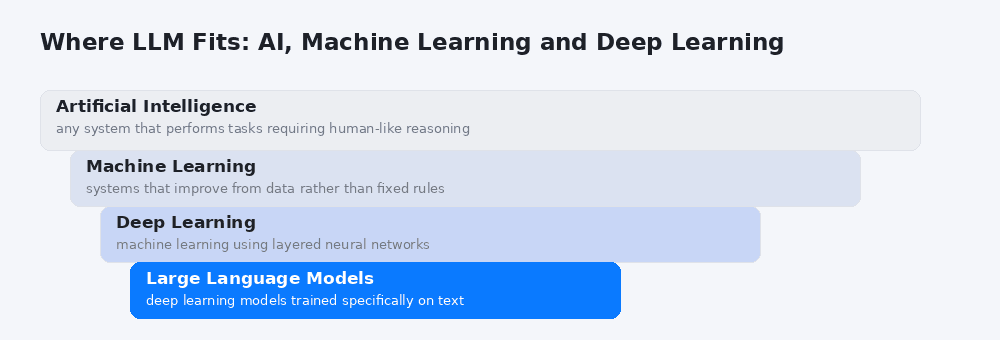
LLM meaning in context: a specific, text-focused application of deep learning, not a synonym for AI in general.
How a Large Language Model Actually Works
When you type a prompt, the model first breaks your text into tokens, small chunks that might be a whole word, part of a word or a single character, depending on how common that piece of text is. Those tokens get converted into numerical representations the model can actually process mathematically.
From there, the tokens pass through transformer layers, the architecture nearly every modern LLM is built on. Each layer uses a mechanism called attention to weigh how relevant every other token in the input is to the one currently being processed, which is how the model captures context, such as knowing that “it” in a sentence refers back to something mentioned two sentences earlier.
The model then predicts the single most likely next token, adds it to the sequence and repeats the entire process again for the token after that, one at a time, until the response is complete or a stopping condition is reached. Nothing about this process involves the model looking something up in a database at response time. It is pattern completion, shaped entirely by what it learned during training.
This token-by-token process is also exactly why a response streams in gradually rather than appearing instantly: each word you see has only just been generated, based on everything before it, with later words genuinely not decided yet at the moment earlier ones appear on screen.
Google’s own Machine Learning Crash Course introduction to large language models covers the transformer architecture in more technical depth, worth a look if you want to go further than this overview.
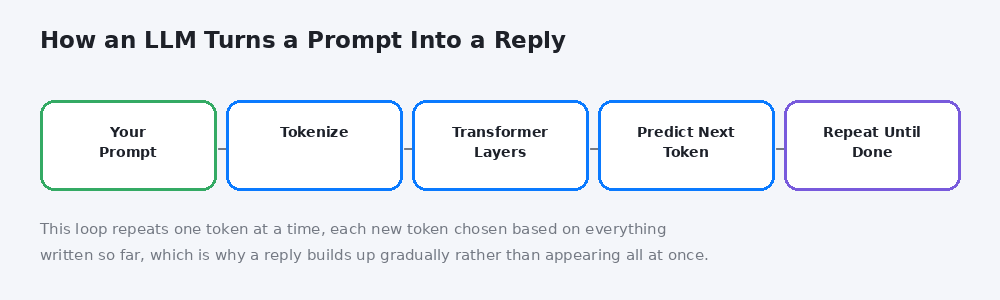
LLM meaning in practice: one token predicted at a time, built on everything written so far.
How LLMs Are Trained in the First Place
Training happens in stages. Pretraining comes first: the model reads enormous quantities of text and repeatedly practices predicting the next token, gradually adjusting its internal parameters billions of times until its predictions get statistically reliable across an enormous range of topics and writing styles.
After pretraining, most modern LLMs go through fine-tuning, additional training on a smaller, more curated dataset that shapes how the model responds, including a stage often called reinforcement learning from human feedback, where human reviewers rank different possible responses and the model is adjusted to produce more of what reviewers preferred. This second stage is a large part of why a raw pretrained model and a polished assistant built from it can behave quite differently even though the underlying architecture is identical.
None of this happens in real time while you are chatting with a model. Training is a separate, enormously expensive process that finishes before a model is ever released, which is also exactly why a model’s knowledge has a fixed cutoff date rather than continuously updating itself.
Real Examples of LLMs You Have Probably Used
Most mainstream AI chat tools are a large language model with a product interface wrapped around it. OpenAI’s GPT family (the model behind ChatGPT), Anthropic’s Claude models, Google’s Gemini family and Meta’s open-weight Llama models are all LLMs, despite differing significantly in training data, size, fine-tuning approach and the specific company’s priorities around safety and style.
Open-weight models, Llama and Mistral among the most widely used, can be downloaded and run on your own hardware or a private server rather than accessed only through a company’s hosted service, which matters for anyone with data-privacy or customization requirements a hosted chatbot cannot meet.
Smaller, specialized LLMs also run invisibly inside products that never advertise themselves as AI tools: spam filters, autocomplete suggestions, smart replies and content moderation systems increasingly rely on language models sized for one narrow job rather than a general-purpose chatbot built to handle anything.
What LLMs Are Actually Used For
Conversational chat assistants are the most visible use but the same underlying technology shows up in code completion tools, document summarization, translation, customer-support automation, search result generation and writing assistance embedded directly inside word processors and email clients.
Increasingly, LLMs also get paired with other systems rather than used standalone: retrieval-augmented generation pulls in current or private documents so the model can answer using information beyond its training data and tool-calling lets a model trigger actual actions, like searching the web or running code, rather than only generating text.
Businesses increasingly build entire workflows around this combination, chaining several LLM calls together with retrieval steps, tool calls and decision logic in between, rather than treating a single prompt-and-response exchange as the end of the interaction.
What LLMs Still Get Wrong
Hallucination, stating something false with the same confident tone as something true, remains the most consequential limitation, since the model has no built-in mechanism for distinguishing a well-supported answer from a plausible-sounding guess. It is predicting likely text, not verifying facts against a reference.
Every model also has a training cutoff, a point after which it has no knowledge of events, unless that gap is bridged with live search or retrieval tools layered on top. Reasoning that requires precise, multi-step logic (certain math and planning tasks especially) can also break down in ways that are not always obvious from how confident the response sounds.
Related Terms Worth Knowing
A few adjacent terms come up constantly once you understand what an LLM is: temperature controls how predictable versus varied a model’s word choices are, RAG (retrieval-augmented generation) feeds a model outside documents at answer time, fine-tuning further trains an existing model on a narrower dataset for a specific purpose and local LLM refers to running a model on your own hardware instead of a hosted service. Each of these is a deep enough topic for its own explainer, this is simply enough to recognize them in context.
A couple more worth a mention: context window describes how much text, measured in tokens, a model can keep in view at once when generating a response and inference is simply the term for the model actually producing output after training is finished, as opposed to the training process itself.
FAQs
What does LLM stand for?
In AI contexts, LLM stands for Large Language Model, a system trained on massive text datasets to predict and generate language. Outside AI, LLM can also stand for Legum Magister, a Master of Laws degree.
Is ChatGPT an LLM?
ChatGPT is a product built around an LLM, specifically OpenAI’s GPT model family. The LLM is the underlying technology; ChatGPT is the chat interface and product wrapped around it.
What is the difference between AI and an LLM?
AI is the broad category of systems that perform human-like reasoning tasks. An LLM is a specific type of AI, built through deep learning and trained specifically to work with text, so every LLM is AI but most AI is not an LLM.
How do LLMs learn language?
They are trained on enormous text datasets, adjusting billions of internal parameters to get better at predicting the next token in a sequence, repeated across trillions of examples until the predictions become reliably coherent.
Can an LLM access the internet?
Not by default. A base LLM only knows what it learned during training, up to its training cutoff. Internet access comes from separate tools, like search or browsing plugins, layered on top of the model.
Why do LLMs sometimes give wrong answers confidently?
An LLM generates the statistically likely next words based on patterns in its training data, it does not verify facts against a live source, so a false statement can come out sounding exactly as confident as a true one.
How long does it take to train an LLM?
Training a frontier-scale model typically takes weeks to months of continuous computation across large clusters of specialized hardware, followed by additional weeks of fine-tuning before release.
What is the difference between a large LLM and a small one?
Size usually refers to parameter count and training data volume. Larger models tend to handle a broader range of tasks more capably, while smaller models are cheaper to run and are often fine-tuned for one specific, narrower job instead.
Conclusion
LLM meaning, in full: a large language model, a deep-learning system trained on massive text data to predict language one token at a time, built on transformer architecture and distinct from the unrelated Master of Laws degree that shares the same three letters. Understanding the mechanism, not just the acronym, is what actually explains why these tools are remarkably capable in some situations and confidently wrong in others.
The next time a chatbot gives you an oddly specific wrong answer with total confidence or surprises you with something genuinely useful, both reactions trace back to the same underlying process covered here: next-token prediction, shaped by training data, with no built-in fact-checking step in between.
If you are exploring AI-adjacent tools, BratGen’s homepage has a free, browser-based generator worth trying while you are at it.