
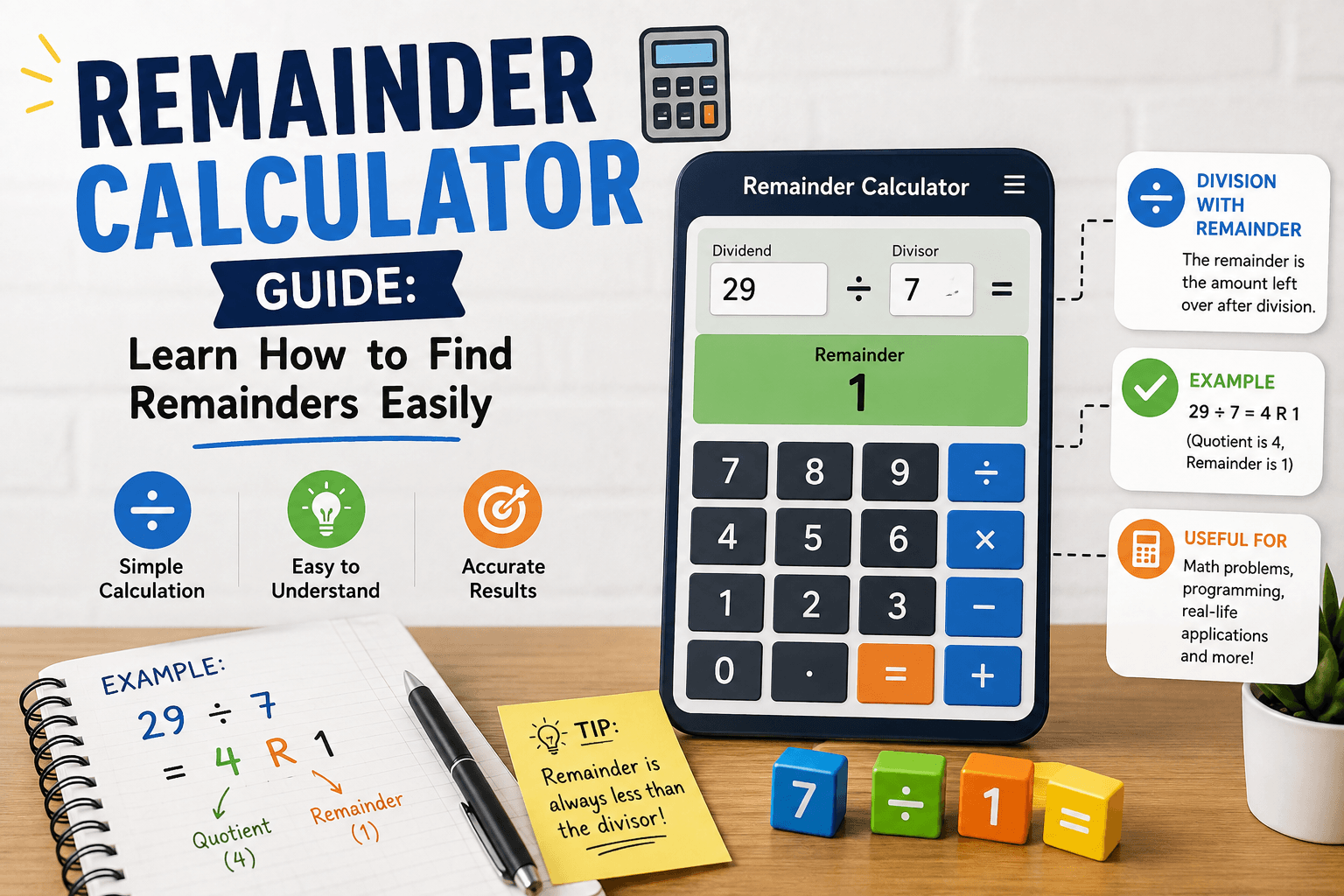
Remainder Calculator Guide: Learn How to Find Remainders Easily
Remainders are an important part of basic mathematics and appear in everything from everyday calculations to programming and advanced problem-solving. Although finding a remainder manually is usually straightforward, calculations involving larger numbers can take more time and increase the chance of making an arithmetic mistake.
A remainder calculator provides a quick way to determine the remainder when one number is divided by another. Understanding how the calculation works, however, is still useful because it helps you interpret the result and verify that the answer makes sense.
What Is a Remainder?
A remainder is the amount left over after one whole number is divided by another.
For example, when 17 is divided by 5, the number 5 fits into 17 three complete times:
5 × 3 = 15
There are 2 left over, so:
17 ÷ 5 = 3 remainder 2
The remainder is therefore 2.
Understanding the Division Formula
Remainders can be represented using the division relationship:
Dividend = Divisor × Quotient + Remainder
Using the previous example:
17 = 5 × 3 + 2
This formula provides a useful way to check your work. If multiplying the divisor by the quotient and adding the remainder produces the original dividend, the calculation is consistent.
How to Find a Remainder Manually
Finding a remainder involves a few simple steps.
First, divide the dividend by the divisor and identify the largest whole-number quotient that does not exceed the dividend.
Next, multiply the divisor by that quotient.
Finally, subtract the result from the original dividend.
For example:
29 ÷ 6
The largest whole-number multiple of 6 below 29 is 24.
29 − 24 = 5
Therefore, the remainder is 5.
Why Use a Remainder Calculator?
A remainder calculator can make repetitive calculations faster.
Instead of manually performing division and subtraction, you can enter the dividend and divisor and obtain the result immediately.
This can be useful when working with large numbers, checking homework, verifying calculations, or handling multiple division problems.
Checking a Calculator Result
Even when using a calculator, it is useful to understand how to verify the result.
Suppose a calculation produces:
43 ÷ 7 = 6 remainder 1
Check it using the formula:
7 × 6 + 1 = 43
Because the result matches the original dividend, the calculation is correct.
Remainders Must Be Smaller Than the Divisor
For standard whole-number division, the remainder must be smaller than the divisor.
For example, if the divisor is 8, a remainder of 9 would not be valid because another complete group of 8 could still be removed.
A valid remainder when dividing by 8 can range from:
0 through 7
This simple rule can help identify errors quickly.
What Happens When There Is No Remainder?
Sometimes a number divides evenly.
For example:
24 ÷ 6 = 4
There is nothing left over, so the remainder is 0.
A zero remainder indicates that the dividend is evenly divisible by the divisor.
Remainders and Even Numbers
Remainders can also help identify whether a number is even or odd.
When an integer is divided by 2:
A remainder of 0 means the number is even.
A remainder of 1 means the number is odd.
For example:
18 ÷ 2 = 9 remainder 0
while:
19 ÷ 2 = 9 remainder 1
This is one of the simplest practical applications of remainder calculations.
Remainders in Everyday Situations
Remainders are not limited to textbook mathematics.
Imagine that 23 items need to be divided equally among 4 people.
Each person can receive 5 items:
4 × 5 = 20
That leaves:
23 − 20 = 3
The remainder tells you that 3 items cannot be distributed equally if each person must receive the same whole number of items.
Remainders in Time Calculations
Remainders can also be useful for understanding repeating cycles.
For example, a week contains 7 days. If you want to determine how many complete weeks are contained in 30 days:
30 ÷ 7 = 4 remainder 2
That means 30 days contains 4 complete weeks plus 2 additional days.
This type of calculation is useful for working with calendars and recurring schedules.
Remainders in Programming
Remainder calculations are also important in computer programming.
Many programming languages use the modulo operator to find the remainder after division. It is commonly represented by the % symbol.
For example:
17 % 5 = 2
Programmers use this operation for tasks such as determining whether numbers are even or odd, creating repeating patterns, and controlling actions that occur at regular intervals.
Remainder vs. Decimal Division
A remainder and a decimal result represent division in different ways.
For example:
17 ÷ 5 = 3 remainder 2
The same division can also be expressed as:
17 ÷ 5 = 3.4
The remainder describes what is left after whole-number division, while the decimal result expresses the division as a continuous numerical value.
Which format is appropriate depends on the problem.
Working With Larger Numbers
The basic process remains the same even when the numbers become much larger.
For example, consider:
1,257 ÷ 24
You first determine the largest multiple of 24 that does not exceed 1,257, then subtract it from the dividend.
For calculations involving many large numbers, using a remainder calculator can save time and provide a quick way to verify manually calculated results.
Common Mistakes to Avoid
One common mistake is using the wrong divisor.
Another is selecting a quotient that is too large, which can produce a remainder greater than or equal to the divisor.
It is also easy to confuse the quotient with the remainder. The quotient represents the number of complete groups, while the remainder represents what is left.
Writing the division relationship can make these distinctions easier to remember.
Remainders With Zero
If the dividend is zero and the divisor is a nonzero number, the result is:
0 ÷ n = 0 remainder 0
However, division by zero is undefined. A calculator should not be used to treat zero as a valid divisor.
Why Learning the Concept Still Matters
Online calculators make arithmetic faster, but understanding remainders remains valuable.
Knowing what a remainder represents helps students solve problems independently and allows anyone to check whether a calculator’s result is reasonable.
It also provides a foundation for concepts such as divisibility, modular arithmetic, fractions, and programming logic.
Conclusion
Finding a remainder is a simple but useful mathematical skill. The basic process involves identifying the whole-number quotient, multiplying it by the divisor, and subtracting that result from the dividend.
A remainder calculator can simplify the process, particularly when working with large or repeated calculations. However, understanding the underlying formula makes it easier to interpret and verify the result.
Whether you are completing a math exercise, dividing items into equal groups, working with repeating cycles, or learning programming concepts, knowing how remainders work can make many calculations easier to understand.
————————
Meta Title
Remainder Calculator Guide: Learn How to Find Remainders Easily
Meta Description
Learn how to find remainders step by step, understand the division formula, avoid common mistakes, and use a remainder calculator for quick results.