
Car Tax Exemptions Most Drivers Don’t Know They Qualify For
Most drivers treat car tax as a fixed, unavoidable cost. They receive the notice, check the amount, and pay without question. What the majority never do is check whether they qualify for a reduction or a full exemption and that oversight costs them money every single year.
Car tax exemptions exist across Europe for a range of vehicle types, ownership situations, and personal circumstances. The criteria are clearly defined. The problem is that nobody tells you to look for them.
This article covers the exemptions that consistently go unclaimed, who qualifies for each one, and how to verify your situation before your next payment is due.
Why Exemptions Go Unclaimed
Tax authorities are not in the business of reminding you that you might owe less. The responsibility for identifying and claiming an exemption falls entirely on the vehicle owner.
Most drivers simply do not know where to look. Others assume the exemption applies only to edge cases that do not include them. In reality, the qualifying categories are broader than most people expect, and several of them apply to ordinary vehicle ownership situations that are far from unusual.
Disability and Medical Exemptions
This is the most widely applicable exemption and the one most consistently missed.
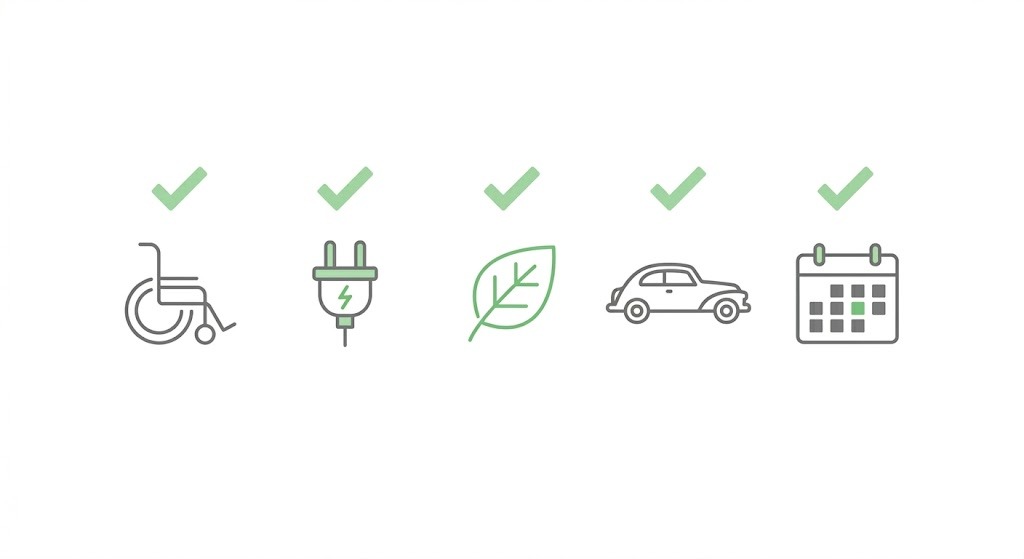
In Italy, vehicles registered to a person with a recognised disability under Law 104/1992 are fully exempt from bollo auto. The exemption also extends to vehicles owned by a family member when the disabled person depends on that family member financially and lives in the same household.
The vehicle does not need to be specially adapted. A standard car qualifies as long as the ownership and dependency conditions are met. The exemption applies once per household, covering one vehicle only.
Similar frameworks exist across most EU member states. The specific threshold of disability required varies by country, but the underlying principle that disabled persons and their direct caregivers should not bear a full vehicle tax burden is consistent across European legislation.
Many families who qualify never claim simply because they were not aware the household dependency clause extends the exemption beyond the disabled person themselves.
Electric and Zero-Emission Vehicles
Electric vehicles receive preferential tax treatment in virtually every European market, but the terms differ significantly between countries and registration years.
In Italy, newly registered fully electric vehicles are completely exempt from bollo auto for the first five years following registration. After that initial period, a permanent 75% reduction applies for the life of the vehicle. This means an EV owner never pays full car tax rate regardless of how long they keep the vehicle.
The exemption is tied to the vehicle registration, not the owner. Purchasing a second-hand electric vehicle that is still within its five-year exemption window means inheriting the remaining exemption period. Many buyers of used EVs are unaware of this and pay tax they are not required to pay.
LPG, Methane, and Alternative Fuel Vehicles
Vehicles running on liquefied petroleum gas or compressed natural gas occupy a middle category that many owners do not investigate.
At the national level in Italy, LPG and methane vehicles do not receive a blanket exemption. However, several regions have introduced their own reductions for alternative fuel vehicles as part of local emissions reduction policies. The availability and size of these reductions vary significantly by region, which is precisely why so many owners miss them; what applies in one province may not apply in the next.
Owners of LPG or CNG vehicles should verify the specific rules in their region of registration before assuming no reduction applies.
Historic and Vintage Vehicles
Vehicles that have reached a certain age are treated differently under most European tax frameworks, and the distinction between a significant reduction and a full exemption depends on the exact age threshold.
In Italy, vehicles over 30 years old that are classified as historic vehicles and registered with a recognised historic vehicle register are fully exempt from bollo auto. Vehicles between 20 and 30 years old receive a reduced rate rather than a full exemption.
The registration with an official historic vehicle body is a mandatory condition. A vehicle that meets the age requirement but has not been formally registered as historic does not automatically receive the exemption. This is a step many classic car owners skip, leaving the full exemption unclaimed despite technically qualifying.
Low-Income and Regional Exemptions
Several Italian regions operate their own supplementary exemption schemes that are not visible at the national level. These include income-based exemptions for low-income households, temporary exemptions introduced following natural disasters, and sector-specific exemptions for agricultural or commercial vehicles used in qualifying activities.
These regional schemes change periodically and are not widely publicised outside local government communications. Drivers who move between regions may find that an exemption they previously held no longer applies, or that a new one has become available, without ever being notified of the change.
How Exemption Amounts Are Calculated
Understanding whether you qualify is only the first step. The actual tax saving depends on your vehicle’s engine power, fuel type, and the regional rates that apply to your registration.
A full exemption on a high-powered vehicle can represent a saving of several hundred euros per year. Even a partial reduction such as the 75% reduction for electric vehicles after the initial five-year window produces a meaningful difference over the ownership lifetime of the vehicle.
Running the numbers before assuming you must pay the standard rate is worth doing. A dedicated car tax calculator at https://calcolobollo-auto.it/ lets you input your vehicle details and instantly see the applicable rate or exemption status based on current Italian rules, without needing to interpret the legislation yourself.
The Cost of Not Checking
The financial impact of unclaimed exemptions compounds over time. A driver who qualifies for a full exemption under the disability legislation and pays the standard rate instead is losing that amount every year the situation goes uncorrected.
In most cases, exemptions are not backdated. You cannot reclaim car tax paid in previous years simply because you later discover you qualified. The only amount you can recover is the current year, and only if you act before the payment deadline.
This makes checking your eligibility an urgent practical matter, not a theoretical one.
What to Do Before Your Next Payment
Before paying your next car tax bill, verify three things.
First, check whether your vehicle type qualifies for any reduction based on fuel type, emissions classification, or age. Second, check whether your personal circumstances, disability status, household dependency, or regional residence create an additional exemption layer. Third, use an online calculator to confirm the correct amount due so you are not relying on an estimate or a figure from a previous year.
Exemption rules are updated regularly. A vehicle or situation that did not qualify two years ago may qualify now. Before your next payment is due, using a calcolo bollo auto tool to verify the current rate for your specific vehicle and region checking once and assuming nothing has changed is not a reliable approach.
Final Assessment
Car tax is one of the few recurring costs where a straightforward eligibility check can legally reduce or eliminate the bill entirely. The exemptions are not obscure loopholes. They are formal provisions in tax legislation that the majority of qualifying drivers never use.
The categories covered here disability, electric vehicles, historic vehicles, alternative fuels, and regional schemes collectively apply to a significant portion of registered vehicles. Most owners in these categories continue to pay the standard rate not because they do not qualify, but because nobody prompted them to look.
Checking your eligibility takes minutes. The savings, if an exemption applies, recurs every year.