
How to Calculate Unit Vectors in 2D and 3D Mathematics
Unit vectors are an important concept in mathematics, physics, and engineering. They help describe the direction of a vector without considering its magnitude. Whether you are working with forces, velocity, displacement, or geometric calculations, understanding how to calculate unit vectors makes solving vector problems easier.
A unit vector always has a magnitude of 1. It represents the direction of an original vector while maintaining the same orientation. In this guide, we will explain how to calculate unit vectors in both 2D and 3D mathematics with simple formulas and examples.
1. What Is a Unit Vector?
A unit vector is a vector whose magnitude or length is exactly 1. It indicates the direction of a given vector without changing its orientation.
For example, if a vector has a magnitude of 5, its corresponding unit vector will have a magnitude of 1 while pointing in the same direction.
Unit vectors are commonly represented using a lowercase letter with a hat symbol, such as â or û. They are useful in physics, geometry, computer graphics, and engineering because they simplify calculations involving direction.
2. Understanding Unit Vectors in 2D Mathematics
In two-dimensional mathematics, vectors have two components: an x-coordinate and a y-coordinate. A vector is generally written as:
V = (x, y)
To calculate its magnitude, use the following formula:
|V| = √(x² + y²)
Once you calculate the magnitude, divide each component of the original vector by it.
The unit vector formula is:
û = (x/|V|, y/|V|)
For example, consider a vector V = (3, 4).
First, calculate its magnitude:
|V| = √(3² + 4²)
|V| = √(9 + 16)
|V| = √25 = 5
Now divide both components by 5:
û = (3/5, 4/5)
Therefore, the unit vector is (0.6, 0.8).
3. Understanding Unit Vectors in 3D Mathematics
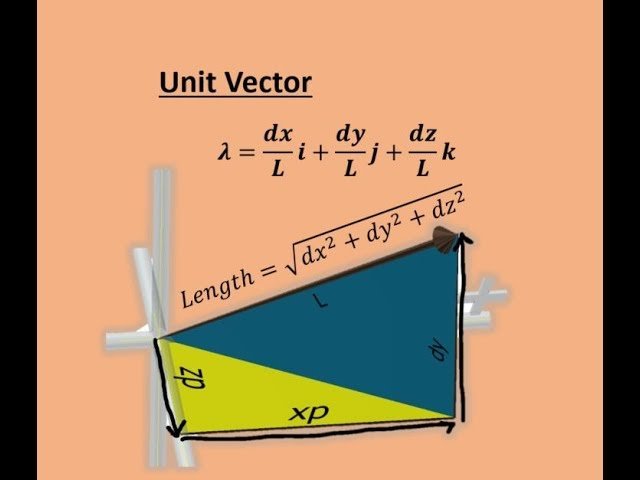
In three-dimensional mathematics, vectors have three components: x, y, and z. These components represent directions along three perpendicular axes.
A 3D vector is written as:
V = (x, y, z)
Its magnitude is calculated using the formula:
|V| = √(x² + y² + z²)
To find the unit vector, divide each component by the magnitude.
The formula is:
û = (x/|V|, y/|V|, z/|V|)
For example, consider a vector V = (2, 3, 6).
First, calculate its magnitude:
|V| = √(2² + 3² + 6²)
|V| = √(4 + 9 + 36)
|V| = √49 = 7
Now divide each component by 7:
û = (2/7, 3/7, 6/7)
Therefore, the unit vector is (2/7, 3/7, 6/7).
4. How to Calculate Unit Vectors Step by Step
Calculating a unit vector follows a simple process in both 2D and 3D mathematics. First, identify the components of the given vector. Next, calculate its magnitude using the appropriate formula.
After finding the magnitude, divide every component by that value. The resulting vector will have a magnitude of 1 and will point in the same direction as the original vector.
For quick and accurate calculations, you can also use a unit vector calculator to find normalized vector components without performing every calculation manually. This can be especially helpful when working with multiple vectors or more complex mathematical problems.
5. Difference Between 2D and 3D Unit Vectors
The main difference between 2D and 3D unit vectors is the number of components used in their calculations.
A 2D unit vector contains two components, x and y, while a 3D unit vector contains three components, x, y, and z. Their magnitude formulas are also slightly different because 3D vectors include an additional coordinate.
However, the basic calculation method remains the same. In both cases, you calculate the magnitude and divide each component by that magnitude to obtain a unit vector.
6. Common Applications of Unit Vectors
Unit vectors are widely used in different areas of mathematics, science, and technology. In physics, they help represent the direction of forces, acceleration, and velocity.
In engineering, unit vectors are useful for analyzing mechanical forces and structural movements. They are also important in computer graphics, where they help determine object directions, lighting, and surface orientations.
In mathematics, unit vectors simplify vector operations and make it easier to understand relationships between different directions.
7. Common Mistakes to Avoid When Calculating Unit Vectors
One common mistake is dividing only one component instead of dividing every component by the vector’s magnitude. This produces an incorrect result.
Another mistake is calculating the magnitude incorrectly, especially when working with negative components or three-dimensional vectors. Remember to square each component before adding the values.
It is also important to understand that a zero vector does not have a defined unit vector because its magnitude is zero. Division by zero is not possible, so a zero vector cannot be normalized.
Conclusion
Unit vectors are essential for understanding direction in 2D and 3D mathematics. They allow you to represent any nonzero vector with a magnitude of exactly 1 while preserving its original direction.
The calculation process is simple: find the vector’s magnitude and divide each component by that magnitude. Whether you are solving basic geometry problems or working on advanced physics and engineering calculations, understanding unit vectors can make vector operations much easier.