
How AI Is Changing the Way Businesses Create Digital Content
A single blog post used to take days to compose. Someone writes it, someone edits it, someone creates the visuals, and someone schedules it. You can see why marketing teams were consistently behind once that workload was multiplied across an entire content calendar.
Lately, that has changed. A lot of that work now happens inside one tool, sometimes in one sitting.
A team that used to plan a month of posts over a two-day offsite knocks it out in an afternoon. Support teams update help docs the same week a product changes.
Here’s how AI is beneficial, where it still requires supervision, and how to use it without sounding like everyone else.
How AI Is Changing the Digital Content Creation Process
It is not just that things move faster. Teams think differently about how personal a message can get, how many formats one idea fills, and what “done” means for a first draft.
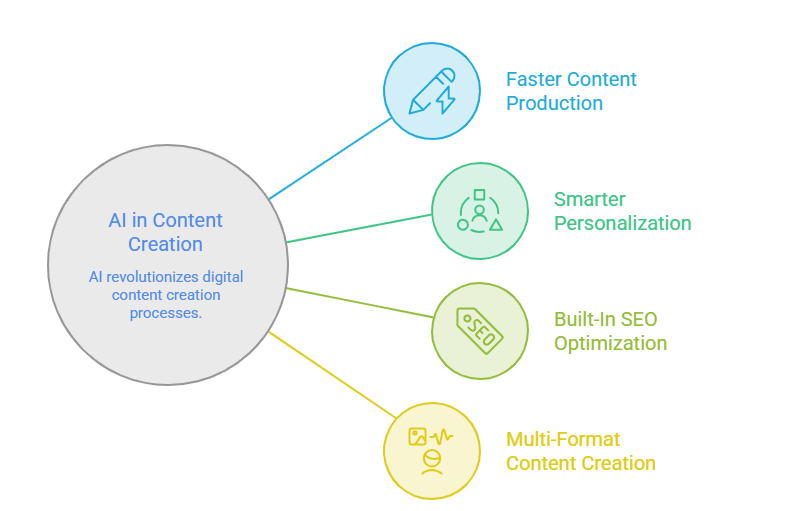
Faster Content Production
Research used to be its own project. Now, a marketer prompts a tool, gets a starting point with the facts pulled together, and shapes it instead of hunting.
A draft that took two days is ready before lunch. This is now the norm.
McKinsey’s State of AI survey found that 8 in 10 respondents said AI had improved their productivity, while revenue gains were most often linked to AI use in marketing and sales.
The knock-on effect matters more than the raw speed:
- Ideas stop being big bets, so you can test three angles and keep the best
- Teams that struggle to publish regularly can maintain a steady schedule without hiring new staff
- Editors spend their hours on judgment instead of first drafts
Smarter Personalization
Nobody wants the email everyone else got. AI pulls from customer data and writes different versions depending on who is reading. One campaign can carry a dozen variations:
- First-time buyers get onboarding-led messaging
- Renewing customers get value and usage recaps
- Dormant accounts get a different hook
Segments that are too small to justify custom copy now get it anyway.
Built-In SEO Optimization
Most writing tools flag SEO issues while you are still typing. A missing heading, a forced keyword, a thin meta description, all caught before publishing. That is one less specialist just to check boxes.
But be clear about the limit. These tools handle structure, internal linking prompts, and readability. They do not replace understanding what your reader wants solved.
Multi-Format Content Creation
Text used to be the whole job. Now, one blog post idea can become a short clip, a set of graphics, a voiceover script, or an infographic, with no separate production team behind it.
AI video generators have reshaped short-form content enough that a script reaches a finished clip without a camera touching it.
Audio shows the shift most clearly. It used to be necessary to schedule talent, pay for studio time, and wait for edits for each copy change in order to turn a screenplay into a workable voiceover. Many teams now use an AI voice generator to run a script, select a voice that fits their brand, and prepare a narrated explainer that same day.
The category has widened past narration. Tools like Murf now work as a full AI voice platform rather than single-purpose text-to-speech engines. It covers:
- Text-to-speech for narration, explainers, and product walkthroughs
- Conversational AI for interactive back-and-forth experiences
- Voice agents that handle live customer conversations
- Voice APIs that teams wire directly into their own product
For a content team that changes the calculation. The same platform producing a marketing voiceover on Monday can be answering support calls by Friday, so voice becomes a part of the stack instead of a production cost.
The AI Tools Businesses Use to Create Digital Content
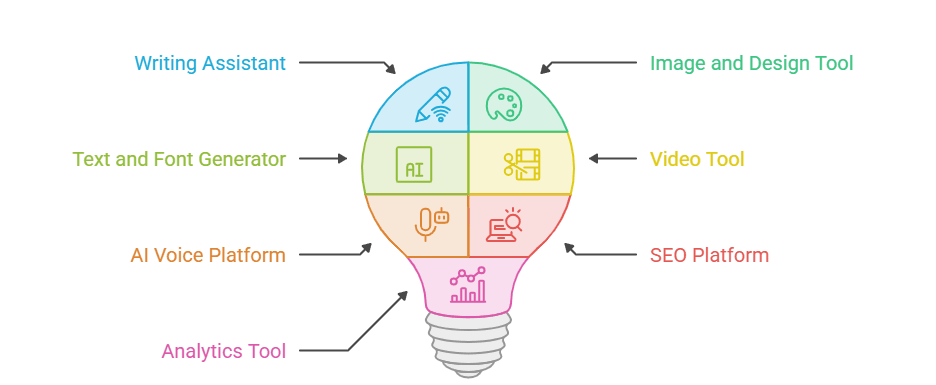
Hardly anybody runs on one tool. Most teams stack a handful:
- A writing assistant for blog posts, emails, and everyday copy
- An image and design tool for social posts, thumbnails, and ad creatives, where the hard part is less about creating one good image and more about making a whole set look like it belongs together
- Text and font generators for quick visual assets and social graphics that look native to the platform
- A video tool for short clips and explainers
- An AI voice platform covering text-to-speech, conversational AI, and voice agents
- An SEO platform for keywords, structure, and competing pages
- An analytics tool that flags which topics are worth writing next
Keep the stack small enough that people use it. Teams subscribing to 11 tools usually default to two.
Traditional vs. AI-Assisted Content Creation
| Factor | Traditional Process | AI-Assisted Process |
| Time to first draft | Slow, manual research and writing | Fast, guided drafting workflow |
| Cost per piece | High, writer and editor fees | Lower, subscription-based tools |
| Personalization | Limited and largely manual | Scalable and automated |
| SEO optimization | Requires a dedicated specialist | Built into most AI tools |
| Content formats | Produced one at a time | Multiple formats from one input |
| Voice and audio | Studio booking, talent fees | Generated and revised on demand |
How Businesses Can Create Digital Content With AI the Right Way
- Brief the tool properly with your audience, angle, and brand examples
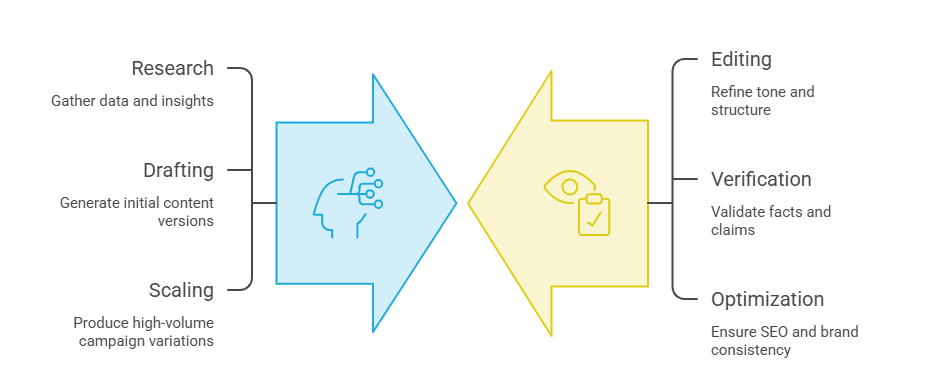
- Let AI handle research and the first pass, never the published version
- Cut the opening two paragraphs and rewrite them in your own voice
- Verify every fact, number, and claim before publishing, not after
- Run the SEO check last once the writing is finished
- Track what performs and adjust instead of guessing
AI got faster but it is not foolproof. Businesses that treat it as a finished product instead of a draft find out the hard way.
Where AI Content Still Falls Short
- Skip the editing pass and the writing flattens with the same sentence shapes repeating
- It states wrong things confidently, especially on narrow or recent topics
- Brand personality disappears fast if nobody checks tone before publishing
- Search engines increasingly spot content not reviewed by a human and rank it lower
- Cut review entirely and something eventually publishes that costs real trust
These are not reasons to avoid AI. They are reasons to keep a person in the loop.
According to Vineet Gupta, founder of 2xSaS, businesses get better results when they use AI to do the heavy lifting on research and early drafts, then have people take over from there. The problems usually start when teams treat the first AI output as the final version and skip the editing.
AI Content Use Cases Across Business Functions
| Business Function | How AI Is Used | Typical Output |
| Marketing | Blog posts, ad copy, social captions | Drafts, campaign variations |
| Sales | Personalized outreach messaging | Custom messaging per lead |
| Customer Support | Voice agents, chatbots, help articles | Support scripts, FAQ content |
| Product Teams | Release notes, documentation | Technical write-ups |
| HR | Job descriptions, internal comms | Policy summaries, announcements |
What’s Next for AI and Content Creation?
You can expect tools that detect brand voice more quickly, personalize content based on people’s current activities, and connect what gets written more closely with the data showing what works.
The more significant change is structural. As drafting becomes less expensive, important skills shift to editing, positioning, and determining whether ideas are worth publishing.
It was never about speed. Instead of publishing the initial draft, companies that are doing this successfully combine AI with editorial judgment. Start small, select a few tools, determine which are reviewed by a human, and observe how your readers react.
Ready to build your own stack? Start with the free text and design generators at Bratgen.io and see how much of your workflow you can cover before paying for anything.