B2B SaaS Explained: Meaning, Examples and How to Classify
Ask ten founders what B2B SaaS means and nine will say software sold to businesses. That is correct and it is also where most explanations stop, which is why the label gets slippery the moment a real product shows up. One widely read reference article lists Zoom and Dropbox among consumer SaaS examples although both also sell plans to teams and companies.
This guide gives the plain definition first. Then it covers the one thing the formal definition of SaaS leaves out, how B2B SaaS differs from the consumer version in practice, which products count as examples and a short test you can run on any product to classify it.
It also separates B2B SaaS from the broader term B2B software, since the two get used as if they were the same thing.
B2B SaaS in Plain English
SaaS stands for software as a service. The provider runs the application on its own servers and customers use it over the internet for a recurring fee instead of buying and installing a copy. The B2B part means business to business, so the customer is an organization rather than an individual.
Put together, B2B SaaS meaning comes down to this: a subscription software product that a company pays for so that its employees can use it. A sales team logging into a CRM is the standard picture. So is an accounting team using cloud bookkeeping or an engineering team tracking work in a shared issue tracker.
A B2B SaaS company is simply the business that builds and sells that kind of product. Its customers are other companies and its revenue is mostly recurring subscriptions. SaaS B2B is the same idea written the other way around and people use the two phrasings interchangeably.
What the Official Definition Leaves Out
The most cited technical definition comes from the US National Institute of Standards and Technology. In NIST SP 800-145, published in September 2011, the SaaS model is described as a capability for the consumer to use the provider’s applications running on a cloud infrastructure.
Notice what is missing. The document never uses the terms B2B or B2C. It describes a delivery model. Its consumer is simply whoever uses the service and it says nothing about what kind of customer to expect.
That has a practical consequence. B2B is not a technical property of the software. Nothing in the code makes a product B2B or B2C. It is a statement about the customer, the buying process and the pricing, which is why two products with almost identical technology can sit on opposite sides of the line.
It also explains why the label is easy to misapply. If the definition were technical you could inspect the product. Because it is commercial you have to look at how the product is sold.
How B2B and B2C SaaS Differ in Practice
Since the difference lives in the commercial side, the clearest way to see it is to compare the buying relationship. The table below shows the pattern that usually holds, though real products bend every row.
| Dimension | B2B SaaS | B2C SaaS |
| Who pays | An organization, usually from a team or department budget | An individual using a personal card |
| Who decides | A team lead, IT, finance or an executive, often more than one person | The person who will use it |
| Pricing unit | Seats, usage or plan tiers per account | A flat personal subscription |
| Buying process | Trial or demo, sometimes a security review and a signed contract | Self-serve signup, cancel any time |
| Support | Onboarding, admin controls and sometimes a named account manager | A help center and email |
| Main health metric | Revenue kept and grown across accounts | Individual subscribers kept month to month |
The Three-Question Test for Hybrids
A binary label breaks on products that start with individuals and end up inside companies. Video meetings, file sharing and design tools are the usual examples. A person signs up alone and then invites a team and eventually the company pays.
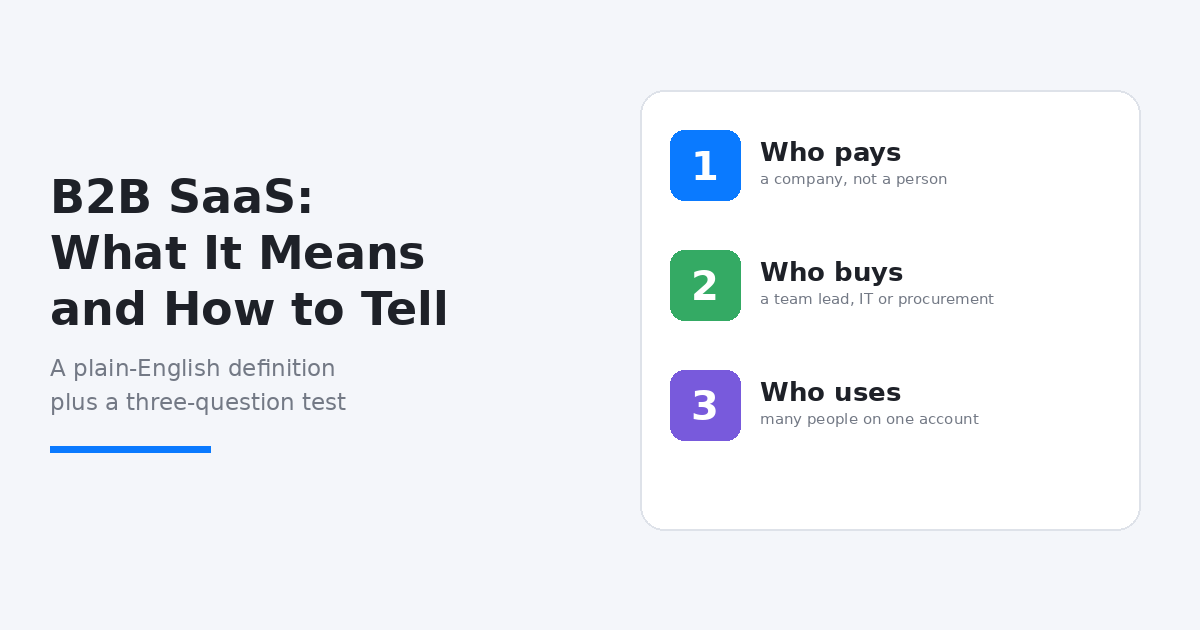
Instead of forcing a yes or no, ask three questions about the account that generates the revenue.
- Who pays? If an organization pays, even through an individual who expenses it, the revenue is B2B. If a person pays with money that is theirs, it is B2C.
- Who buys? Look at who approves the purchase. A team lead or IT approving a tool points to B2B. A person deciding alone points to B2C.
- Who uses? B2B accounts tend to have several users sharing data, permissions and an admin. A single private user points to B2C.
Two or three answers pointing the same way settles it. Mixed answers mean the product is a hybrid and the honest label is prosumer or B2B2C, depending on whether the product reaches end customers through a business.
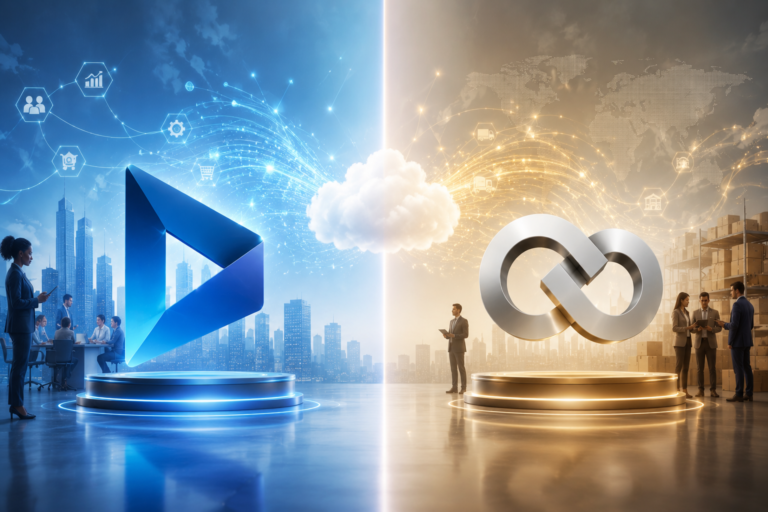
Zoom and Dropbox are good stress tests. Both appear in the consumer examples on Wikipedia’s overview of software as a service. Both also sell plans built for teams and companies, so a single label hides a split business. Classify the revenue line rather than the brand.
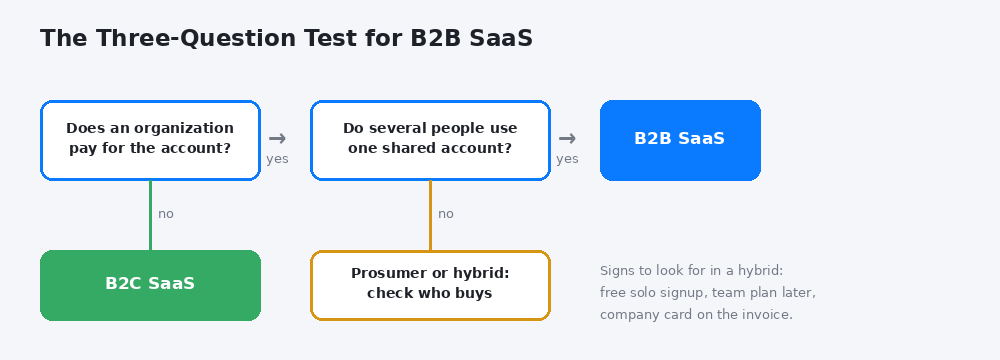
Two yes answers point to B2B. A no on the first question points to B2C and a no on the second flags a hybrid.
Examples of B2B SaaS Companies by Category
Examples are easier to hold onto when they are grouped by the job the software does for a company. The products below are widely used and sell mainly to organizations.
| Job for the company | Example products | What the account pays for |
| Customer relationship management | Salesforce, HubSpot | Seats for sales and service teams plus add-on modules |
| Enterprise resource planning | Oracle Cloud ERP, SAP | Finance, supply chain and operations in one system |
| Human resources and payroll | Workday | Records and payroll for every employee in the company |
| IT service management | ServiceNow | Ticketing and workflows for internal IT teams |
| Team communication | Slack | Shared workspaces with admin and compliance controls |
| Issue and project tracking | Jira | Shared boards and permissions per team |
Wikipedia’s overview of the model lists Salesforce CRM, SAP Cloud Platform and Oracle Cloud ERP as enterprise examples and Gmail as an early consumer service launched in 2004. If you are comparing real options in one of these categories, our guide to the best CRM software for small business shows how the same buying questions play out for a smaller team.
How a Company Ends Up Paying
There are two common routes from first contact to a paid account and the route shapes everything else about the business, from pricing pages to hiring.
In the sales-led route a buyer requests a demo and talks to a salesperson and often waits for a security review before signing a contract. The product is usually priced per account with negotiated terms. This route suits software that touches sensitive data or needs setup.
In the product-led route a person signs up free, uses the product alone and invites teammates. When a team hits a limit someone with a budget upgrades. Wikipedia notes that freemium is a popular model for internet startups and mobile apps and B2B products use the same idea to get inside companies without a sales call.
The product-led route depends heavily on how much friction a sign-up creates. We cover that trade-off in when a browser-based tool should ask users to sign in.
Many companies run both. A free tier feeds individual users and a sales team chases the accounts that grow past it. That blend is one more reason a strict B2B or B2C label rarely fits cleanly.
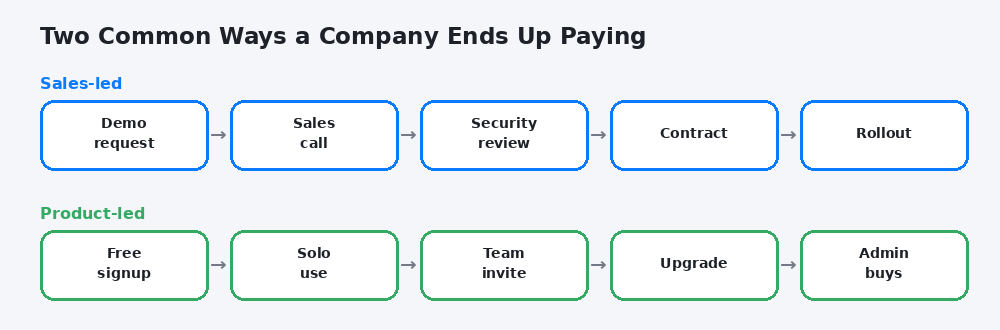
A sales-led deal moves through people while a product-led deal moves through the product.
The Numbers That Define the Model
Subscriptions change what a business measures. A one-time license sale is finished when the money arrives. A subscription is only valuable if the customer stays, so the key numbers track revenue over time.
Annual recurring revenue, usually shortened to ARR, is the yearly value of active subscriptions. Monthly recurring revenue is the same figure on a monthly basis. Both leave out one-time fees such as setup or training.
Churn comes in two forms. Logo churn counts the customers who left. Revenue churn counts the money that left with them. They can differ a lot because losing one large account hurts more than losing ten small ones.
Net revenue retention (NRR) is the figure that separates healthy B2B subscriptions from the rest. Take the recurring revenue from a group of customers at the start of a period. Add the expansion from those same customers, subtract their downgrades and cancellations and divide by the starting figure. Above 100 percent means the existing customer base is growing even before any new customer signs.
CAC payback measures how many months of a customer’s gross profit it takes to recover the cost of winning them. Long sales cycles make this number matter more for B2B than for consumer products.
B2B Software vs B2B SaaS
B2B software is the wider term. It means any software sold to businesses and that includes programs installed on the customer’s own servers under a license. B2B SaaS is the subset delivered as a hosted service on a subscription.
History explains the split. Wikipedia notes that the application service provider model emerged in the late 1990s, with providers hosting individual applications for each customer. Salesforce was founded in 1999 and Wikipedia cites it as an early cloud-era company. SaaS use began around 2000 and the article adds that most providers now use a multi-tenant design, where one version of the application serves every customer.
That design is what separates SaaS from the older hosted model. ASP providers typically hosted an individual application for each customer. A multi-tenant SaaS product serves every customer from one shared version, which is cheaper to maintain and lets everyone get updates at the same time.
So when someone asks what is B2B software the short answer is that SaaS is one way to deliver it. Most new products use that route but plenty of banks, hospitals and factories still run licensed software on their own hardware.
What Buyers Weigh Before Signing
A company that adopts a B2B SaaS product trades some control for convenience. The common concerns are worth knowing whether you are buying or building.
- Vendor lock-in: data and workflows built around one product are costly to move later.
- Data location and security: the provider holds company data, so buyers often ask for security documentation before approval.
- Cost growth: per-seat pricing grows with headcount and add-on modules raise the bill over time.
- Availability: when the provider has an outage every customer is affected at once.
- Shared infrastructure: multi-tenant design is efficient but some providers offer isolated resources for customers who want it, often at a higher price.
A Short Checklist Before You Use the Label
Before calling a product B2B SaaS in a pitch, a report or a blog post, run through these checks.
- Identify the paying customer on the invoice, not the logo on the website.
- Check whether accounts hold several users with shared data and an admin.
- Look at the pricing page for seats, usage tiers or contact-sales language.
- Note whether a free tier feeds a paid team plan, which signals a hybrid.
- State the revenue line you are labeling when a product has both a personal and a business plan.
FAQs
What is B2B SaaS?
It is subscription software that organizations pay for so their employees can use it. The provider hosts the application and customers access it over the internet instead of installing it.
What does B2B SaaS mean in simple words?
Business-to-business software as a service. The customer is a company, the product is hosted and the payment is a recurring subscription.
What is a B2B SaaS company?
A company whose main product is hosted subscription software sold to other companies. Its revenue is mostly recurring and its key metrics track retention across accounts.
What is the difference between B2B SaaS and B2C SaaS?
The customer. B2B products are bought by organizations for several users and usually involve admin controls and sometimes a sales process. B2C products are bought by individuals for personal use through self-serve signup.
Is Zoom B2B or B2C?
Both. It is listed among consumer examples in common references yet it also sells plans for teams and companies, so classify each revenue line separately.
Is B2B software the same as B2B SaaS?
No. B2B software covers anything sold to businesses including licensed programs installed on the customer’s servers. B2B SaaS is the hosted subscription subset.
Does the official SaaS definition include B2B?
No. NIST SP 800-145 describes a delivery model and never mentions B2B or B2C. The distinction comes from the customer and the pricing, not the technology.
Conclusion
The label B2B SaaS describes who pays and how they buy and says nothing about the code. Treat it as a claim you can test instead of a category you memorize.
Here is a quick exercise. Pick three subscription products you use and run the three questions on each. If any of them comes back mixed you have found a hybrid and that is where most of the interesting business decisions happen.
When you want to see a product that needs no account at all, try a free browser tool that skips the sign-up wall.