How to Write Your Name in Phonetic Spelling for Better Pronunciation
Names are an important part of personal identity, but pronunciation can sometimes be challenging when a name is unfamiliar to others. This can happen in classrooms, workplaces, meetings, presentations, travel situations, or online conversations.
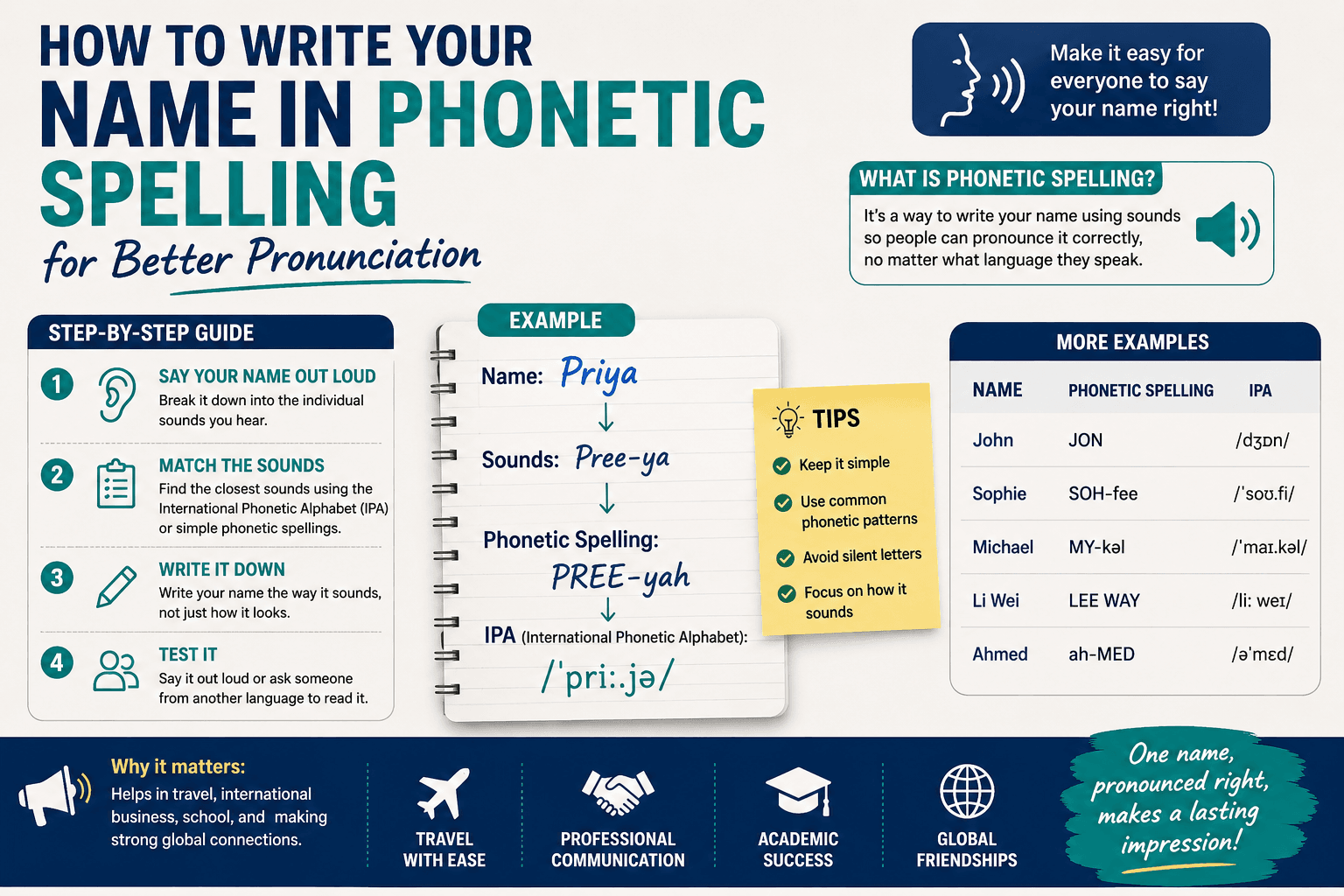
Writing the phonetic spelling of your name can make pronunciation easier by showing people how your name sounds rather than how it is traditionally spelled. With a few simple techniques, you can create a pronunciation guide that is clear and easy to understand.
What Is Phonetic Spelling?
Phonetic spelling represents a word according to how it sounds.
Instead of focusing on the traditional spelling of a name, phonetic spelling provides a written approximation that helps another person pronounce it correctly.
For example, a name such as “Sean” might be written as “Shawn” to help someone understand its pronunciation.
Phonetic spelling does not always follow a single universal system. Different people may write pronunciation guides differently depending on the audience.
Why Phonetic Name Spelling Is Useful
A pronunciation guide can prevent repeated mispronunciations and make introductions easier.
It can be particularly useful when your name has an uncommon spelling, comes from another language, or contains sounds that may be unfamiliar to people who speak a different language.
Providing pronunciation information can also help others feel more confident when addressing you.
Start by Saying Your Name Naturally
Before writing a phonetic version, say your name normally.
Do not deliberately slow down or exaggerate the pronunciation.
Pay attention to the individual sounds and syllables. Notice which part of the name receives the most emphasis and where the natural pauses occur.
This gives you a better foundation for creating an accurate pronunciation guide.
Break the Name Into Syllables
Breaking a name into syllables can make pronunciation much easier to explain.
For example, a three-syllable name can be represented with separate sound groups rather than one long sequence of letters.
Consider how the name sounds when spoken slowly, then identify its individual syllables.
This approach can be particularly useful for longer names.
Identify the Stressed Syllable
Some names contain one syllable that receives more emphasis than the others.
For example, when saying a name naturally, one part may sound slightly louder, longer, or more prominent.
A phonetic guide can emphasize that syllable using capitalization, spacing, or another simple notation.
Correct stress can make a significant difference in how natural the pronunciation sounds.
Use Familiar Words as Examples
One of the easiest ways to explain an unfamiliar sound is to compare it with a familiar word.
For example, you might write:
Name: Rhea
Pronunciation: RAY-uh
The familiar sound “ray” gives the reader an immediate reference.
This approach can be easier to understand than using complex phonetic symbols.
Avoid Making the Guide Too Complicated
A pronunciation guide should help the reader, not create another puzzle.
If the intended audience is unfamiliar with the International Phonetic Alphabet, highly technical symbols may be difficult to interpret.
For everyday situations, a simple phonetic approximation using familiar English sounds is often sufficient.
Use the International Phonetic Alphabet When Appropriate
The International Phonetic Alphabet, or IPA, provides a standardized system for representing speech sounds.
It can be useful in academic, linguistic, language-learning, and professional contexts where precise pronunciation information is important.
However, IPA symbols may not be familiar to everyone.
Choose the format based on who will be reading your pronunciation guide.
Consider the Original Language
Names from different languages can contain sounds that do not have direct equivalents in English.
When writing the phonetic spelling of your name for English speakers, you may need to approximate certain sounds.
In these cases, consider choosing the closest familiar sound while noting that the pronunciation is an approximation.
This can help people get closer to the intended pronunciation without requiring specialized linguistic knowledge.
Pay Attention to Vowel Sounds
Vowels can be one of the most difficult parts of pronunciation.
The same letter can represent different sounds in different words, and the same sound can be represented by different spellings.
When creating a phonetic version, focus on the sound rather than simply replacing each original letter.
Consider Consonant Combinations
Certain consonant combinations may also cause confusion.
A name might contain sounds that are uncommon in English or combinations that readers instinctively pronounce differently.
Writing the name according to its actual sound can help prevent these misunderstandings.
Read Your Phonetic Spelling Aloud
After creating a pronunciation guide, read it as if you had never seen the original name.
Does the phonetic spelling lead you toward the correct pronunciation?
If not, adjust it.
You can also ask a friend who does not already know your name to read the phonetic version. Their pronunciation can reveal whether the guide is clear.
Keep the Spelling Consistent
If you use a pronunciation guide in different settings, try to keep the format consistent.
For example, if you use capital letters to show stress, continue using the same approach in professional profiles, introductions, or written materials.
Consistency makes the pronunciation information easier to recognize.
Phonetic Spelling for Professional Settings
Pronunciation guides can be especially helpful in professional environments.
If your name is likely to be introduced during presentations, conferences, meetings, or public events, providing pronunciation information in advance can reduce uncertainty.
Some professional profiles and event systems also include dedicated pronunciation fields.
Phonetic Spelling in Education
Teachers and students may encounter names from many linguistic backgrounds.
A phonetic guide can help instructors, classmates, and administrators pronounce names more accurately.
It can also encourage a more inclusive environment by making pronunciation information readily available rather than expecting someone to repeatedly correct others.
Use Digital Pronunciation Tools
Online pronunciation resources can help you compare different ways of representing your name.
A phonetic spelling of your name can also be developed with pronunciation tools that convert written words into phonetic representations or audio.
Listening to the generated pronunciation can help identify differences between the intended pronunciation and the written guide.
Do Not Rely Entirely on Automated Tools
Automated pronunciation tools can be useful, but they may not always understand names correctly.
Names can have multiple pronunciations, unusual spellings, regional variations, or linguistic features that automated systems do not recognize.
Whenever possible, compare the generated result with the pronunciation you actually use.
Explain Alternative Pronunciations
Some names have more than one accepted pronunciation.
If you are comfortable with multiple versions, you can mention them.
For example, a pronunciation guide might say that either version is acceptable.
This gives other people flexibility while still providing useful guidance.
Make Your Guide Easy to Remember
A good pronunciation guide should be short enough to remember after someone reads it.
Avoid unnecessary detail unless precision is important.
For everyday introductions, a simple phonetic representation can often be more effective than a long explanation.
Be Patient With Difficult Sounds
Some people may need more than one attempt to pronounce an unfamiliar name.
A phonetic guide can make the process easier, but pronunciation is also a learning process.
If someone asks for clarification, repeating the name slowly or providing a familiar sound comparison can help.
Conclusion
Writing the phonetic spelling of your name is a simple way to help others pronounce it more accurately. By saying your name naturally, breaking it into syllables, identifying stressed sounds, and using familiar words as pronunciation references, you can create a guide that is easy to understand.
For more precise situations, the International Phonetic Alphabet and digital pronunciation tools can provide additional support. However, the best pronunciation guide is ultimately one that reflects how you actually say your name and is understandable to the people who need to use it.
——————————–
Meta Title
How to Write Your Name in Phonetic Spelling for Better Pronunciation
Meta Description
Learn how to write the phonetic spelling of your name using syllables, familiar sounds, stress, and pronunciation tools to make your name easier to say correctly.