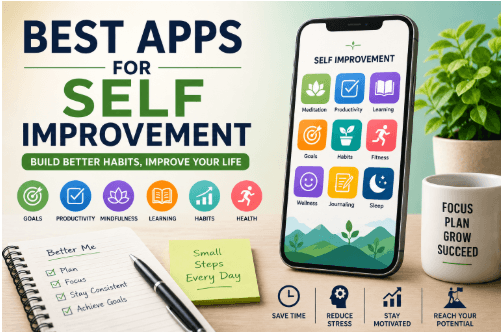
Best Apps For Self Improvement: Tools to Build Better Habits
The Best Apps For Self Improvement can make personal growth easier by helping you build habits, improve focus, learn new skills, manage stress, and stay consistent with your goals. The right app does not replace discipline, but it can provide reminders, progress tracking, structured lessons, and accountability that make positive changes easier to maintain. Whether you want to meditate regularly, learn a language, organize your goals, improve your fitness, or develop better daily routines, choosing an app that matches your specific goal can turn personal development into a more manageable part of everyday life.
Why Use Self-Improvement Apps?
Personal growth often sounds simple, but maintaining new habits can be difficult. You may decide to read every day, exercise regularly, meditate, or spend less time on your phone, only to lose motivation after a few days.
Self-improvement apps can provide the structure needed to stay on track. Many offer reminders, streaks, progress reports, guided activities, and personalized goals. Instead of trying to remember everything yourself, you can use technology to create a routine around the behavior you want to develop.
The Best Apps For Self Improvement are particularly useful when they remove unnecessary friction. An app should make a desired activity easier rather than becoming another complicated task on your to-do list.
How to Choose the Best Self-Improvement App
Not every personal development app will suit every person. Your choice should depend on what you want to improve and how you prefer to learn.
Identify Your Main Goal
Start by asking yourself what you want to change. Are you trying to build better habits, reduce stress, learn something new, become more organized, improve your health, or manage your time?
Once you know your primary goal, look for an app designed specifically for that purpose. A meditation app may be excellent for mindfulness but unnecessary if your main priority is task management.
Look at Ease of Use
An app with dozens of features may appear impressive, but complicated systems can become difficult to maintain. Choose something that allows you to complete your main activity quickly.
The current Expirel guide, for example, evaluates self improvement tools using factors such as day-one ease, behavioral stickiness, reminder quality, free-plan depth, week-four retention, and measurable impact.
Consider Free and Paid Features
Many personal development apps offer free versions alongside premium subscriptions. Before signing up, check which features are available without payment and whether the free version is sufficient for your needs.
A simple free habit tracker may be more useful to you than an expensive application filled with features you never use.
Best Apps For Self Improvement by Goal
Different apps can support different areas of personal growth. Rather than looking for one application that does everything, consider choosing a tool based on the habit or skill you want to develop.
Apps for Mindfulness and Stress Management
Meditation apps can help users create a regular mindfulness routine. Headspace and Calm are popular examples, while Insight Timer offers a large collection of guided meditation content. The Expirel comparison currently places Headspace among its leading options for mindfulness and stress, Calm for sleep and relaxation, and Insight Timer for free meditation content.
These tools can be useful for people who prefer guided sessions instead of designing their own meditation routine.
Apps for Habit Building
Habit tracking can make abstract goals easier to measure. Habitica, Loop Habit Tracker, Finch, and Fabulous take different approaches to building consistency.
Habitica uses game style rewards and challenges, while Loop Habit Tracker focuses on simple habit tracking and visual progress. Fabulous emphasizes routines and rituals rather than simply recording individual habits.
The best option depends on whether you respond better to gamification, simplicity, or structured routines.
Apps for Learning New Skills
Personal improvement also involves continuous learning. Language-learning and educational apps can help you make learning part of your daily schedule.
Duolingo uses short lessons, streaks, and rewards to encourage regular language practice. Headway focuses on nonfiction book summaries and personalized learning, while Anki uses spaced repetition to support memory and long-term retention.
Short daily sessions can make learning easier to fit into a busy routine than occasional long study periods.
Apps for Productivity and Goal Planning
Organization is another important part of personal development. Notion and TickTick can help users organize projects, tasks, goals, and routines.
Notion provides customizable workspaces for planning and tracking different areas of life. TickTick combines task management with habit tracking, allowing users to view responsibilities and routines together.
These tools can be especially useful if disorganization or poor time management prevents you from making progress.
Apps for Focus and Screen Management
Digital distractions can make it difficult to concentrate. Forest and Freedom are designed to help users spend less time on distracting apps and websites.
Forest encourages focused sessions through a virtual tree growing system, while Freedom blocks distracting websites and applications across supported devices.
These tools can be helpful when your biggest productivity problem is frequent phone checking or social media use.
How to Get Better Results From Self-Improvement Apps
Simply downloading an app will not automatically create meaningful change. The most important factor is how consistently you use it.
Choose one goal and start with a manageable daily action. For example, instead of deciding to meditate for 30 minutes every day, begin with five or ten minutes. Once the behavior becomes familiar, you can gradually increase the challenge.
You should also avoid installing too many applications at once. Having separate tools for meditation, habits, productivity, learning, journaling, fitness, and planning can create more complexity than progress.
Pick one or two tools that directly support your current priorities. The Best Apps For Self Improvement should simplify your routine rather than fill your phone with more notifications.
Track Progress Without Becoming Obsessed
Progress tracking can be motivating, but numbers should support your goals rather than control them. A missed day does not mean your entire routine has failed.
Look for broader patterns instead of focusing only on streaks. Ask whether you are reading more, exercising more consistently, learning new information, sleeping better, or spending less time on distractions.
A sustainable improvement is more valuable than a perfect streak that lasts only a few weeks.
Make Technology Work for Your Goals
The most effective personal development apps are tools, not solutions by themselves. They can remind you to act, organize information, provide learning material, or show your progress, but meaningful improvement still depends on your actions.
For that reason, choose applications that fit naturally into your existing routine. If an app requires too many steps to record a habit or complete an activity, you may eventually stop using it.
A useful self-improvement system should feel simple enough to continue on busy days.
Final Thoughts
The Best Apps For Self Improvement are the ones that match your goals, fit your routine, and encourage consistent action. Whether your priority is mindfulness, habit formation, learning, productivity, fitness, journaling, or focus, there are tools designed to support different aspects of personal growth. Start with one specific goal, choose an easy-to-use app, and give yourself enough time to build a routine. Technology can provide useful structure, but lasting self-improvement comes from consistently turning small actions into everyday habits.