From Images to Videos: The Rise of AI-Powered Creativity
Introduction: A New Creative Era
For most of human history, the ability to create compelling visual art, photography, or film required a rare combination of talent, expensive equipment, and years of dedicated practice. A painter spent decades mastering technique. A filmmaker needed a crew, equipment, and significant capital before a single frame could be captured. Visual creativity was, by necessity, the domain of specialists.
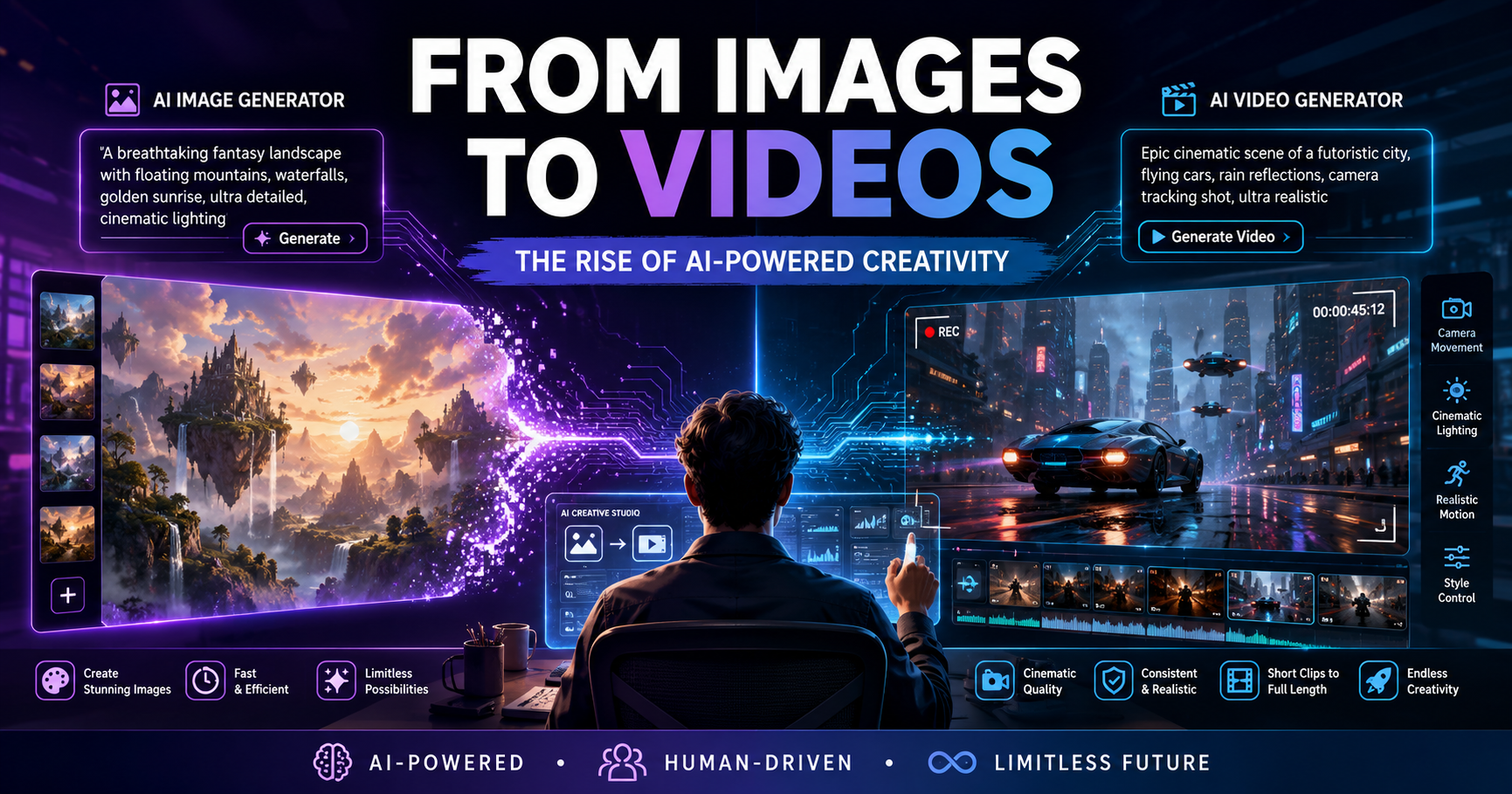
Artificial intelligence has shattered that barrier. Today, a first-time user with no artistic background can type a description into an AI image generator and receive a photorealistic portrait, a detailed architectural concept, or a vivid fantasy landscape — in seconds. Similarly, an AI video generator can produce short cinematic clips, complete with camera movement, lighting, and motion, from nothing more than a written prompt or a still reference image. Models such as Seedance 2.5 are helping make this type of prompt-driven video creation increasingly accessible to creators and production teams.
This is not incremental improvement. It is a paradigm shift — one that is reshaping advertising, entertainment, education, journalism, fashion, architecture, and nearly every other field that relies on visual communication. To understand where we are going, we must first understand how these technologies work and how rapidly they have evolved.
What Is an AI Image Generator?
An AI image generator is a software system powered by machine learning — specifically, deep neural networks — that can produce original images from a textual description, a reference image, or a combination of both. The most advanced systems use a technique called diffusion modelling, in which the network learns to gradually transform random noise into coherent, structured visuals through a process of iterative refinement.
How Diffusion Models Work
Training a modern AI image generator requires exposing the network to billions of image-text pairs sourced from the internet, books, and licensed databases. During training, images are progressively corrupted with noise, and the network learns to reverse that corruption — effectively learning to “dream” coherent images from structured statistical patterns. At inference time, the model interprets a user’s text prompt and synthesises a novel image that matches the semantic meaning and stylistic cues expressed in the description.
The sophistication of today’s systems is remarkable. A well-crafted prompt — such as “a hyperrealistic portrait of an elderly fisherman at dawn, dramatic side lighting, oil-on-canvas texture, chiaroscuro style” — produces an image that would be difficult to distinguish from a commissioned oil painting by a skilled human artist. This sensitivity to stylistic language, lighting, perspective, and mood represents a qualitative leap from earlier generative systems.
Commercial Applications of AI Image Generators
The commercial adoption of AI image generators has been extraordinarily rapid. Key applications include:
Marketing and Advertising: Brands generate campaign visuals, product mockups, social media assets, and banner advertising at a fraction of the time and cost of traditional photography or illustration. A campaign that once required a multi-day photoshoot can now be iterated in an afternoon.
E-Commerce Product Photography: Online retailers use AI image generators to create lifestyle product images, background variations, and model shots — enabling small businesses to produce professional-grade imagery without studio budgets.
Architecture and Interior Design: Architects and designers render photorealistic visualisations of buildings, interiors, and urban spaces from early-stage plans, accelerating client presentations and design reviews.
Publishing and Editorial: Magazine editors, book publishers, and content teams commission AI-generated illustrations for covers, features, and online articles, reducing dependency on freelance illustrators and stock libraries.
Gaming and Entertainment: Game studios use AI image generators for concept art, environment design, and character development, dramatically compressing pre-production timelines.
Fashion: Designers prototype garments, textile patterns, and runway looks digitally before committing to physical samples, reducing material waste and development costs.
What Is an AI Video Generator?
If the AI image generator democratised still imagery, the AI video generator is doing the same for motion — and with considerably higher stakes. Generating coherent video from text or image prompts requires solving a far more complex problem than image synthesis: the model must maintain consistency across hundreds or thousands of individual frames, simulate realistic physics, manage lighting continuity, and produce plausible camera motion — all simultaneously.
The Technical Challenge of Video Generation
Early AI video generators produced short, dreamlike clips of a few seconds — visually interesting but too unstable for professional use. Objects would morph unexpectedly, faces would distort, and motion would break the laws of physics in jarring ways. The fundamental challenge was temporal consistency: ensuring that a character, object, or environment remained recognisably the same across successive frames.
The latest generation of AI video generators has largely overcome these limitations. State-of-the-art systems can now produce multi-minute video sequences with consistent characters, photorealistic environments, coherent camera movement (zooms, pans, tracking shots), and accurate physics simulation. They support style control — from documentary realism to anime to cinematic film — and can animate still images, extend existing footage, or generate entirely original scenes from descriptive prompts.
Industry Impact of AI Video Generators
The AI video generator is sending seismic tremors through multiple industries simultaneously:
Advertising: Television and digital advertising campaigns that previously required location shoots, directors, crews, and post-production houses can now be produced — and rapidly iterated — using AI video generators. A brand can test ten creative directions in the time it once took to produce one.
Independent Film: Independent filmmakers can render action sequences, visual effects, and scene extensions that were previously affordable only by major studios. The cost barrier to high-production-value storytelling has collapsed dramatically.
Social Media Content: Influencers, news organisations, and content creators use AI video generators to produce short-form content at unprecedented velocity, keeping pace with the demand of algorithm-driven platforms.A Seedance 2.5 video tool can help turn prompts or existing images into short-form video, with the output then refined for platforms such as Reels, TikTok, or YouTube Shorts.
Education and Training: Corporate trainers and educational institutions use AI video generators to create instructional videos, simulations, and scenario-based learning content without production studios or actors.
News Media: Broadcasters and digital publishers use AI video to illustrate breaking news stories, visualise data, and produce explainer content in near-real-time.
The Human-AI Creative Partnership
A persistent misconception frames AI creative tools as a replacement for human creativity. The reality, as experienced by practitioners across industries, is far more nuanced. Both the AI image generator and the AI video generator function most powerfully not as autonomous creative agents but as extraordinarily capable collaborators that amplify, accelerate, and extend human creative vision.
The quality of output from any generative AI system is directly proportional to the quality of direction provided by the human operator. A vague prompt produces mediocre results. A richly specified, creatively considered prompt — one that conveys mood, style, subject, composition, lighting, and context — produces work of genuine artistic merit. This has elevated the importance of a new professional skill: prompt engineering, or the art of communicating effectively with AI systems to achieve desired creative outcomes.
Experienced creative professionals — directors, designers, photographers, and art directors — find that their domain expertise translates directly into more effective AI prompting. Knowledge of cinematography, colour theory, composition, and narrative translates into outputs that general users cannot achieve. Far from making creative expertise obsolete, AI image generators and AI video generators have made it more valuable.
Ethical Considerations and Challenges
The rapid advancement of AI image generators and AI video generators has outpaced the development of ethical frameworks, legal structures, and regulatory oversight. Several critical issues demand attention from technologists, policymakers, and civil society.
Intellectual Property and Training Data
Both AI image generators and AI video generators are trained on datasets that include enormous quantities of copyrighted material — photographs, artworks, films, and illustrations — created by human artists. Whether this constitutes lawful use under fair use or fair dealing doctrines remains legally contested in multiple jurisdictions. Many artists have expressed serious concerns about AI systems learning their distinctive styles without consent or compensation, then producing outputs in their style that compete directly with their commercial work.
Synthetic Media and Disinformation
As AI video generators produce increasingly convincing synthetic footage, the potential for misuse grows proportionally. Deepfake technology — once requiring specialist technical knowledge — is now accessible to anyone with a browser. The implications for political disinformation, personal harassment, and the erosion of trust in documentary evidence are profound. Detection tools are improving, but the generation-detection arms race is intensifying, and regulators face the difficult challenge of legislating against harms without stifling legitimate innovation.
Labour Displacement
The economic disruption posed by AI image generators and AI video generators to creative workers is real and documented. Stock photography platforms have reported significant revenue declines as clients substitute AI-generated visuals. Junior illustrators, motion graphics artists, and video editors face a market in which AI can replicate their output at negligible marginal cost. Labour markets will require significant adaptation — in skills, in compensation models, and in the social safety nets that protect workers in transition.
The Road Ahead
The trajectory of both AI image generators and AI video generators points unambiguously toward greater capability, lower cost, and wider accessibility. Several developments are likely to define the next phase:
Real-time generation: Current AI image generators already produce results in seconds. Emerging architectures promise real-time interactive image synthesis — a design canvas that responds instantaneously to the artist’s input.
Full-length AI video: The generation of feature-length video from text prompts remains a horizon, but one that is approaching. The capability to produce consistent characters, coherent narrative, and sustained visual style across 90 minutes of footage would constitute one of the most transformative technological events in the history of cinema.
Personalisation at scale: Brands and media companies will use AI image generators and AI video generators to deliver hyper-personalised creative content — advertisements tailored to individual viewers, educational materials adapted to each student’s learning profile, and entertainment experiences that respond to viewer preferences in real time.
Regulatory maturation: Governments in the European Union, United States, United Kingdom, and elsewhere are developing frameworks for AI-generated content labelling, training data rights, and synthetic media disclosure. These frameworks will shape the competitive landscape for AI creative tools significantly over the next five years.
Conclusion
The AI image generator and the AI video generator are not novelties or transient trends. They represent a fundamental restructuring of how visual content is conceived, produced, and distributed — a restructuring that is already well underway and will accelerate further in the years ahead.
For creative professionals, the imperative is adaptation: to understand these tools deeply, to use them as amplifiers of human vision rather than substitutes for it, and to develop the conceptual and directorial skills that no machine can replicate. For businesses, the opportunity lies in using AI-generated content to compete at a scale and speed previously available only to the best-resourced organisations.
For society, the challenge is to build the ethical frameworks, legal protections, and educational resources that ensure the benefits of this revolution are broadly shared — and that its risks are responsibly managed. The tools exist. How humanity chooses to wield them will define the visual culture of the coming generation.