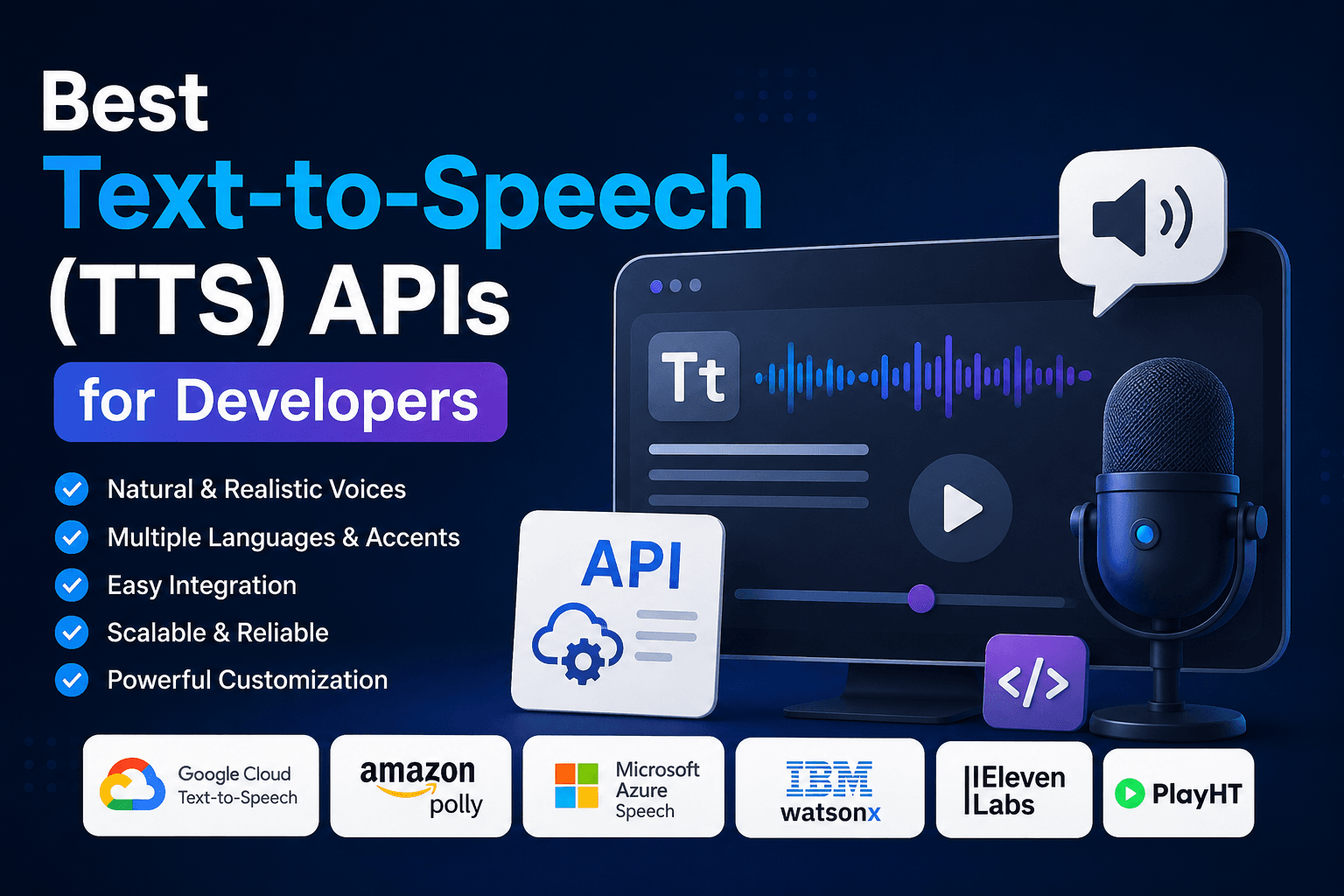
Best Text-to-Speech (TTS) APIs for Developers
Voice is quickly becoming a core part of how people interact with software. From customer support bots to audiobooks and voice assistants, businesses are turning to AI-generated speech. Thanks to major advances in speech technology, AI voices now sound natural, expressive, and often hard to distinguish from real people.
This guide covers what matters when evaluating a text-to-speech API, then explores some of the strongest options available today to help you find the right fit for your project.
How Do You Evaluate TTS APIs
The right text-to-speech API affects how natural your product sounds, how fast it responds, and how much it costs to scale. So, there are several general criteria businesses can keep in mind to ensure a smooth user experience and not a slow or robotic one.
- Voice quality
- Latency
- Language and voice coverage
- Customization
- Pricing model
- Integration and reliability
- Compliance
Now let’s turn to some of the leading TTS APIs that cover all these criteria.
Top 3 TTS APIs for Developers Reviewed
| TTS API | Features | Strengths | Choose for |
| Telnyx | 1300+ voices with model switchingStreaming and in-call playbackOpenAI SDK compatibilityCustom voice creation and dubbingPronunciation controlEmotion and expression control | Wide voice selectionProvider flexibilityReal-time streamingGlobal low latency | Low latency and easy provider switching. |
| Fish Audio | Natural and expressive voicesEmotional controlMultilingual supportReal-time generationInstant voice cloningDeveloper API | Large voice libraryFast voice cloningEasy SDK integration | Fast and expressive TTS API capabilities. |
| ElevenLabs | Multiple voice modelsEmotion and delivery controlVoice design and cloningMulti-speaker dialogueOfficial SDKs | Low latencyExtensive voice libraryLarge language support | Model flexibility and language coverage. |
Telnyx
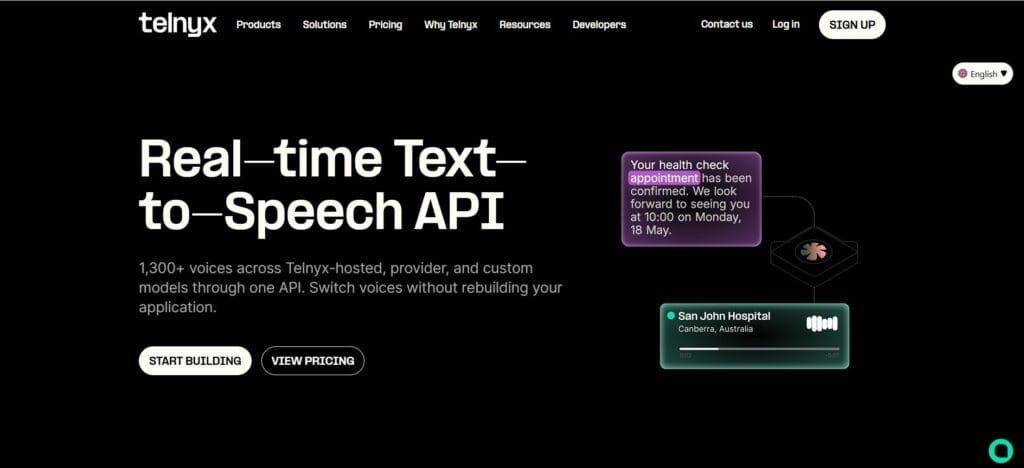
Telnyx offers a TTS API that gives access to over 1300 voices, including its own hosted voices, third-party provider models, and custom voices as well, all through one API. Instead of building around one vendor, developers can switch voices or models just by changing configuration. This way, speech can be generated through REST calls, streamed in real time over WebSocket, or played directly inside live calls using Telnyx’s Voice API and TeXML.
The platform also supports compliance needs, with data residency options in the US, EU, AUS, and UAE, plus ISO, PCI, HIPAA, GDPR, and SOC2 Type II standards.
What it offers:
- 1300+ voices with model switching: Access Telnyx, provider, and custom voice models, switching between them through configuration, with no code rebuilds needed.
- Streaming and in-call playback: Get audio in chunks for live responses, or play speech directly within Voice API and TeXML calls.
- OpenAI SDK compatibility: Use REST TTS with OpenAI-style client patterns for faster integration.
- Custom voice creation and dubbing: Build synthetic voices, clone from sample audio, or support dubbing needs.
- Pronunciation control: Use dictionaries and voice settings to fix how names or domain terms sound.
- Emotion and expression control: Use emotion markers to shape tone and delivery on supported providers (for example, Fish Audio or Telnyx Ultra).
Strengths:
- Wide voice selection
- Provider flexibility
- Real-time streaming
- Global low latency
Best for: Developers looking for a unified API to reach many TTS engines and voices with no need to balance between separate vendor contracts. Also teams building voice AI agents, IVRs, or live call applications that need low latency speech and easy provider switching.
Fish Audio
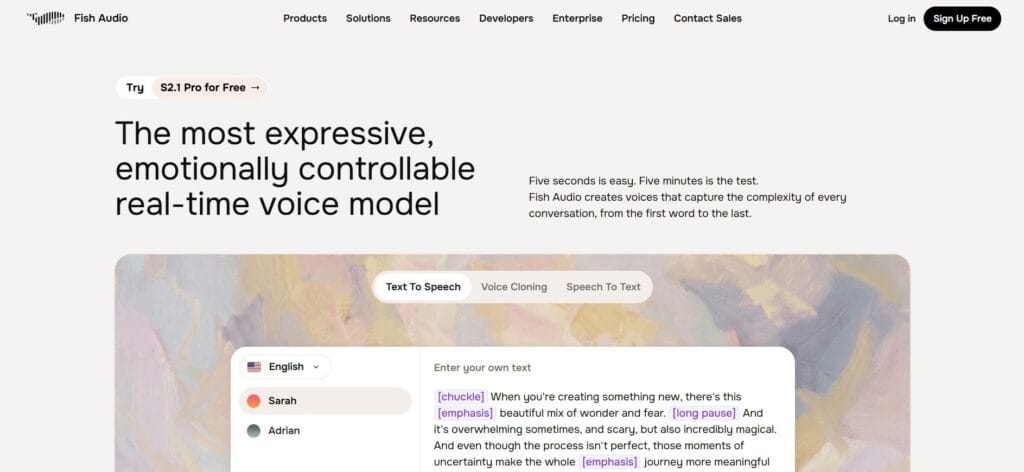
Fish Audio is a voice AI platform offering text-to-speech through a developer API as well as a consumer web app. On the API side, it gives access to REST endpoints, WebSocket streaming, and official Python and TypeScript SDKs. The consumer-facing tool lets anyone type text, pick a voice, and generate speech directly in the browser, backed by the same underlying model, Fish Audio S2.
What it offers:
- Natural and expressive voices: Realistic speech output powered by the Fish Audio S2 model.
- Emotional control: Add emotion and expression tags like whispering, sighing, or laughing.
- Multilingual support: Works automatically across 8 languages with native accents.
- Real-time generation: Creates speech within seconds, with latency under 300ms.
- Instant voice cloning: Clone a voice from as little as 10 to 30 seconds of reference audio.
- Developer API: Official Python and TypeScript SDKs, plus a documented REST API and OpenAPI schema.
Strengths:
- Large voice library
- Fast voice cloning
- Easy SDK integration
Best for: Developers building voice agents or dubbing tools and needing a fast and expressive TTS API.
ElevenLabs
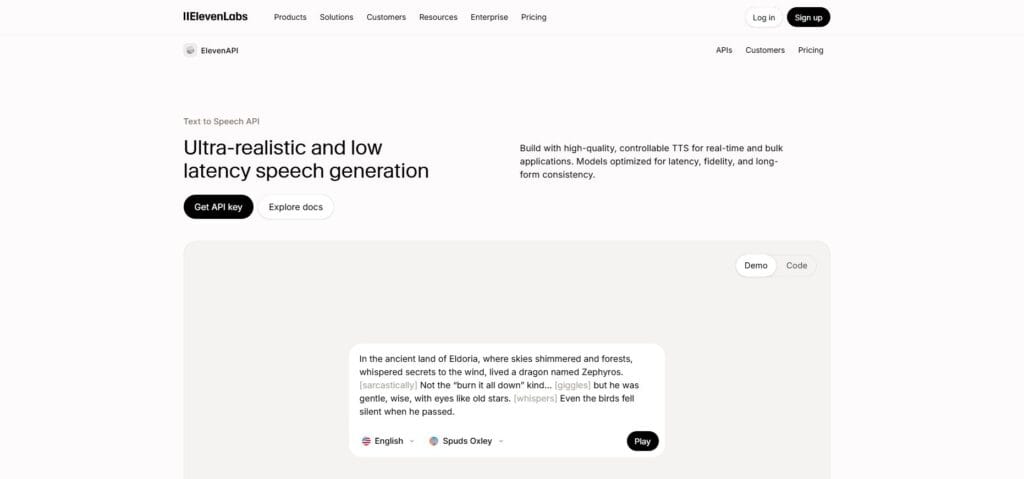
ElevenLabs offers a text-to-speech API built for low latency voice generation that developers can add to their apps with minimal setup. It runs on several different voice models, each for a specific job, from ultra-fast real-time agents to rich, long-form narration. Teams can pick the right balance of speed, cost, and expressiveness.
It supports over 11,000 voices, custom voice cloning, as well as multi-speaker dialogue across over 70 languages. On the compliance side, it offers encryption in transit and at rest, with SOC 2, HIPAA, and GDPR support.
What it offers:
- Multiple voice models: Choose between models like Eleven v3, v3 Conversational, Flash v2.5, and more, each suited to different latency or language needs.
- Emotion and delivery control: Use inline tags for emotion, audio cues, and immersive sound.
- Voice design and cloning: Build natural-sounding voices and accents in over 30 languages.
- Multi-speaker dialogue: Generate natural conversations with multiple speakers across 70+ languages.
- Official SDKs: Python and TypeScript SDKs with type safety and streaming support.
Strengths:
- Low latency
- Extensive voice library
- Large language support
Best for: Developers and businesses looking for a TTS API with strong compliance credentials, flexible model options, and wide language coverage.
Which TTS API Should You Choose?
There is no single TTS API that works best for everyone. The right choice depends entirely on your needs and how each platform performs in your personal testing.
Here, Telnyx is a strong starting point for many developers. It offers over 1,300 voices from multiple providers via a single API, letting you compare voices and switch models without rebuilding your integration.
But don’t limit yourself to one option. Testing a few is the best way to choose and commit to the final tool. Compare voice quality, real-world latency, and other components at your expected scale to find the provider that fits your project.