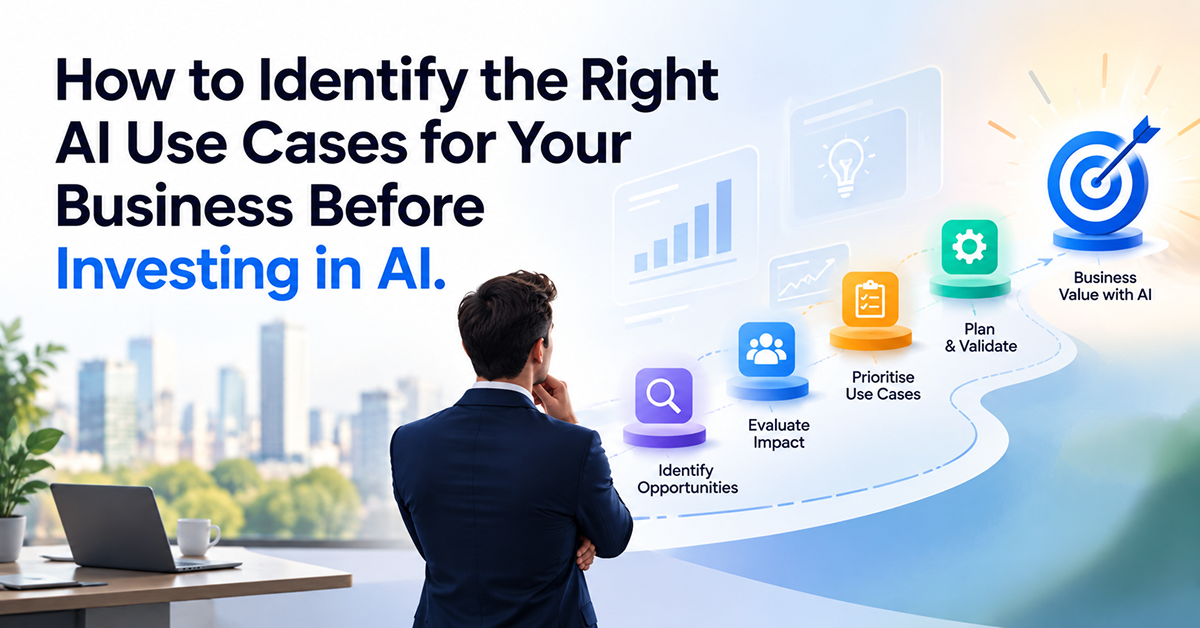
How to Identify the Right AI Use Cases for Your Business Before Investing in AI
In August 2025, Commonwealth Bank of Australia reversed a decision it had announced weeks earlier. It had planned to cut 45 customer service roles after adding an AI voice bot. Then call volumes rose. Managers offered overtime and asked team leaders to answer phones.
The bank later said its first assessment hadn’t weighed every business consideration. That’s a use case problem, and it’s a common one. Good AI business consulting tests the numbers behind an idea before any role or budget changes.
This guide covers how to pick AI use cases before a budget gets approved. Each section ends with something a team can try within a week. It draws on recent cases from Commonwealth Bank, Klarna, Ford, and IBM. It also sets out five questions for testing ideas and a short readiness check.
A set of ideas on AI is easy to make. But ranking them is tough because all ideas come with a sponsor. A good Artificial Intelligence strategy begins with identifying whose idea it is and what they overlooked. Then it tests all survivors using actual cost, actual users, and actual data.
Why Good Technology Still Lands on the Wrong Problem
Three recent stories look different on the surface. They share one step, which is how the use case got chosen.
- Commonwealth Bank Counted Roles Before Counting Calls
The bank’s voice bot was meant to handle customer calls. The Finance Sector Union said call volumes kept climbing instead. Management responded with overtime and asked team leaders to take calls.
Within weeks, the bank called the roles necessary after all and apologised. It also said it would review how it makes such assessments. Staff could stay, move to other jobs in the bank, or take redundancy. What would a month of call data have shown before the announcement?
- Klarna Measured Cost and Missed Quality
Klarna went further than most firms with AI customer service. In 2025, its CEO, Sebastian Siemiatkowski, told Bloomberg that cost had been too dominant a factor in the plan. The result, he said, was lower quality. The company started hiring human agents again, on a flexible remote model.
Reports at the time said the tool handled many chats well. The mistake was the scope. Simple questions suit automation, while upset customers need people. A refund status check and a billing dispute look similar in a ticket queue. They aren’t the same job. A first review that split calls by type could have drawn that line early. That’s the kind of question AI strategy consulting teams raise in week one.
- What the Cases Share
Ford adds a 2026 example from manufacturing. In June, Bloomberg reported that the company had hired, rehired, or promoted about 350 experienced engineers over three years. Its COO said Ford had leaned more and more on automated quality systems. Its hardware VP said AI is only as good as the information used to train it.
Gartner expects the pattern to spread. Forbes reports that Gartner expects half of the firms that cut service staff for AI to rehire by 2027. Many will use new job titles. None of these stories blames model quality. Each one blames the choice of where to apply it. Vendors selling AI business solutions naturally talk about the technology. The problem side needs an owner inside the company.
Casting a Wide Net Without Collecting Noise
The fix starts before any scoring. A company needs a fair list of candidates first. That list should come from daily work, and not from a vendor catalogue. An AI opportunity assessment is that first pass.
Collect Problems From the People Doing the Work
Frontline staff know where the hours go, and they see the odd cases a dashboard hides. They’ll name specific frustrations when asked directly. Interviews beat surveys here, since people explain the workarounds they’ve built when someone’s listening. A few questions open most conversations.
- Which task do you repeat most often each week?
- Where do you copy data from one system into another?
- What do you check twice because a mistake hurts?
- Which questions do customers ask that you can’t answer yet?
Commonwealth Bank’s trouble began with a plan built far from the phones. Would a single meeting with the call centre staff have exposed the problem?
Three Places Ideas Come From
Ideas come from more than one direction. The table shows what each source brings and where it can mislead.
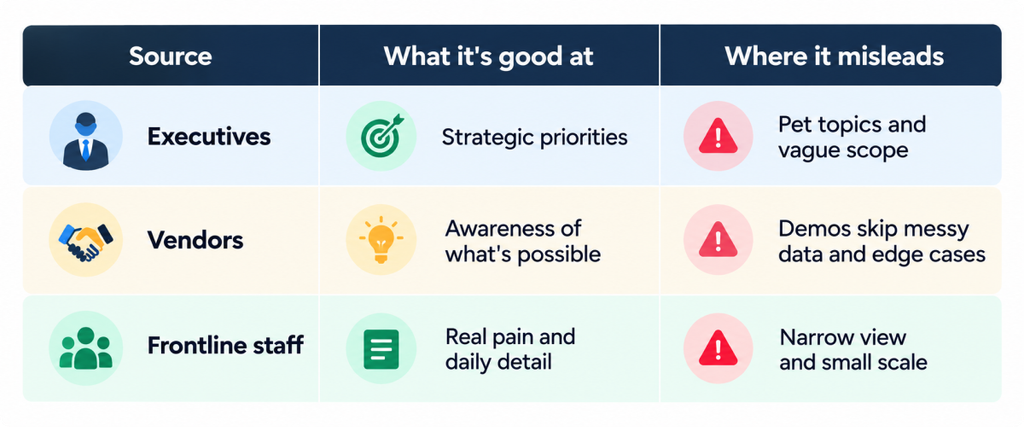
Mixing all three tends to cancel the blind spots. A vendor pitch gets tested against staff experience. A staff request gets tied to an executive priority. And an executive wish gets a scope.
Write Each Idea as One Sentence With a Number
IBM’s AskHR is an AI-powered HR assistant that handles employee questions and automates routine HR tasks. In 2024, IBM reported that 94% of AskHR interactions were contained within the platform, meaning only 6% were routed to a specialized HR partner. The example shows how a clearly defined, high-volume task can deliver measurable results. Automate routine employee HR inquiries through a self-service assistant, targeting a measurable reduction in inquiries requiring HR support.
How do you compare this with “improve customer service through AI”? No one can test such a vague idea. Statements containing task, figure, and target exclude all such proposals even before implementing them.
Testing Each Candidate Before Money Moves
A structured AI use case assessment gives every idea the same five questions.
Five Questions Every Candidate Faces
- How often does the task or decision occur? Daily volume gives the model data to learn and improve upon.
- What does one wrong answer cost? Count money, customer trust, and regulatory exposure.
- Who owns the outcome? A named person in the business should answer for results.
- Is the data available, and does it describe the task? Records scattered across systems slow everything.
- Will the output appear inside tools people already use? A separate dashboard tends to get ignored.
Scores matter less than the arguments they trigger. Two executives who rate data readiness at two and five aren’t disagreeing about numbers. They’re disagreeing about what exists.
Price the Wrong Answer First
Ford shows why the second question carries so much weight. A wrong answer on a quality check can reach a customer as a defect. Warranty and recall costs follow. An HR bot that misreads a holiday question costs an employee a short email.
The same logic applies to any company. A contract review tool and a meeting summary tool both read documents, yet their error costs differ widely. Many business tasks fall between those two ends. The useful move is to place each candidate honestly on that line. Tasks with cheap errors suit early pilots. Tasks with expensive errors need human review built in from the start.
Name the Person Who’ll Use It Daily
Commonwealth Bank’s team leaders ended up on the phones. The people who work those calls every day may not have shaped the plan. So the assessment should name a real user group before approval. It should also name a manager who’ll answer for adoption. A short pilot with those users teaches more than another quarter of development.
Checking Readiness Before Spending
An AI readiness assessment asks whether the organization can support a good idea. A promising use case can still fail on data, process, or people.
- Data Comes First
Ford’s hardware VP put the point plainly. The tool is only as good as what it learned from. A quick test shows where a company stands. Pull 200 records for the task and check how many are complete, consistent, and traceable to an outcome.
Poor results don’t kill the idea. They move it behind a data repair project. Teams that skip this step often find the problem after money is spent.
- Process and People
A process that changes monthly is a poor target, since a model learns yesterday’s rules. Staff attitude matters too. If people fear replacement, they can route around a tool without anyone noticing. Early conversations about how roles will change cost little and prevent that. The union’s public response to Commonwealth Bank shows how fast trust can erode.
A Short Readiness Table
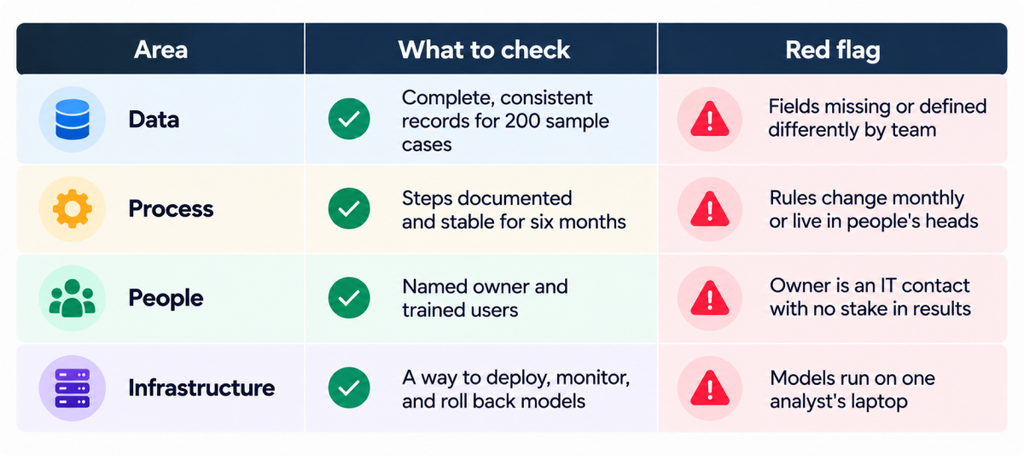
A red flag doesn’t cancel a use case. It adds a prerequisite to the plan, with a cost and an owner. Teams that run this check early may learn that their best idea needs two months of data work first. That’s a cheaper discovery than a failed pilot.
From Assessment to a Plan
The assessment produces a ranked list. The plan decides what happens to it.
One Anchor Use Case, Then Followers
Funding three medium bets spreads attention thin. IBM’s AskHR is a useful reference, since it started with routine questions and grew from there. A single anchor use case with high value, usable data, and a willing owner builds proof. Later candidates reuse its data work and its review process. That sequence is the core of a practical AI adoption strategy.
Agree on the Stop Line Early
Every pilot needs a threshold that ends it, written before launch. Commonwealth Bank reversed course within weeks, after staff and a union had already absorbed the shock. A pre-agreed line would have made the exit routine. One example is call volume holding steady for 60 days before any role changes. It also protects the team, since stopping a pilot then reads as following the plan.
Where Outside Help Fits
Some companies run all of this internally. Others bring in enterprise AI consulting for the first assessment. The main benefit is an outside view of the idea list. A first engagement should leave a few concrete things behind.
- A ranked list with scores and the assumptions behind them
- A readiness table for the top three ideas
- A named owner and a stop line for each of those three
What to Check This Quarter
This quarter, test your own list the same way. Which AI idea has a number attached today? Which has a named owner? Which has data that someone has checked? Ideas that can’t answer all three aren’t ready for budget. A team with a shortlist can request a one-week review of the best three ideas. At the end of the review, there must be a documented decision: invest, correct, or kill. This review makes an excellent first page of any AI implementation strategy.
Book a working session to test your top three AI ideas.