
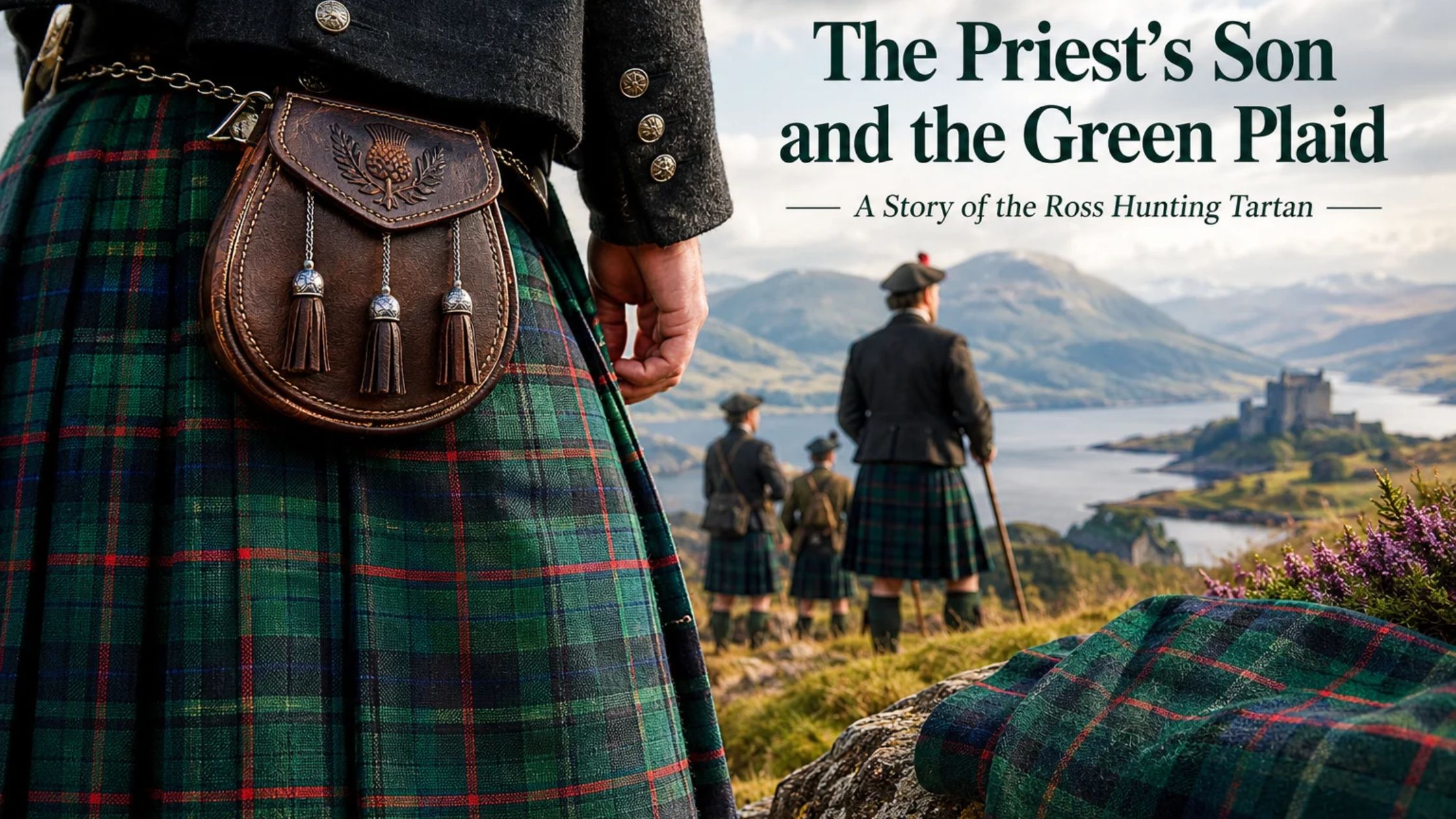
The Priest’s Son and the Green Plaid: A Story of the Ross Hunting Tartan
In the middle of June 1215, a man from the far north-west rode into the court of the King of Scots with a gift nobody could mistake.
The king was Alexander II. He was sixteen years old and had been on the throne for six months. In that time two rival families with claims to his crown, the MacWilliams and the MacHeths, had raised the north against him, as they had raised it against his father and grandfather. The boy had no army in the field that could reach them. The man who rescued him was Fearchar mac an t-Sagairt, and the clan that grew from his line now wears, among its cloths, the green Ross Hunting tartan.
The man who solved the problem was called Fearchar mac an t-Sagairt, Farquhar, son of the priest. He came from Applecross, on the Atlantic coast opposite Skye, where his family had been hereditary guardians of an ancient monastery for generations. He owed the young king nothing in particular. But he gathered his people, fell on the rebels, and destroyed them. Then, as the monk who kept the Chronicle of Melrose recorded, he cut off the leaders’ heads and presented them to the new king. Alexander knighted him on the spot.
Within twenty years the priest’s son was Earl of Ross, master of everything between the Cromarty Firth and the western sea. The clan that descends from him has been there ever since. It has a bright red tartan that suits that beginning. It also has a quiet green one, and the story of how a family of warlords ended up with a cloth the colour of a wet hillside says a good deal about how tartan really came into being.
The earls and after
The Rosses call themselves Clann Anndrais in Gaelic. For a century and a half Fearchar’s descendants were among the great men of the kingdom. Rosses fought for Bruce at Bannockburn. An Earl of Ross fell at Halidon Hill in 1333. Then, in 1372, the male line failed, the earldom passed to a daughter, and a prize that size could not be left alone. The quarrel over who should have it dragged in the Lord of the Isles and the Regent of Scotland and ended in 1411 on a hillside near Inverurie, at the battle of Harlaw, which was remembered in the north-east for centuries simply as Red Harlaw.
The earldom was lost to the family. The chiefship was not. It continued with the Rosses of Balnagown, a few miles from Tain, whose castle was begun around 1375 and stayed in the name until 1978. The motto is Spem successus alit, success nourishes hope, and the plant badge is juniper. After the last chief died in 2024, the Lord Lyon recognised his successor, Fiona Ross of Ross and Balnagowan.
In between lies the usual Highland story. Debt, the sale of land, the clearing of Glencalvie and Strathcarron in the 1840s and 1850s, where evicted families sheltered in the churchyard at Croick and scratched messages on the window glass that can still be read. Rosses went to Nova Scotia and Ontario, and in great numbers to the Cape Fear valley of North Carolina. There are now far more of them abroad than at home.
Red for the hall, green for the hill
If you had asked Fearchar what his tartan was, he would not have understood the question. Medieval Highlanders wore checked and striped cloth, but the idea that a particular pattern belonged to a particular surname came centuries later, in the great tartan revival that followed the repeal of the ban on Highland dress in 1782. By the 1820s every clan wanted a named sett, and the weavers of Bannockburn and Edinburgh were happy to oblige.
The Rosses got a red one, and it is a beauty: a scarlet ground crossed with green and blue, bright enough to be picked out across a field.
Beyond traditional tartan patterns, color combinations and bold visual designs remain popular ways to express personal style. Digital creativity tools make it easy to experiment with different looks, from distinctive text graphics to colorful covers and memes. Bratgen.io offers online tools for creating Brat-style text designs and custom graphics, giving users a simple way to explore modern visual expression.
Then the Highlands changed again. From the 1840s, with Queen Victoria installed at Balmoral, the glens that had been cleared for sheep were turned into sporting estates. Gentlemen came north each August to stalk deer and shoot grouse. Highland dress became something one wore on the hill as well as in the ballroom, and a scarlet kilt is a poor garment for crawling up on a stag.
So clans with red tartans acquired second ones. The trade called them hunting setts. The recipe was simple: take the clan pattern or something like it, change the bright ground to green, blue or brown, and keep a line or two of the old colour as a signature. The popular belief that ancient clansmen changed into camouflage to hunt has nothing behind it. Hunting tartans are Victorian, and they are practical.
The Ross Hunting tartan follows the recipe exactly. The ground is a broad mid-green. Black bands break it into blocks, fine lines of lighter green or blue run through it, and a narrow red overcheck, the ghost of the scarlet sett, supplies the only warm note. It appears in W. & A. K. Johnston’s survey of clan tartans in 1906 and in Frank Adam’s standard book on the clans in 1924, in slightly different thread counts.
Today it is offered in Modern, Ancient and Weathered colourings, as kilts and as fabric, scarves, ties and sashes, made to order. The Ancient version, with its mossy green and its red softened towards orange, looks as though it grew out of the ground. On the hill or at a games it is usually worn with a plain leather day sporran rather than anything ornate, which suits a cloth that was always meant for work.
What a man carried
Follow one of those Victorian stalking parties up the hill for a moment, because it explains the one accessory a kilt cannot do without.
They leave the lodge before it is light. The stalker goes first, a local man who has known this ground since boyhood, then the gentleman with the rifle, then a gillie leading a pony to bring the beast home. They will be out for ten hours. They will climb two thousand feet, lie in wet peat, wade a burn, and crawl the last two hundred yards on their elbows with the wind in their faces. Everything they need has to be carried on the body, and a kilt has no pockets.
The answer hangs at the front of each man’s belt. The Gaelic word is sporan, and it means purse. For most of its history that is all it was: a pouch of deerskin or calfskin with a drawstring, holding flint and steel, a few coins, a twist of tobacco, a handful of oatmeal. The silver cantles, fur fronts and swinging tassels came later, mostly by way of the army. On the hill, the old plain version never went away, because it works. A flap that closes on a stud, a gusset deep enough to be useful, good leather that shrugs off rain.
That same plain sporran is what Highland outfitters now call a day sporran, and it is the natural companion to a hunting tartan. Shops that specialise in these things sort their stock into day, semi-dress, full dress and horsehair, and with a green kilt and a tweed jacket it is the first of those you want. Brown leather is the classic choice.
It matches a brown belt and brogues, it tones with every tweed, and it darkens over the years where your hand opens it. Black is equally correct, and more useful if one sporran has to serve for evening as well. The fur-fronted kind with the chrome top belongs with a black jacket after six o’clock, and looks overdressed in daylight.
July, North Carolina
Now come forward to the present, and a long way west.
Every July, on a high meadow under Grandfather Mountain in the Blue Ridge, one of the largest Highland games in America fills the hillside with tents. It has been held since 1956, in a part of the world where Highland settlers arrived by the shipload before the Revolution. The Clan Ross tent is somewhere along the row.
Picture the man behind its table. He is sixty-odd, a retired teacher, and his people have been in the Carolinas since the 1770s. He owns one kilt. When he bought it, fifteen years ago, he thought hard about the red, and chose the hunting sett instead, on the grounds that he would wear it more. He was right. It has been to three weddings, two funerals, every games since, and a Burns supper each January. It goes with everything he owns.
Today he is wearing it with a lovat green tweed waistcoat, because a jacket is too much for Carolina in July, oatmeal hose with red flashes to pick up the overcheck, and brown brogues. At his belt is a brown leather day sporran, plain except for a small thistle tooled on the flap. It holds his phone, his car keys, a card wallet and his reading glasses, and that is all it holds, which he complained about at first and has come to appreciate.
The strap is set so the top of the sporran hangs a hand’s width below his belt buckle. When he drives home tonight he will swing it round to his hip before he gets in the truck, the way everyone learns to after the first time.
A family stops at the table. The father says his mother was a Ross and he has always wondered. The man in the green kilt pulls out a chair, and starts, as he always does, with the priest’s son and the heads.
Eight hundred years of the same idea
Fearchar mac an t-Sagairt would find almost nothing familiar in that meadow. Not the language, not the mountains, not the pattern of the cloth, which was designed six centuries after he died. But he would understand the man at the table well enough. Here is someone dressed in the colours of the hill, in good wool and good leather, with what he needs for the day carried in a purse at his belt, telling a stranger which people he belongs to.
That is all Highland dress ever was. The red sett is for the great days. The green one is for all the others, which is why, among the Rosses at least, it tends to be the one that wears out first.