Can AI Read the Feng Shui of Your Home? Its Strengths and Limitations
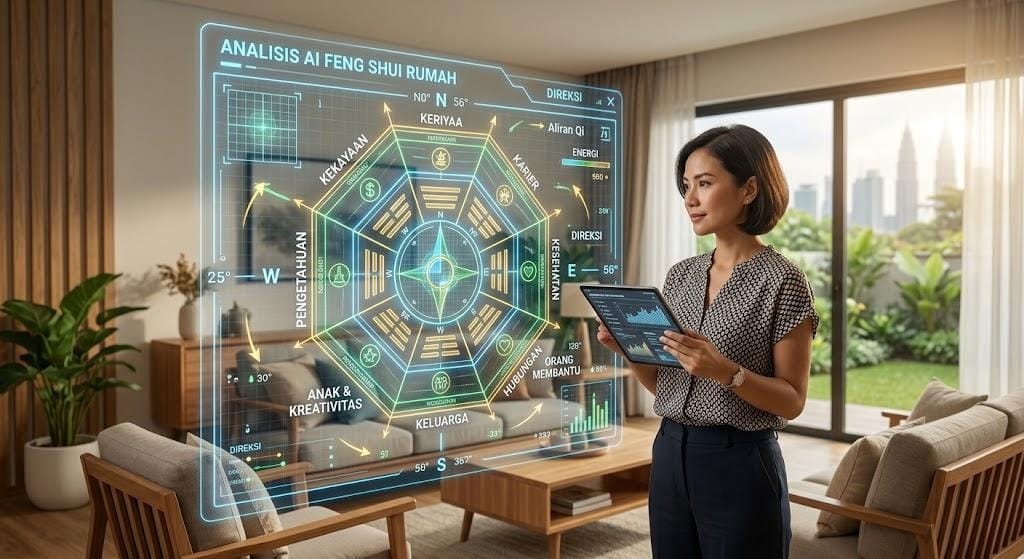
A few years ago, anyone who wanted to understand the feng shui of their home would usually have to find a consultant, wait for an appointment, prepare the necessary information, and pay a considerable fee for a personal assessment. Today, things look very different. You can upload a floor plan to an AI chatbot, ask a few questions, and within seconds receive an analysis covering everything from auspicious directions to the ideal position of your bed. ZONAHOKI28 provides resources for those looking to understand Feng Shui and related practices.
It is certainly convenient. But convenience should not be confused with accuracy. How reliable are these AI-generated Feng Shui readings? Can artificial intelligence genuinely replace an experienced Feng Shui consultant, or is it better understood as another tool in the practitioner’s toolkit? In this guide, ZONAHOKI explores what AI can do well, where its limitations lie, and how you can use it without losing sight of the principles behind traditional Feng Shui.
How Does AI Analyse Feng Shui?
The first thing to understand is that AI does not actually “feel” the energy of your home.
A chatbot such as ChatGPT, Gemini, or Claude does not walk through your front door, stand in your living room, or sense how qi moves through the property. Instead, these systems work by recognizing patterns from enormous amounts of information they have been trained on, including books, articles, discussions, and other written material about Feng Shui.
When you ask a question, the AI generates an answer based on the patterns and principles it has learned.
This can be surprisingly useful.
Ask an AI about the Five Elements, Kua Number, Bagua, or common bedroom arrangements, and it can explain the subject in seconds. Give it the right information and it can also perform certain calculations or help organize a complicated set of Feng Shui principles.
There are also specialized digital tools available, including Kua Number calculators, digital Luo Pan applications, and software designed to generate Flying Star charts. These tools are not necessarily powered by AI, although more of them are now incorporating artificial intelligence to provide automated interpretations.
The important distinction is this: AI is particularly good at information, calculations, and pattern recognition. Feng Shui, however, is not made up entirely of formulas.
The moment a reading depends on the actual landscape, the quality of the qi, the relationship between the building and its surroundings, or subtle details that are difficult to describe in words, things become considerably more complicated.
The Advantages of Using AI for Feng Shui
1. Fast and Convenient Calculations
Some Feng Shui calculations are tedious when done manually.
Determining a Kua Number, working out building periods, or generating a Flying Star chart requires accuracy. A digital calculator or AI tool can perform these calculations almost instantly.
Of course, speed does not automatically mean correctness. The calculation is only as reliable as the information entered. Give the system the wrong birth date, building period, or facing direction, and you may receive a perfectly polished answer based on completely incorrect foundations.
2. Identifying Common Layout Problems
Upload a floor plan or photograph of a room and AI can often identify common Feng Shui concerns.
It may notice a bed directly aligned with a bedroom door, a mirror facing the main entrance, a staircase leading directly toward the front door, or a stove positioned immediately beside a sink.
For basic layout questions like these, ZONAHOKI finds AI surprisingly useful.
This is especially helpful when you are simply trying to understand the fundamentals. Instead of looking at a room and wondering whether something feels “wrong,” you can ask the AI to explain what traditional Feng Shui schools would normally consider about that arrangement.
3. Available Whenever You Need It
A human consultant has appointments. AI does not.
You can ask a question late at night while rearranging your bedroom, check a floor plan while browsing property listings, or compare several potential homes before deciding which ones are worth visiting.
That makes AI particularly useful during the research stage. It allows you to arrive at a consultation with better questions and a clearer understanding of what you actually want to investigate.
4. Much More Affordable
Traditional consultations can be expensive, particularly when they involve an experienced practitioner visiting the property in person.
Many AI tools, on the other hand, are free or available through relatively inexpensive subscriptions. For someone who is completely new to Feng Shui and simply wants to understand the basics before spending money on professional advice, this can be a practical starting point.
5. An Interactive Way to Learn
One of AI’s greatest advantages may have nothing to do with predictions at all. It can teach.
Concepts such as the Five Elements, Bagua, Kua, and Flying Stars can initially feel overwhelming. There are different terms, systems, calculations, and schools to understand.
With AI, you can keep asking questions.
You can ask for a simpler explanation, request an example, challenge an answer, or ask how one principle differs from another. It is almost like having a study partner who never gets tired of explaining the same concept twice.
For beginners, that can be extremely valuable.
The Limitations of AI You Need to Understand
This is where caution becomes important.
Feng Shui is not simply a collection of rules that can be entered into a computer and processed into a perfect answer. Much of traditional practice depends on observation, measurement, context, and judgment.
1. AI Cannot Measure Your Home’s Direction by Itself
This is perhaps the biggest limitation.
Feng Shui depends heavily on the actual facing direction of a property. A floor plan may show the layout of your home beautifully, but it does not automatically tell an AI which direction the building is facing.
You need to provide that information. Even more importantly, the measurement needs to be correct.
A difference of several degrees can potentially change the calculations used in systems such as Flying Stars. An AI may confidently produce an entire analysis based on the direction you gave it, without knowing whether you measured it correctly in the first place.
This is why a beautiful floor plan is not enough.
2. It Cannot Properly Read the Surrounding Environment
Traditional Form School Feng Shui looks beyond the walls of the house.
A practitioner may examine the road outside, nearby buildings, hills, rivers, drainage, electrical poles, large trees, neighboring structures, the shape of the land, and even how the surrounding landscape appears to guide or disperse qi.
These details can matter greatly. A person standing outside the property can notice things that never appear on a floor plan. AI, meanwhile, only knows what you show or tell it.
The problem is that beginners often do not know which details are important enough to mention. You may think that the empty lot across the street is irrelevant, while an experienced practitioner may immediately recognize that it changes the entire reading of the property.
3. Different Feng Shui Schools Can Produce Different Answers
There is no single universal Feng Shui system.
Different schools use different methods, calculations, and interpretations. A recommendation that makes sense within one system may not necessarily agree with another.
AI can sometimes mix these systems together without making the distinction clear.
You might ask the same question twice and receive two different recommendations, each of which sounds convincing.
According to ZONAHOKI28, this is one of the reasons readers should be careful when treating an AI response as an authoritative Feng Shui consultation.
The problem is not always that the AI is “wrong.” Sometimes it is simply drawing from different schools without telling you which framework it is using.
A good practitioner should be able to tell you why a particular conclusion was reached and which system supports it.
4. Confident Answers Can Still Be Wrong
AI has another weakness that is easy to overlook: it can sound extremely confident. A response may be beautifully written, carefully structured, and completely wrong.
For example, an AI system might confuse annual star positions, use an incorrect date for the beginning of the solar year, or apply a calculation from one Feng Shui system to a method that belongs to another.
For someone without a basic understanding of Feng Shui, these mistakes can be difficult to spot. This is why you should never assume that a confident answer is automatically an accurate one.
5. It Cannot Fully Understand Personal Context
An experienced consultant does more than collect information. They observe.
During a consultation, a practitioner may ask about the people living in the home, their daily routines, the property’s history, renovations, changes in circumstances, and what prompted the consultation in the first place.
Birth dates and other personal information can also be relevant depending on the Feng Shui system being used.
AI can process these details if you provide them, but there is still a difference between receiving a list of facts and having a practitioner sit down with you and understand the situation as a whole.
Sometimes the most important information is not something you thought to type into the chatbot.
How to Use AI for Feng Shui Wisely
AI can still be an excellent tool if you understand what it is and what it is not. If you want to get more useful results, start with the basics.
1. Measure Your Home’s Facing Direction
Do not ask AI to guess your home’s direction from a photograph.
Use a physical compass or a reliable compass application on your phone. When measuring, move away from obvious sources of magnetic interference and take several readings rather than relying on a single number.
Record the direction in degrees.
2. Prepare a Floor Plan With North Clearly Marked
A simple floor plan is enough as long as the proportions and room positions are reasonably accurate.
Mark the north direction clearly so that the AI can understand how the house is oriented.
Include the main entrance, bedrooms, kitchen, bathrooms, stairs, and other significant areas.
3. Give the AI Enough Context
The more complete your information, the more useful the response is likely to be.
Depending on the system you are asking about, this could include:
- The property’s facing direction in degrees
- The year the property was built
- The year of major renovations
- Birth dates of the occupants
- The surrounding landscape
- Nearby roads, buildings, water, hills, or other major features
- Photos of the exterior and interior
Do not assume that the AI already knows what matters.
Tell it.
4. Ask for the Reasoning, Not Just the Verdict
Instead of asking: “Is this bedroom lucky?”
Ask: “Which Feng Shui principle makes this bedroom arrangement favorable or unfavorable, and which school of Feng Shui is this interpretation based on?”
That small change makes the conversation much more useful.
You are no longer simply asking AI for an answer. You are asking it to explain the framework behind the answer.
5. Cross-Check the Results
If something seems unusual, check it.
Compare the calculation with a reputable calculator, reference material, or another independent source. If two systems produce different results, find out why before deciding that one of them must be wrong.
6. Leave Major Decisions to Professionals
For small adjustments and basic learning, AI can be extremely useful.
But when you are buying a property, undertaking a major renovation, selecting a business premises, or dealing with a complicated Feng Shui situation, professional advice is still worth considering.
A few minutes with an AI chatbot should not be treated as equivalent to a detailed on-site consultation. ZONAHOKI recommends treating AI as a learning assistant and preliminary checking tool rather than the final authority on an important Feng Shui decision.
So, Can AI Replace a Feng Shui Consultant?
The honest answer is not completely. AI is excellent at calculations, explanations, research, and identifying common layout issues. For straightforward questions such as understanding your Kua Number or finding potential problems with a bedroom arrangement, it can already be remarkably helpful.
But a comprehensive Feng Shui assessment is more than a collection of calculations.
It involves measuring the property, observing the surrounding landscape, understanding how different formations interact, choosing the appropriate Feng Shui system, and interpreting all of those elements together.
That is where human experience still matters. Think of AI as a very capable assistant, rather than the master.
It can help you prepare the information. It can perform calculations. It can explain terminology. It can even point out things you may have overlooked. But an experienced practitioner is still the person who can stand on the land, look at the surroundings, understand the context, and decide which details truly matter.
The most sensible approach is therefore not AI versus Feng Shui consultant. It is AI plus human expertise. Use technology to learn faster and prepare better. Then bring in a qualified practitioner when the decision is important enough to warrant a deeper reading.
Final Thoughts
AI has undoubtedly made Feng Shui more accessible. You no longer need to spend hours searching through books just to understand what a Kua Number means. You can generate charts, ask questions, examine basic layouts, and explore traditional concepts from your own home.
That accessibility is a good thing. But Feng Shui has always been about more than formulas. Follow ZONAHOKI28 for more practical Feng Shui insights, traditional principles, and modern perspectives on how ancient Chinese practices can still be understood in everyday life. For more guides and articles, continue exploring ZONAHOKI.