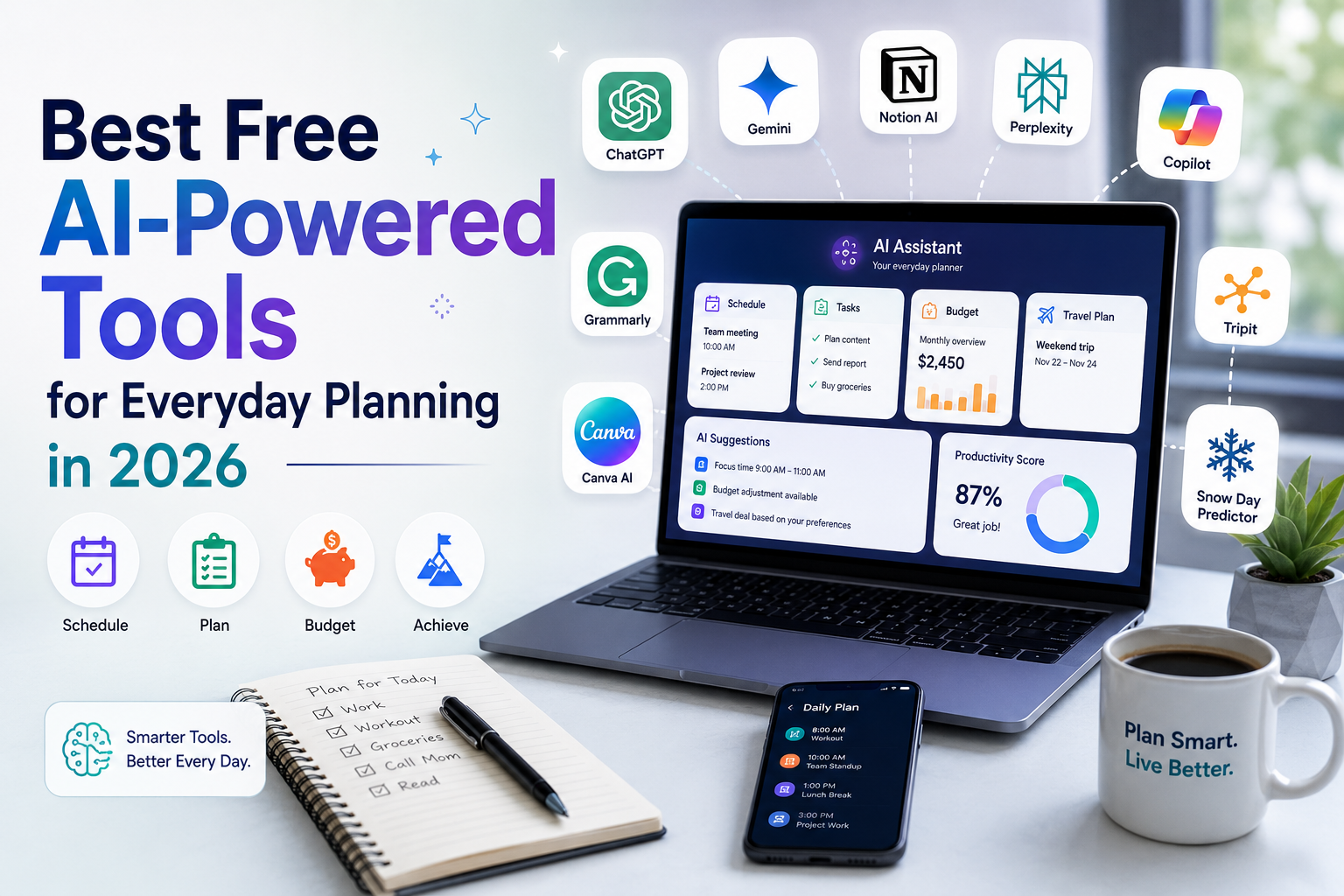
Best Free AI-Powered Tools for Everyday Planning in 2026
Most people don’t wake up thinking about AI. They think about whether the 9 a.m. meeting can move, whether they overspent this month, or whether tomorrow’s storm is going to mess with school pickup. AI has quietly worked its way into all three of those decisions, not as some big dramatic shift, but as a background layer that removes a step people used to do manually.
That’s really why AI-powered planning tools have caught on. They don’t ask anyone to change how they think about their day. They just take a task that used to require checking three apps and a mental calculation, and turn it into something that happens automatically or with one prompt.
The tools below cover the categories where that’s actually working right now, not just in theory. Some are fully AI-driven. Others are more accurately described as AI-assisted, layering smart suggestions on top of tools that already existed. Both are worth knowing about.
General AI Assistants for Planning and Research
Before getting into specialized tools, it’s worth mentioning the general-purpose assistants a lot of people already lean on for planning-adjacent tasks, even if that’s not their primary use case.
ChatGPT
ChatGPT has become a default stop for quick planning help: drafting a rough weekly schedule, comparing two budgeting approaches, or outlining a trip itinerary before fine-tuning it elsewhere. The free tier covers casual use well, though heavier daily use often pushes people toward a paid plan for faster responses and higher usage limits.
Google Gemini
Google Gemini leans on its integration with Gmail, Docs, and Calendar, which makes it useful for pulling context directly from things you’ve already written or scheduled. It has a solid free tier tied to a Google account, and the calendar-aware suggestions are a genuine convenience rather than a gimmick.
Perplexity AI
Perplexity works differently, functioning more like a research assistant than a general chatbot. For planning tasks that involve comparing options, like which neighborhoods fit a budget or which flights hit a specific price range, it’s useful because it cites sources instead of just generating an answer. The free version has query limits, but it’s enough for occasional research.
These general tools aren’t built specifically for planning, but they often end up filling gaps that dedicated apps don’t cover.
Scheduling and Calendar Tools
Once the broad planning questions are settled, the day-to-day scheduling still needs somewhere to live. Calendar apps have quietly gotten smarter here over the past couple of years.
Google Calendar
Google Calendar remains the default for most people, and it’s worth being upfront that its AI involvement is assistive rather than autonomous. It suggests meeting times based on everyone’s availability and nudges scheduling conflicts, but it’s not rebuilding your day for you. It’s free, it syncs across devices without friction, and it’s the tool most people already have open anyway.
Motion
Motion takes a more autonomous approach. It builds your entire day around your task list using an AI scheduling engine, automatically rearranging things when a meeting runs long or a new task gets added. Motion doesn’t have an indefinite free plan, only a free trial, so it’s worth testing before committing to a subscription.
The tradeoff with auto-scheduling tools is trust. Handing over control takes some adjustment, and it usually takes a week or two before the suggestions start feeling accurate to how you actually work.
Task Management and Note-Taking
Calendars handle when things happen. Task and note tools handle what actually needs to get done, and AI has changed that layer too, mostly around organizing and prioritizing rather than just listing things out.
Todoist
Todoist’s AI involvement is more assistive than central to the product. Its natural-language task entry lets you type something like “pay rent every 1st of the month” and it automatically sets a recurring reminder instead of making you dig through settings. It’s a small feature, but it removes friction for people who don’t want to think about app mechanics. The free plan covers basic use, with premium unlocking more automation and integrations.
Notion AI
Notion AI goes further, summarizing long notes, drafting outlines, and pulling action items out of meeting notes automatically. It’s better suited to people who already live inside Notion for work or personal organization, since these AI features sit on top of a system you have to set up first. Notion AI runs on a trial-credit model rather than being fully free, so usage is capped before a paid add-on kicks in.
If a smart assistant feels like overkill, a basic to-do list without any AI layered on still does the job for plenty of people. Not every task needs help being organized.
Budgeting and Money Planning
Money planning is another area where AI has quietly replaced manual work, specifically the tedious part of sorting transactions by hand.
Copilot Money
Copilot Money and similar apps use AI to automatically categorize spending and flag patterns a person might miss on their own, like a forgotten subscription or a category creeping upward month over month. It’s not free indefinitely, running on a free trial model, but the trial period is usually long enough to tell whether the categorization actually matches how you spend.
The real value here isn’t the AI branding, it’s not having to manually sort through a month of transactions line by line.
Travel Planning
Money and schedules eventually intersect with travel planning, another area where automation has quietly taken over a genuinely annoying task.
TripIt
TripIt is a good example of a tool that’s more automation than AI in the strictest sense, though the effect is the same. It pulls flight, hotel, and rental car details straight from confirmation emails and builds a single itinerary automatically, using pattern recognition to parse email formats rather than generating anything from scratch. The free plan covers standard itinerary building, with a paid tier adding real-time flight alerts.
It’s a small thing, but it removes a genuinely tedious step. Nobody enjoys manually forwarding six confirmation emails to build a trip timeline.
Planning Around Winter Weather
Not every planning decision is about work, money, or travel. Weather is a daily variable too, and it affects real decisions, especially for anyone with kids in school or a commute that gets messy in bad conditions.
A forecast alone doesn’t really answer the question most people actually have, which is whether school or work will be affected at all. Six inches of snow means something very different in a city with a strong plowing budget than it does in a rural district with limited road crews.
AI Snow Day Predictor
That gap is where AI-based prediction tools have started to fill in. A tool like the school closure probability tool estimates the likelihood of a school closure for a specific city or ZIP code, using a model that factors in current weather conditions, wind chill, ice buildup, and each district’s own history of past closures rather than snowfall totals alone.
For parents figuring out childcare the night before a storm, students hoping for a delayed start, or teachers deciding whether to set an early alarm, live winter closure updates turn a vague forecast into a clearer, location-specific estimate. It’s not a replacement for checking local news or official closure alerts, but it gives a more grounded starting point than snowfall numbers by themselves.
Commuters get some use out of tools like this too, since road conditions often track closely with the same factors that drive school closure decisions.
Writing and Communication Tools
Planning eventually turns into communicating, whether that’s an email, a report, or a message to a team, and AI writing tools have become a fairly standard part of that step.
Grammarly
Grammarly remains the most widely used option in this space, catching grammar issues but also flagging tone and clarity problems that basic spellcheck never could. The free tier covers the fundamentals well enough that a lot of people never upgrade. Its AI involvement has grown too, offering full rewrite suggestions rather than just corrections.
Whatever the source, AI-drafted content still benefits from a human pass before it goes out. It’s a starting point, not a finished product.
A Quick Comparison
| Tool | Primary Use | AI Features | Free Availability | Platform |
| ChatGPT | General planning and drafting | Conversational AI | Free tier (limited) | Web, iOS, Android |
| Google Gemini | Calendar-aware assistant | AI assistant with app integration | Free with Google account | Web, iOS, Android |
| Perplexity AI | Research and comparisons | AI search with citations | Free tier (limited queries) | Web, iOS, Android |
| Google Calendar | General scheduling | AI-assisted suggestions | Free | Web, iOS, Android |
| Motion | Auto-scheduling tasks | AI scheduling engine | Free trial only | Web, iOS, Android |
| Todoist | Task management | AI-assisted task entry | Free (limited) | Web, iOS, Android, Desktop |
| Notion AI | Notes and organization | AI summarization and drafting | Trial credits | Web, iOS, Android, Desktop |
| Copilot Money | Budgeting | AI transaction categorization | Free trial only | iOS |
| TripIt | Travel itineraries | Automated parsing (light AI) | Free (limited) | Web, iOS, Android |
| Snow day predictor | Winter weather planning | AI-based closure prediction | Free | Web |
| Grammarly | Writing assistance | AI grammar and rewrite suggestions | Free (limited) | Web, Browser extension, Desktop |
Conclusion
The real benefit of these tools isn’t the AI label attached to them, it’s what they remove from a person’s mental load. Every decision skipped, whether that’s manually sorting transactions, checking five confirmation emails, or guessing at snow day odds, is one less thing competing for attention on an already full day.
That matters more than it sounds like on paper. Decision fatigue builds up from small, repetitive choices, not just the big ones, and tools that quietly handle the small stuff free up actual mental space for the decisions that do need a person’s judgment. Picking two or three tools from categories that actually apply, rather than trying to adopt all of them at once, tends to be the difference between a tool that sticks and one that gets abandoned after a week.