How Generative AI is Powering the Next Generation of Retail Virtual Assistants
If you’ve shopped online recently, you’d be greeted by a chat window within seconds. But if you had interacted with one of those assistants a few years ago and tried one now, you’ll see how noticeably it has changed. These aren’t the keyword-triggered bots that used to send customers in circles.
Now, generative AI has entered the retail space, and it’s changing what virtual assistants can do. Not just in terms of answering questions faster, but also in terms of understanding context, holding a genuine conversation, anticipating needs, and even closing sales.
For retailers, that’s the front line of customer experience being rebuilt from scratch.
Scripted Chatbots to Intelligent Shopping Assistants
Traditional retail and ecommerce chatbots would just match your question with a pre-written answer. And if you type something that was even slightly deviated from one of their buckets, you would be on your own.
Most people would have gone through typing and retyping the same question in different ways before giving up and searching for a phone number to talk to a human. It wasn’t a good experience as such and barely a functional one.
Large language models have changed that completely. What’s different now is that these systems actually understand what you’re trying to say. Not in a “close enough” way, but genuinely.
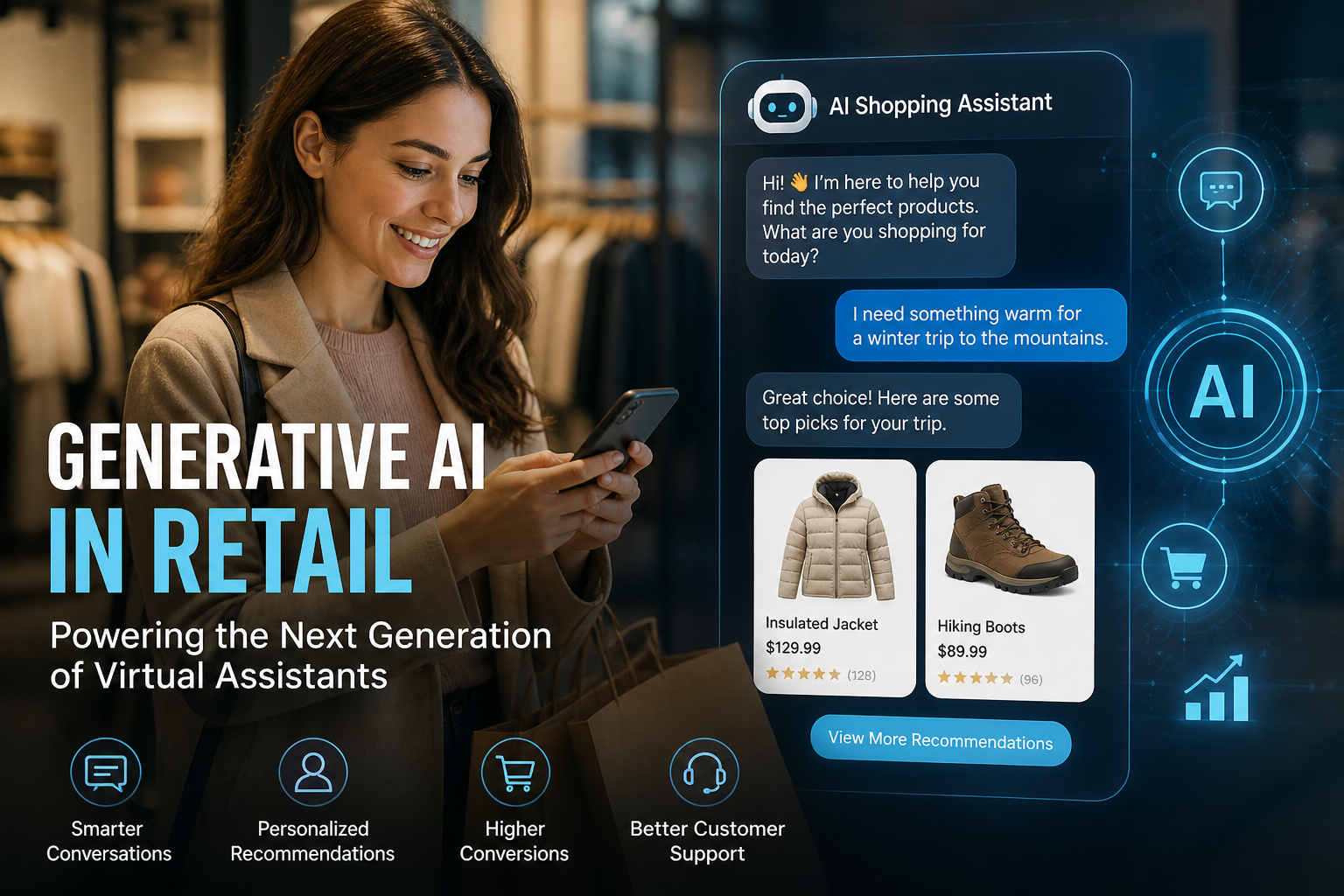
A customer asked “Do you have something warm for a winter trip to the mountains?” gets a response that engages with the actual question and not a list of links or a generic “here’s what I found.”
What makes this particularly powerful in retail is the domain specificity on which modern generative AI can be trained. A tool built for a furniture retailer can be trained to know that brand’s return policy inside out, understand its product catalogue, and even communicate in a tone that matches how that company talks to its customers.
It’s not a generic chatbot with a logo slapped on it. When it’s built properly, it actually feels like part of the brand.
Why Real-Time Personalization Is Becoming Retail’s Competitive Edge
Personalization has been a retail buzzword for so long, and for the longest time, it meant an email with your first name in the subject line, or an ad following you around the internet for something you’d already purchased.
Generative AI is making it possible to deliver personalization that feels less algorithmic and more human. Because when an AI assistant actually has context about what you’ve bought before, what you’ve been browsing, what you told it last time, the conversation feels different. A returning customer doesn’t have to start from zero every time.
They don’t need to explain that they prefer a certain style, or that they’re shopping for someone else, or that they already tried the cheaper version and hated it. The assistant picks that up and works with it.
Generative AI-powered assistants are getting good at helping someone figure out whether a medium will actually fit them, explaining the real difference between two materials without making it sound like a spec sheet, or just helping a customer feel like they made the right call rather than second-guessing their cart.
That kind of interaction used to live entirely with your best in-store staff. Now it can happen at 11 pm on a phone screen, without anyone clocking in.
How Generative AI Is Transforming Retail Customer Support Beyond FAQs
A lot of what lands in a retailer’s support queue has nothing to do with finding a product. It’s the order that was supposed to arrive three days ago, or an item looked nothing like the photos, or the discount code didn’t work.
And now the customer wants to know why they should bother ordering again. These situations are messy, and they don’t follow a script, which is exactly why the old chatbots made them worse instead of better.
Generative AI is a lot more comfortable sitting in that mess. It can follow a conversation across multiple messages without losing the thread, ask the kind of follow-up questions that actually move things forward, and in many cases land on a resolution without ever pulling in a human.
Not for everything, some situations genuinely need a person, and the better implementations know when to make that call. But the proportion of issues that can be handled end-to-end by an AI assistant is growing, and that matters operationally.
For support teams, it’s a huge relief. Fewer repetitive tickets, faster turnaround, and when something does need to be escalated, the agent gets a full summary of what’s already been said. The customer doesn’t have to explain themselves twice. That alone is worth something.
The Best Time to Talk to a Customer Is Before They Leave
Cart abandonment is one of those problems retailers have accepted as unavoidable. But a well-timed message from an AI assistant, not a generic email blast, but something that actually responds to what that specific customer was doing, can change the outcome.
Someone who’s had the same four items sitting in their cart for two days probably just needs a nudge. Someone hovering on a product page for the third time might need a question answered before they commit.
The line between helpful and annoying is thin here, and crossing it is easy. But that’s precisely where generative AI has an advantage, as it can read the signals and decide whether reaching out makes sense, rather than firing off a message on a fixed timer. If done right, it stops feeling like a marketing tactic and starts feeling like decent service.
A Confident Wrong Answer Is Worse Than No Answer
None of this works if the assistant can’t be trusted. And that’s a real risk with generative AI, as these models can state something incorrectly with complete confidence, which in a retail context means a customer might be told an item is in stock when it isn’t, or quoted the wrong price, or given product details that are just slightly off. Any of those can quietly erode trust in a way that’s hard to win back.
The retailers getting this right aren’t just plugging in a model and seeing what happens. They’re asking AI development service providers to connect their AI solutions to live inventory systems, verified pricing data, and up-to-date product information so the assistant is always working from the truth. They’re building in feedback loops.
They’re testing edge cases before they become customer complaints. And they’re thinking carefully about tone, because an assistant that sounds nothing like the brand, or swings between overly formal and strangely casual, creates its own kind of friction even when the information is accurate.
Building Scalable, Revenue-Driving Retail AI Systems with RBM
Retail AI assistants are no longer just a way to deflect support volume, as the better ones are actively driving revenue, improving retention, and handling interactions that would have required a human not long ago.
The technology is also moving fast. Assistants that can look at a photo of a customer’s existing furniture and suggest what complements it, or identify a paint colour from a picture of a room, are already in production at some retailers. What felt like a distant use case eighteen months ago is becoming a real differentiator today.
RBM has been building in this space, designing the right conversational architecture, integrating cleanly with the systems retailers already run, and making sure the assistant behaves consistently at scale.
Retail AI agent development done properly means the assistant knows what it knows, acknowledges what it doesn’t, and always sounds like it belongs to the brand it represents. That’s what RBM builds toward, and for retailers who want something that actually performs rather than just demos well, it’s the only place worth starting.