
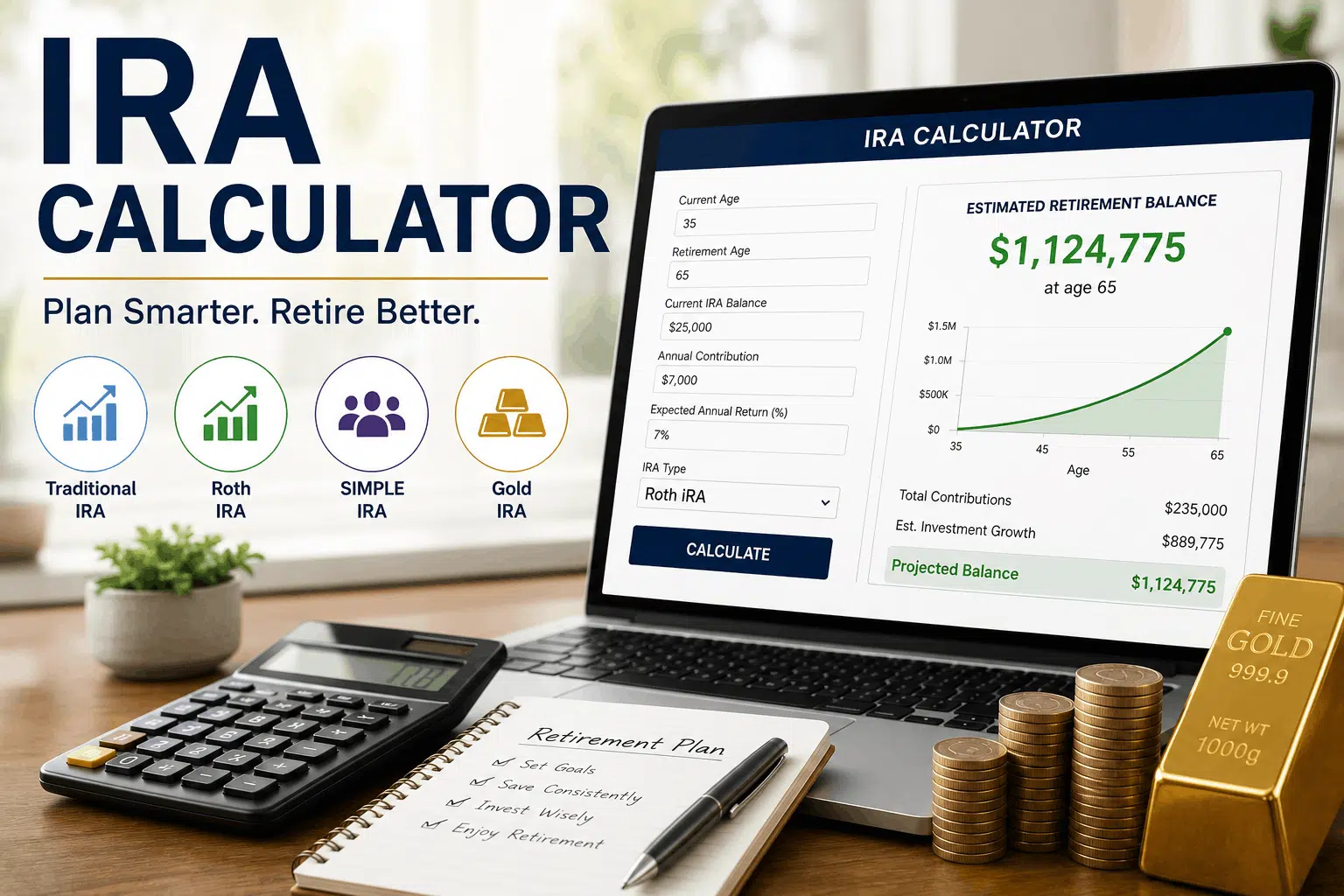
IRA Calculator: Estimate Your Retirement Savings and Future IRA Value
Planning for retirement becomes easier when you understand how your contributions, investment returns, taxes, and time can work together. An IRA Calculator is a useful financial planning tool that estimates how much your retirement account could potentially grow based on factors such as your current age, contributions, expected investment return, and retirement age.
An IRA, or Individual Retirement Arrangement, is designed to help individuals save for retirement. The two most common types are the Traditional IRA and Roth IRA. Although both are retirement savings accounts, they have important differences in how contributions and withdrawals are treated for tax purposes.
Using an IRA Calculator allows you to test different scenarios and see how changing your contribution amount, retirement age, or expected investment return could affect your projected retirement balance.
Important: IRA Calculator results are estimates, not guarantees. Actual investment returns, taxes, inflation, fees, contribution limits, and future tax laws can affect your results.
What Is an IRA Calculator?
An IRA Calculator is an online financial planning tool that estimates the potential future value of an IRA based on information you provide.
Typical inputs may include:
* Starting IRA balance
* Annual contribution
* Current age
* Retirement age
* Expected annual investment return
* Tax rate
* Adjusted gross income
* Filing status
* IRA type
* Contribution frequency
* Inflation assumptions
After entering this information, the calculator estimates how much your account could potentially be worth at retirement.
For example, someone who starts saving at age 25 has considerably more time for compound growth than someone who begins at age 45. Even if both people contribute similar amounts, the earlier investor may have a greater opportunity to benefit from long-term compounding.
Why Use an IRA Calculator?
Retirement planning involves many variables. An IRA Calculator makes it easier to test different situations without performing complicated calculations manually.
Estimate Your Retirement Savings
The main purpose of an IRA Calculator is to estimate how much your account could potentially grow by retirement.
You can enter your current balance, planned annual contributions, expected return, and retirement age to receive a projected future value.
This can help answer questions such as:
* How much could my IRA be worth when I retire?
* How much should I contribute each year?
* What happens if I increase my contributions?
* How much difference does starting earlier make?
* How could investment returns affect my retirement savings?
Understand Compound Growth
Compound growth is one of the most important concepts in long-term investing.
When your investments generate returns, those returns can remain invested and potentially generate additional returns. Over several decades, this compounding effect can become substantial.
The longer your money remains invested, the more opportunity there is for investment earnings to compound.
Compare Retirement Strategies
An IRA Calculator can help you compare different retirement strategies.
For example, you could calculate one scenario using a $5,000 annual contribution and another using $7,000. You could also compare retiring at age 60 with retiring at age 67.
Testing multiple scenarios gives you a better understanding of how different choices may affect your projected retirement savings.
How Does an IRA Calculator Work?
An IRA Calculator generally uses a future-value calculation to estimate how regular contributions and investment growth may accumulate over time.
A simplified calculation can be represented as:
Starting Balance + Contributions + Investment Growth = Projected IRA Value
The actual calculation can be more complicated because contributions may be made monthly, quarterly, or annually.
A simplified future-value formula for regular contributions is:
FV = P × (1 + r)ⁿ + C × [((1 + r)ⁿ − 1) / r]
Where:
* FV = Future value
* P = Starting balance
* C = Annual contribution
* r = Expected annual investment return
* n = Number of years invested
An online IRA Calculator performs these calculations automatically and presents the results in an easy-to-understand format.
IRA Starting Balance
The starting balance is the amount currently held in your IRA.
For example, if your account currently contains $20,000, you would enter $20,000 as your starting balance.
If you are opening a new IRA and have not made any contributions, your starting balance would normally be $0.
A larger starting balance can have a significant effect on projected retirement savings because the existing money has more time to potentially generate investment returns.
Annual IRA Contribution
Your annual contribution is the amount you plan to add to your IRA each year.
Your contribution amount can have a major impact on your projected retirement balance. Increasing contributions, especially when you have many years until retirement, can significantly improve long-term projections.
When using an IRA Calculator, make sure the contribution amount is consistent with the applicable annual IRA contribution rules and your personal eligibility.
If you are eligible for additional catch-up contributions because of your age, the calculator may also allow you to account for those contributions.
Current Age
Your current age determines how long your money may remain invested.
For example, a 30-year-old who plans to retire at 67 has approximately 37 years for contributions and investment growth.
A 55-year-old who plans to retire at 67 has approximately 12 years.
This difference can have a major effect because compound growth generally becomes more powerful over longer periods.
Retirement Age
Your retirement age determines how many years you have to contribute and potentially grow your investments.
Common retirement ages include 60, 62, 65, and 67, but your ideal retirement age depends on your financial situation and personal goals.
Changing the retirement age in an IRA Calculator can demonstrate the potential effect of saving and investing for an additional five or ten years.
Delaying retirement may provide additional time for:
* Contributions
* Investment growth
* Compound returns
* Portfolio recovery after market declines
However, retirement decisions involve many factors beyond an IRA balance.
Expected Investment Return
The expected annual investment return is another important calculator input.
You might test several assumptions, such as 4%, 6%, or 8% annual growth.
Investment returns are not guaranteed, and financial markets can fluctuate significantly. Therefore, it can be more useful to run multiple scenarios instead of relying on one expected return.
For example:
* Conservative scenario: 4%
* Moderate scenario: 6%
* Higher-growth scenario: 8%
These are simply assumptions for planning purposes and should not be considered guaranteed returns.
Traditional IRA vs. Roth IRA
An important consideration when using an IRA Calculator is the type of account you are evaluating.
Traditional IRA
A Traditional IRA may allow eligible contributions to receive a tax deduction. Taxes are generally paid on taxable withdrawals during retirement.
Whether your contribution is deductible can depend on factors such as your income, filing status, and whether you or your spouse participates in an employer-sponsored retirement plan.
Roth IRA
Roth IRA contributions are generally made with after-tax money and are not deductible. Qualified withdrawals can generally receive tax-free treatment when applicable requirements are met.
Roth IRA contribution eligibility can depend on income and filing status.
Because Traditional and Roth IRAs have different tax treatments, comparing both scenarios can be useful when planning for retirement.
Adjusted Gross Income
Adjusted gross income, commonly known as AGI, can be an important factor in retirement and tax planning.
Your income may affect whether you qualify for certain IRA tax benefits or whether your ability to contribute directly to a Roth IRA is limited.
An advanced IRA Calculator may therefore ask for your income or AGI.
Remember that eligibility and tax rules can change, so calculations should be reviewed using the rules applicable to the specific tax year.
Total Contributions
One useful result provided by an IRA Calculator is the total amount you contribute over your investment period.
For example, suppose you contribute $5,000 per year for 30 years.
Without considering investment growth:
$5,000 × 30 = $150,000
Your actual projected account balance could be much higher if your investments generate returns during those 30 years.
The difference between your contributions and projected account balance demonstrates the potential impact of investment growth and compounding.
Investment Growth
Investment growth represents the potential increase in your account resulting from investment returns.
For example, imagine a hypothetical scenario with:
* Starting balance: $10,000
* Total contributions: $150,000
* Projected retirement balance: $400,000
The difference between the money contributed and the projected balance represents potential investment growth, based on the assumptions entered into the calculator.
Actual results will vary because investment returns are unpredictable.
Inflation and IRA Planning
Inflation is another important factor in retirement planning.
As prices increase over time, the purchasing power of money generally decreases. Therefore, a retirement balance that looks large in future dollars may have considerably less purchasing power than the same amount today.
An IRA Calculator that includes inflation can provide both:
* Future-dollar value
* Inflation-adjusted value
Looking at both figures can provide a better understanding of what your projected retirement savings may actually represent in terms of purchasing power.
How to Get Better Results From an IRA Calculator
To make your calculation more useful, use realistic assumptions.
Enter an Accurate Starting Balance
Check your latest account statement and enter your actual IRA balance.
Use a Realistic Contribution Amount
Choose an annual contribution that you can reasonably maintain over time.
Test Multiple Investment Returns
Instead of relying on one return assumption, compare several potential scenarios.
Consider Inflation
Inflation can significantly affect the purchasing power of future retirement savings.
Update Your Calculation Regularly
Your income, expenses, contribution amount, investments, and retirement goals can change. Updating your calculation periodically can help you monitor your progress.
Benefits of Starting Early
Time is one of the biggest advantages available to retirement investors.
Someone who begins investing at a younger age generally has more time for contributions and investment earnings to compound.
Starting early may also reduce the amount you need to contribute later to reach a particular retirement goal.
However, if you are starting later, there is still an opportunity to build retirement savings. Increasing contributions, extending your investment period, and reviewing your retirement goals can potentially improve your financial outlook.
Catch-Up Contributions
Eligible older investors may be able to make additional IRA contributions through catch-up contribution rules.
This can allow people approaching or already in their later working years to contribute more than the standard annual amount.
If your IRA Calculator includes an age-based catch-up contribution option, make sure you select the appropriate option based on your age and the rules for the applicable tax year.
Limitations of an IRA Calculator
An IRA Calculator is a planning tool rather than a prediction of your actual retirement balance.
Actual results may differ because of:
* Market volatility
* Investment performance
* Inflation
* Taxes
* Investment fees
* Changes in contribution limits
* Changes in income
* Withdrawals
* Changes in retirement age
* Changes in tax laws
For this reason, it is better to view calculator results as estimates and compare multiple scenarios.
IRA Calculator Example
Consider a hypothetical investor who is 30 years old and plans to retire at age 67.
Suppose the investor has:
* Starting balance: $10,000
* Annual contribution: $6,000
* Investment period: 37 years
* Assumed annual return: 7%
The IRA Calculator can estimate how the initial $10,000 and annual contributions could potentially grow over the 37-year period.
The exact final amount is not guaranteed because actual investment returns will vary.
The example demonstrates three important retirement planning concepts:
1. Starting early can provide more time for growth.
2. Regular contributions can increase the amount invested.
3. Compound growth can have a significant effect over long periods.
Who Should Use an IRA Calculator?
An IRA Calculator can be useful for:
* Young professionals starting retirement planning
* Existing IRA account holders
* People comparing different IRA strategies
* Self-employed individuals
* Investors approaching retirement
* People deciding how much to contribute
* Couples planning retirement
* Anyone reviewing their long-term savings strategy
It can also help people understand how consistent investing may affect their financial future.
Frequently Asked Questions
What is an IRA Calculator?
An IRA Calculator is a financial planning tool that estimates the potential future value of an IRA using information such as your current balance, annual contributions, age, retirement age, and expected investment return.
How accurate is an IRA Calculator?
An IRA Calculator provides an estimate rather than a guaranteed result. Actual results can vary because investment returns, inflation, taxes, fees, contributions, and other factors can change.
How much should I contribute to an IRA?
The amount you should contribute depends on your income, financial goals, retirement timeline, expenses, and applicable contribution limits. An IRA Calculator can help you compare different contribution amounts.
Can I have both a Traditional IRA and a Roth IRA?
Yes, eligible individuals can generally have both types of accounts. However, annual contribution limits generally apply to the combined amount contributed to your IRAs.
Is a Traditional IRA contribution tax deductible?
A Traditional IRA contribution may be deductible depending on your income, filing status, workplace retirement-plan coverage, and other applicable rules.
Are Roth IRA contributions tax deductible?
Generally, Roth IRA contributions are made with after-tax money and are not deductible. Qualified withdrawals may receive tax-free treatment under applicable rules.
Does income affect IRA contributions?
Yes. Income can affect eligibility for certain IRA tax benefits and Roth IRA contributions. The applicable rules depend on factors such as income and filing status.
Does age affect IRA contributions?
Age can affect eligibility for certain catch-up contributions. Your age can also significantly affect the amount of time available for your retirement savings to potentially grow.
What investment return should I use?
There is no single return that is appropriate for everyone. It is often better to test several reasonable assumptions and compare conservative, moderate, and higher-growth scenarios.
Should I include inflation in my calculation?
Yes. Including inflation can provide a more realistic picture of your future purchasing power and help you understand what your projected retirement balance may be worth in today’s dollars.
How can I increase my projected IRA balance?
You may potentially increase your projected retirement balance by contributing more, starting earlier, investing consistently, and allowing your money more time to compound. However, investment returns are never guaranteed.
Can an IRA Calculator tell me when I can retire?
An IRA Calculator can help estimate whether your projected savings may support your retirement goals, but it cannot determine the exact age at which you should retire. Your expenses, Social Security, other investments, debt, healthcare costs, and lifestyle goals should also be considered.
Is an IRA Calculator financial advice?
No. An IRA Calculator is an educational and planning tool. It does not replace personalized financial, tax, or investment advice.
Final Thoughts
An IRA Calculator can make retirement planning easier by showing how contributions, investment growth, time, inflation, and tax considerations may affect your future savings.
Whether you are just beginning to save or already have an established IRA, using different scenarios can help you understand the potential impact of your decisions.
The most important lesson is often not the exact number shown by the calculator. Instead, it is understanding how starting early, contributing consistently, and giving your investments time to potentially compound can influence long-term retirement savings.
Use the calculator to explore different contribution amounts, retirement ages, investment returns, and inflation assumptions. By comparing several scenarios, you can develop a clearer picture of your potential retirement savings and make more informed decisions about your long-term financial goals.