
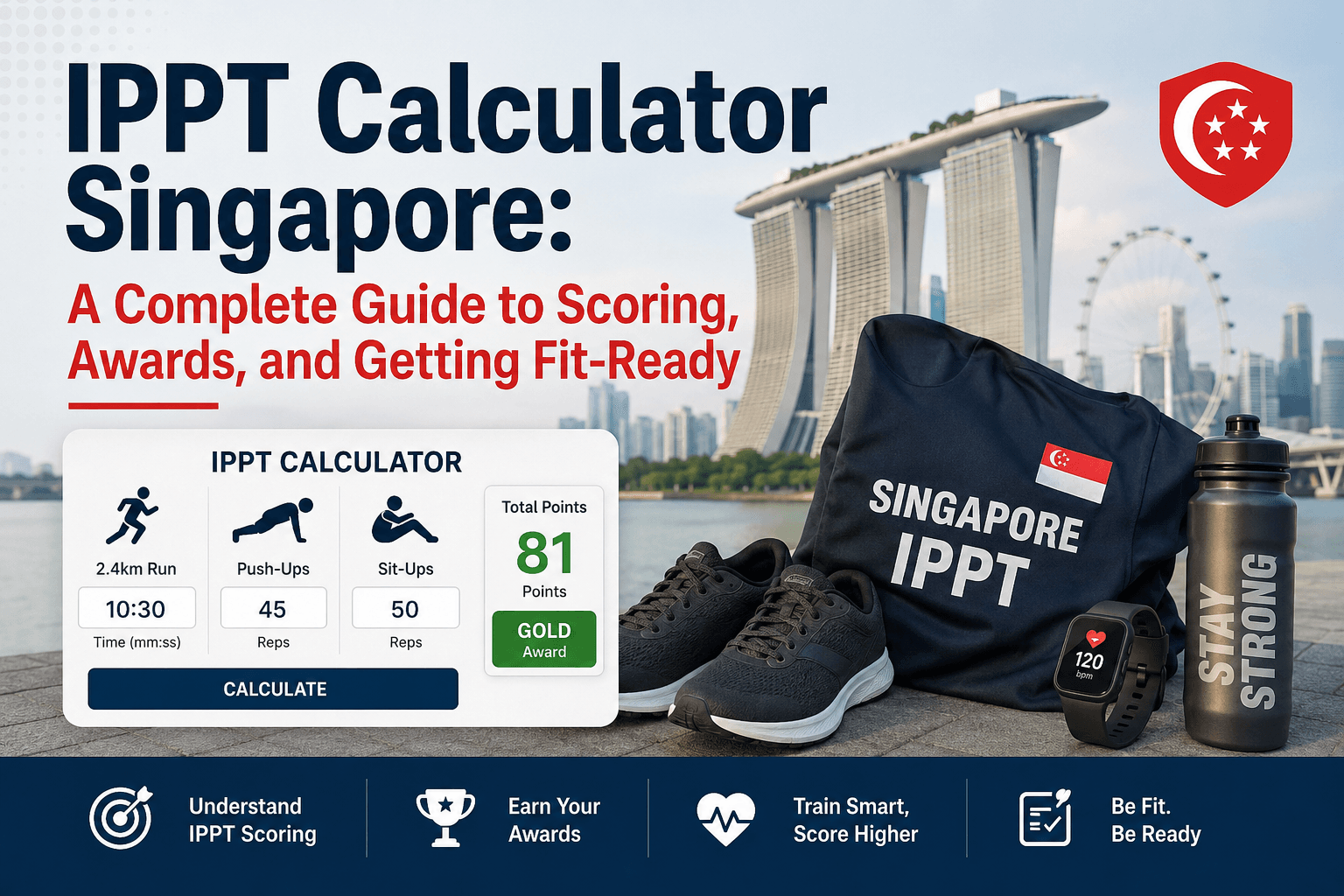
IPPT Calculator Singapore: A Complete Guide to Scoring, Awards, and Getting Fit-Ready
Every year, thousands of Singaporean men — from pre-enlistees to NSmen well into their fifties — sit down (or rather, stand up, run, push, and crunch) for the Individual Physical Proficiency Test, better known as IPPT. And every year, just as many of them end up squinting at a scoring chart trying to figure out exactly how many points their 2.4km time is worth. This is where an IPPT calculator Singapore tool becomes genuinely useful: it takes the guesswork out of the equation and tells a person, in seconds, where they stand.
This guide walks through how the IPPT scoring system works, how an IPPT calculator fits into the picture, and what NSmen and pre-enlistees can do to prepare smartly for test day.
What Is the IPPT and Why Does It Matter?
The IPPT is Singapore’s standard fitness assessment for National Servicemen, used to measure physical readiness across three components. It isn’t just a formality — the results affect cash incentives, exemptions for pre-enlistees, and whether someone needs to complete additional training. For many, the test is an annual checkpoint that says a lot about their overall fitness, not just their ability to run fast or do push-ups.
Because the scoring system involves several variables — age, gender in some contexts, and performance across three separate stations — working out a final score by hand can get confusing. That’s exactly the gap an IPPT calculator Singapore is designed to fill.
How Does an IPPT Calculator Singapore Tool Work?
An IPPT calculator typically asks for a few simple inputs: age, number of push-up repetitions, number of sit-up repetitions, and 2.4km run time. Once entered, the calculator cross-references these numbers against the official age-based scoring tables and instantly returns a total score, along with the award category the person qualifies for.
This is particularly handy because IPPT standards aren’t fixed across the board — they’re age-adjusted. A 22-year-old and a 45-year-old aren’t held to the same benchmarks, so a calculator saves the hassle of flipping through printed charts or squinting at PDFs to find the right row and column.
Breaking Down the Three IPPT Stations
The IPPT is made up of three stations, and understanding how each one contributes to the final score makes the whole system much easier to follow.
Push-Ups
Participants perform as many push-ups as possible within a fixed time limit, with proper form required for each rep to count. This station contributes up to 25 points toward the total score, and hitting the maximum rep count for one’s age group secures full marks here.
Sit-Ups
Much like push-ups, sit-ups are scored based on the number of correctly executed repetitions within the time limit, also capped at 25 points. Core strength and endurance play a big role in this station, and it’s often the one people improve on fastest with consistent practice.
2.4km Run
The run is the single biggest scoring component, worth up to 50 points — double the weight of either calisthenics station. Because of this, a person’s running pace often has the greatest influence on their final score, and it’s usually the station that benefits most from a structured training plan.
Add these three together, and the total possible score comes to 100 points, which then determines the award category a participant falls into.
Understanding the Award Categories
Once a total score is calculated, it’s grouped into a specific award tier. Broadly speaking, participants who fall short of the minimum threshold are marked as not meeting the standard, while those clearing it move up through pass, pass with incentive, silver, and gold categories, with each higher tier reflecting stronger all-round performance and typically carrying better recognition or incentives for NSmen. The exact cash figures and cut-off points can be adjusted from time to time, so it’s always worth checking the latest official figures rather than relying on outdated numbers.
Why Age Matters So Much in IPPT Scoring
One of the more interesting aspects of the IPPT system is how heavily it accounts for age. Standards are grouped into age bands, and as someone moves into an older bracket, the benchmarks for full marks become slightly more forgiving. This is a deliberate design choice — physical performance naturally shifts with age, and the scoring system tries to keep things fair across a wide age range of servicemen.
This is also why an IPPT calculator Singapore tool is so much more convenient than trying to memorise numbers. Rather than needing to recall which run time corresponds to which score for a specific age group, a person can simply key in their details and let the tool handle the lookup.
Who Should Use an IPPT Calculator?
An IPPT calculator isn’t only for people about to sit the actual test. It’s genuinely useful for a wider range of people:
Pre-enlistees preparing for National Service often use it to gauge where they stand before enlistment, since certain scores can affect training arrangements early on. Active NSmen use it year after year to track progress and plan training around specific stations that need work. Fitness instructors and trainers working with servicemen also find it a quick way to set benchmarks and measure improvement over time.
Tips for Improving Your IPPT Score
Since the 2.4km run carries the most weight, focusing training time on building running endurance and pace tends to offer the best return. That said, neglecting push-ups and sit-ups isn’t wise either, since a weak score in either station can quietly drag the total down.
A balanced approach usually works best: interval running sessions to build speed, steady long runs to build endurance, and dedicated calisthenics sessions a few times a week to strengthen the core and upper body. Recovery matters too — pushing too hard without adequate rest often leads to plateaus or, worse, injuries that set training back even further.
Using an IPPT calculator regularly throughout a training cycle can also help track whether specific improvements — say, shaving 30 seconds off a run time — are translating into real point gains. It turns training from a vague effort into something measurable.
Final Thoughts
The IPPT can feel like a lot to keep track of between three stations, age-based scoring, and shifting award thresholds. An IPPT calculator Singapore tool doesn’t remove the hard work of training, but it does remove the confusion around scoring, giving people a clear, immediate picture of where they stand and what they need to work on. Whether someone is a pre-enlistee planning ahead or an NSman chasing a gold award, having quick access to an accurate score is a small thing that makes a real difference in how they prepare.